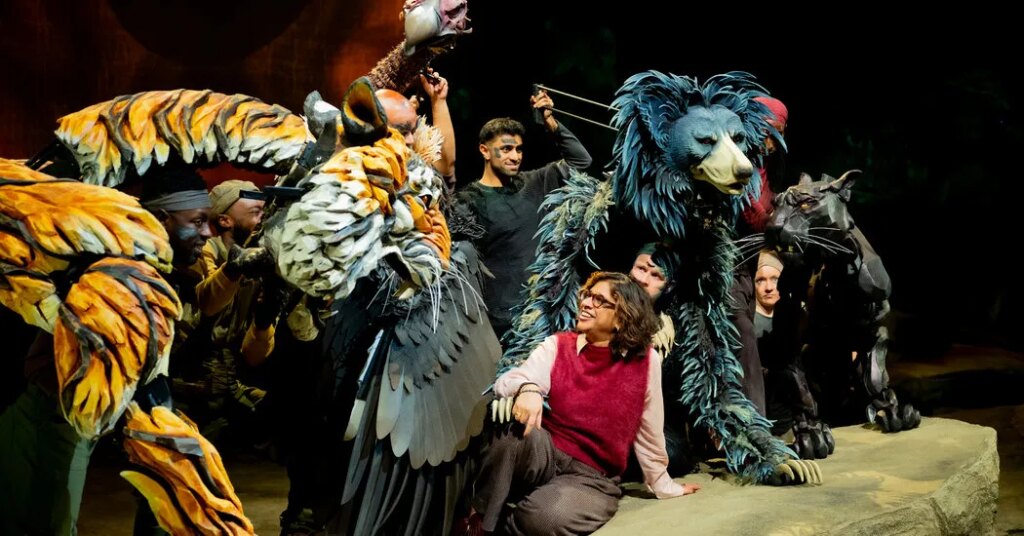
The director Indhu Rubasingham barely blinked as a snarling tiger charged across a London rehearsal room toward a small boy who was feebly waving a flaming torch. Nor did she flinch when, a split second before the beast could crush the child, a bear yanked the tiger away by its tail.
“That’s really nice!” Rubasingham called out from the edge of a studio at the National Theater, where actors and puppeteers were working on a new adaptation of “The Jungle Book.” But soon she was huddling with her playwright and technical crew, speaking in whispers over a script that was already on its 12th draft.
A “Jungle Book” with puppets may seem to have to all the ingredients of another hit for the National, which has sent dozens of transfers to Broadway, including “War Horse” and “The Lehman Trilogy.” Yet the stakes are unusually high for Rubasingham, 56, who is the first woman and the first person of color to serve as the National Theater’s artistic director.
Since starting the role about 18 months ago, Rubasingham has programmed a host of attention-grabbing shows, like “Electra/Persona” with Cate Blanchett and an adaptation of Molière’s “The Misanthrope” starring Sandra Oh. But she has yet to premiere a landmark show that could define her tenure, like Peter Hall had with “Amadeus,” or Nicholas Hytner with “The History Boys.”
Rubasingham said that she didn’t actually want one show to typify her term. “I’m a complexity of passions and ideas and personalities,” she said — but she was still feeling the pressure over “The Jungle Book,” which opens Monday.
“There’s a lot on the line,” Rubasingham said. “It’s our Christmas show, so we have to sell tickets.”
Written by Anupama Chandrasekhar, this staging of “The Jungle Book,” is a long way from the Disney movie. Although it is based on Rudyard Kipling’s 19th-century tale of a boy raised by wolves in the jungle, Chandrasekhar and Rubasingham have tweaked it to give the story contemporary relevance.
Rubasingham said the show touched on “themes of immigration, of nature versus human kind, and it’s also about family — who’s your real family, and where do you belong?” It’s exactly the type of “state-of-the-world play” she wants to bring to the National’s stages, she added. In fact, she said, she had pitched it in her application for the artistic director position.
The National has been at the center of Britain’s theatrical life since opening under the leadership of Laurence Olivier in 1963. Today, it has three stages and each year spends over 120 million pounds, about $156 million, to put on about 16 productions a season.
Rubasingham, who grew up in a Sri Lankan-immigrant family in Sheffield in northern England, first saw a play at the National on a school trip in 1987: a production of “Antony and Cleopatra” with Judi Dench and Anthony Hopkins that she called “awe-inspiring.”
As a teenager, Rubasingham said, she had expected to become a lawyer. But that ambition changed when her school arranged a placement in a job-shadowing program at the Nottingham Playhouse. Rubasingham arrived at the regional theater in central England expecting to do photocopying, and she fell in love with life backstage.
On a break outside the theater, she recalled, she saw some suited office workers, and their world suddenly “looked gray.”
Rubasingham went on to study drama at Hull University, where she directed her first play, Clare McIntyre’s feminist dark comedy “Low Level Panic.” The director Phyllida Lloyd, who will stage a show at the National next season, was part of a jury that gave that student production a prize. Even then, Lloyd recalled, Rubasingham already seemed to have the composure that a major director needs.
At college, Rubasingham also oversaw a production of Federico García Lorca’s “The House of Bernarda Alba” and became “really obsessed” with Greek classics like “Antigone,” she said.
As she embarked on a freelance directing career, Rubasingham said, she was advised to focus on plays connected to her South Asian heritage, but she rejected that idea. “What got me into theater wasn’t because of identity, it was because of a good story,” she said. At venues like the Royal Court, the National and Birmingham Rep, she staged canonical works and contemporary classics including “Wuthering Heights” and David Hare’s “Secret Rapture” as well as presenting new writing.
Roy Williams, a playwright who has worked on four productions with Rubasingham, said that writers loved working for her because she was enthusiastic about new ideas and had the patience to let them form. It could be frustrating when she asked for so many script changes during rehearsals, Williams said, but “nine times out of 10,” her instincts were right.
In 2012, Rubasingham got a theater of her own when she took over the artistic leadership of the Tricycle, a London institution now called the Kiln. She programmed many acclaimed productions there, including a first foray into theater by Zadie Smith.
Yet she also had a crash course in the challenges of running a playhouse, including fund-raising for a refurbishment and navigating public controversies.
After Israel invaded Gaza in 2014, Rubasingham pulled out of hosting the U.K. Jewish Film Festival at the Tricycle, sparking a social media furor. Rubasingham said it was inappropriate for the festival to receive funding from Israel’s Embassy in London while the country was at war, but some critics called her decision antisemitic. Rubasingham, who won rave reviews the year before with a play about Filipino caregivers in Tel Aviv, said in interviews at the time that her record showed she was “not antisemitic or anti-Israeli.”
She caused another flap in 2018 when, after a multimillion-dollar building refit, she rebranded the Tricycle as the Kiln — a move that some theater grandees complained was an unnecessary erasure of the house’s history.
So far, Rubasingham has avoided any scandals at the National. But the reception of shows during her tenure has been mixed. Critics have slated some, but she has also secured transfers for productions like “Inter Alia,” which opens at the Music Box Theater in New York on Tuesday, and “Pride,” a musical playing at the Bridge Theater in London through spring.
Rubasingham said that she wasn’t worried about harsh criticism and that ticket sales spoke for themselves: The theater sold 89 percent of its seats in her first year, up from 81 percent for the previous 12 months. Her biggest challenge isn’t financial or political, Rubasingham said, but overseeing over a dozen productions at any time, all of which could need her creative input. And that includes “The Jungle Book.”
Rubasingham said that she and Chandrasekhar had to make some major decisions early in the process, including whether to create a musical — which Rubasingham rejected to avoid comparisons with the Disney movie — and how to portray the animals onstage.
The pair considered using actors in animal costumes, or puppeteers, Rubasingham said, before settling on a hybrid solution. To bring the giant bear Baloo to life, for instance, the actor Sebastian Charles wears a costume topped by a puppet head, which another performer, Azan Ahmed, manipulates using poles. (The pair swap the roles on different nights.)
At a recent preview performance, many children in the 1,150-seat auditorium seemed transfixed by the results, and some even gasped when the tiger Shere Khan first prowled menacingly across the back of the stage.
Rubasingham said by phone after the show that she was “really excited” by the children’s reactions, but there was still more work to do. “It’s going in the right direction,” she said, “but you know: One keeps wanting to constantly finesse, and finesse, and finesse.”
The Jungle Book Through Feb. 6 at the National Theater in London; nationaltheatre.org.uk.
The post Can This ‘Jungle Book’ Define a New Era at Britain’s National Theater? appeared first on New York Times.