Lucassie Tooktoo stood before a large wall map of northern Quebec, a sparsely populated region little known to outsiders. He traced a finger across it, pausing at favorite hunting grounds in the tundra, fishing spots upriver, the place where he caught his first ptarmigan and waters where beluga are plentiful.
Mr. Tooktoo, 61, a longtime military reservist in Umiujaq, a subarctic village of 550 Inuit, pointed to unmarked sites where he used to spend weeks in the wilderness with his parents. They would visit, over a cup of tea, with the many other families doing the same.
“You don’t see tents there anymore,” he said in front of the map in his home. “The people who used to be out camping have become old. The younger people go out on snowmobiles. They go out in the morning and then come back in the evening to watch hockey.”
Stretched thin across Canada’s vast north, the military has for decades relied on part-time local reservists like Mr. Tooktoo to monitor and protect the country’s remotest, most inhospitable areas. Often called the eyes and ears of the military, the reservists, known as Canadian Rangers, anchor the defense of the north. They carry out search-and-rescue missions, report unusual activity, guide southern soldiers on Arctic military exercises and build temporary airstrips.
The Rangers in the northernmost areas are Inuit and members of First Nations with ancestral ties to their land and knowledge passed down from parents and grandparents, some of whom led nomadic lives. But changing lifestyles are pulling many away from that connection. Many are moving to growing cities, like Iqaluit, where the search for an Inuit identity is expressed through the arts and language.
Few today have the encyclopedic, experiential knowledge of their territory that Mr. Tooktoo and other senior Rangers have.
“Before, we had a lot of knowledge from elders who could read the sky, read the clouds and the stars, but nowadays, it’s more about technology,” said Simeonie Naluktuk, 49, the leader of the reservists in Umiujaq.
“It’s disappearing,” he said of traditional knowledge.
The fraying of the connection to the land and its effects on the Rangers, described as “critical to Arctic stability and security” by Prime Minister Mark Carney, comes at a tense time for Canada. As relations with the United States have deteriorated since the start of President Trump’s second term, Canada is pushing ahead with a record increase in military spending. Much of it is focused on the Arctic, where the lack of heated hangars and other basic infrastructure has scuttled military exercises in the past.
Climate change is complicating Canada’s defense of its north. Melting sea ice is opening up the Canadian Arctic and drawing the attention of the United States, Russia and China. Thawing permafrost is making it harder to maintain railroads and ports. In Umiujaq, the warming climate is drawing beavers, which are reshaping the landscape and waterways. It is also upending traditional knowledge, “exacerbating the loss of knowledge and land skills,” a Canadian government report said in 2022.
“It is the central fear of our communities that we are going to continue to lose knowledge that is just essential to our survival,” said Natan Obed, the president of Inuit Tapiriit Kanatami, the national organization representing Canada’s 70,000 Inuit.
With less “organic transmission” of knowledge between generations, Mr. Obed said, more investment in the Rangers and in Junior Rangers, a program for future reservists, is critical to ensuring that traditional knowledge is passed on.
Canada established the Rangers in 1947 at the onset of the Cold War, fearing that its vast north was vulnerable to a Soviet attack. Today, 5,000 Rangers serve in 200 remote communities. They include 1,500 in more than 60 communities across Canada’s three northern territories — an area equal to 40 percent of the country’s landmass, or roughly the size of the entire European Union.
The part-time Rangers are Canada’s main military presence in its far north, where it maintains only 300 full-time military personnel, a sharp contrast to the tens of thousands of permanent forces Russia, the United States and Nordic nations keep in their Arctic regions.
Rangers receive uniforms, rifles and other supplies. They are reimbursed for wear and tear on their own vehicles and boats, and are paid for up to 12 days a year, plus exercises and other duties. They get basic, noncombat training. The military considers them “trained on enrollment” because of their skills and intimate knowledge of the land.
Into the 1960s, some Inuit and First Nations families still led nomadic or seminomadic lives.
Charlie Kumarluk, 57, a Ranger in Umiujaq for two decades, has watched land knowledge fade in his own family.
His grandparents were “home” on the land, he said, moving across their traditional territory in northern Quebec with the seasons and the animals. The government forced them to settle in a community south of Umiujaq in the mid-1950s, but they still spent long stretches in the wilderness with their children.
As his grandchildren played around him in the family home, Mr. Kumarluk said that time spent on the land has diminished with each generation. “They don’t know anything about the land, they don’t even know what to call animals,” he said of his grandchildren. “But at the same time, they’re much more educated than back then.”
“If my grandparents didn’t know the land, they would have starved,” Mr. Kumarluk said. “Now I can buy chicken in the store.”
The Canadian government warned a generation ago that the loss of traditional skills threatened the force’s long-term viability. Part of the government’s response was to create the Junior Rangers program, a formal setting to transmit traditional knowledge and encourage youths to become Rangers, starting in Nunavik, the Inuit region in northern Quebec that includes Umiujaq.
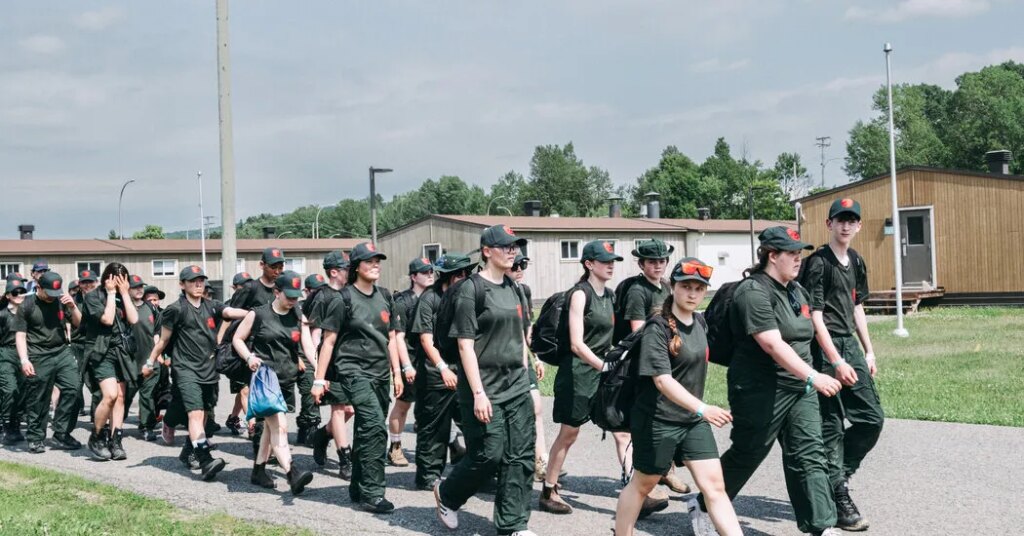
Over the summer, some 160 teenage Junior Rangers converged for an annual weeklong camp at the military base in Valcartier, near Quebec City. They practiced shooting and archery, learning from southern military personnel and adult Rangers. The camp also offered adult Rangers the chance to learn how to teach.
“When it comes to younger Rangers, they’re a little bit more nervous or a little less confident about teaching,” said Maj. Dexter Ruiz-Laing, the camp commander. “When they’re forced to practice and kind of learn those skills, it helps build a lot of confidence.”
Southern military personnel try to spend extended periods in remote communities working with the Rangers, said Lt. Col. Karl Perreault, the commander of the Rangers force in Quebec. The military imposes no mandatory retirement age on Rangers and allows those up to 69 to carry out ground operations.
At the camp, several Junior Rangers said they had joined because relatives had served as reservists. Some said that the program was a way to learn about the land, as many young people find it increasingly hard to do so with their families because of the high cost of snowmobiles and fuel, and the absence of role models.
Matiusie Gordon, 17, a Junior Ranger from Eastmain, a Cree village on James Bay, said his grandfather and both of his parents had been Rangers. He loved going out on the land, he said, to feel the freedom his grandparents experienced, untethered to a place or technology.
“My grandfather knows more routes and more of the land than my father did,” he said. “The further out you go, he knows the patterns of animals and what they do.”
But few young people shared his interest.
“It’s not really that cool anymore,” he said.
In Umiujaq, Davidee Naluktuk, 22, a Ranger and a son of Mr. Naluktuk, the local Ranger leader, said that young people remained glued to their phones even out in the wilderness.
“I myself try not to let the kids do it when we’re outing,” he said. “I try to limit their screen time.”
The post Canada’s Arctic Reservists Know the Land. Fewer Young People Do. appeared first on New York Times.