The wildlife ranger was preparing to go on patrol early one April morning when a distressing call came in. A dead Bornean elephant was lying by the road and 20 elephants from its herd were gathered nearby.
The ranger, Henry Jamis, raced to the scene and was shocked by what he found. The body of a young male elephant was lying 60 feet from the two-lane highway that cuts through Malaysia’s eastern jungle. Its head was missing.
“I thought, ‘Why would someone do this to an elephant?’” he said.
As rangers from several agencies arrived to take photos and look for clues, the wild elephants retreated into the woods. Later, officials said, they returned and gently pushed the body over a rise and down to the jungle’s edge, where they left it, still on its knees, in the shade of a tree.
“The group of elephants kind of did a funeral,” said Dionysius Fedilis of the Maliau Basin Conservation Area, another ranger who had been called to the scene.
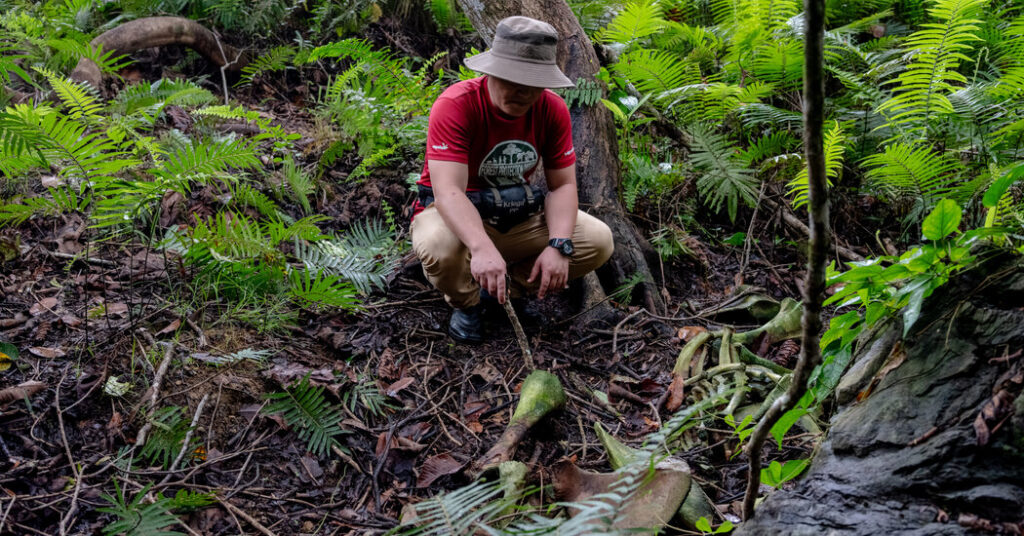
Some of the elephants’ bones remain today, scattered on the ground. The herd has not been seen again in the area.
The juvenile, believed to be 5 years old, is one of 13 elephants killed for their ivory since July 2024 along a 150-mile stretch of highway that runs through the rainforest in Malaysia’s Sabah state, the authorities say. Five of them were beheaded.
By cutting off the head — a tactic that is rare but not unheard-of — the culprits were able to make a relatively quick getaway and carry off the tusks intact.
“Removing the tusks is hard labor, like a dentist extracting teeth,” said Rahimatsah Amat, founder of the Sabah Environmental Trust, which has helped fund anti-poaching efforts. “The longer the poachers stay in that spot, the higher the risk of getting caught. So, the easiest thing is to behead it, load the head in the truck and disappear.”
The endangered Bornean elephant subspecies, the smallest of Asian elephants, is found only in northeastern Borneo, the world’s third-largest island. About 1,000 remain in the wild.
Mohd Soffian Abu Bakar, director of the Sabah Wildlife Department, believes one group of four to six local men is responsible for all the recent poaching.
“This is some kind of a syndicate and the modus operandi for all the killings is almost the same,” he said.
The poachers operate in the dead of night when few cars are on the road. After the first wave of five beheadings, Mr. Soffian said, they changed their tactics and began cutting out the section of skull where the tusks are rooted.
They appear to use a homemade shotgun to kill the elephants, and an ax or chain saw to take the head or parts of the skull, rangers said. They likely bury their haul for weeks until the flesh decomposes and then extract the ivory. It is unclear how much the tusks are being sold for.
The poachers appear to be well established in the community and have intimate knowledge of the elephants’ movements, Mr. Soffian said. Some elephants, he added, may have been killed by palm oil plantation workers who consider the animals pests and who contact the poachers to come take the tusks.
Mr. Soffian said Saturday that a local man had been arrested on suspicion of possessing ivory. He declined to provide details because the investigation was continuing.
The Malaysian authorities suspect the poachers smuggle the ivory into neighboring Indonesia for shipment to its eastern islands, where some people have a tradition of using tusks as dowries. In 2017 and 2019, Indonesian customs agents intercepted more than two dozen tusks that were had been smuggled from Sabah in Malaysia to Flores Island in Indonesia.
The Bornean elephants are widely known as pygmy elephants, although it is an unscientific term for the modern species.
They may be the smallest Asian elephants, but they are still the largest animals on Borneo, growing to 10 feet in height and weighing up to 11,000 pounds. Their numbers have been declining for decades, according to the International Union for Conservation of Nature, which lists them as endangered.
The corridor where the killings occurred runs along the southern edge of the Damai Rainforest Landscape, a vast conservation area twice the size of Delaware. It is also home to other endangered species, such as the Bornean orangutan, the Malayan sun bear and the clouded leopard.
Environmental activists have long urged the government to seek designation of the Damai wilderness as a UNESCO World Heritage site, which would bring more funding and tourists. But the application process has been progressing slowly.
Instead, the government appears more focused on extending the long-planned Pan Borneo Highway through the area, following the basic route of the existing road, even though it sees little traffic. Environmentalists fear that such a major highway would fragment the habitat, further endangering the creatures that live there.
Even now, protecting the elephants from people is not easy, in part because the animals sometimes prefer to walk along the road outside the conservation area and forage near human settlements, rather than making their way through the dense jungle.
In response to the beheadings, the Sabah Wildlife Department hired 20 community rangers and established two new posts along the highway, including one 10 miles from the site of the young elephant’s beheading.
Given only a week’s training, the community rangers are assigned to monitor the elephants within a 12-mile radius, said Selestyne Chin, 45, one of the new recruits.
They are expected to go on patrol, but the government has not provided them with vehicles, officials acknowledge. To get to an area where they can patrol on foot, they use a ranger’s personal vehicle.
Each unit has been issued a GPS locator, a small camera and one cellphone — but not a satellite phone in a region with limited cellular service. Mr. Soffian said that he hoped his department would have funds for vehicles and other equipment next year.
Poachers in the area commonly hunt deer and wild boar with homemade shotguns. The rangers go on patrol unarmed since their job is to monitor the elephants, Mr. Soffian said.
The community rangers’ post is a one-room wooden shack with intermittent electricity, a makeshift kitchen and barely enough floor space to sleep 10 people. The structure has no door or glass windows, leaving them vulnerable to mosquitoes in an area where malaria is a concern.
Mr. Rahimatsah, the environmental activist, called the community rangers’ living conditions “deplorable” and questioned whether they complied with Malaysian labor laws.
Mr. Dionysius, one of the rangers called to the scene of the April beheading, said the elephant was so young that its tusks would have protruded barely six inches. Chopping them off would have provided a small amount of ivory, but taking the head would have yielded much more.
On a recent visit to the site of the killing, he pointed out the animal’s remaining bones, now green with fungus. “When I saw it, I was heartbroken and angry because the elephants are going extinct,” he said.
It is possible that the ivory hunters have slaughtered more elephants and their carcasses have gone undiscovered, he said.
For now, the authorities hope to catch the killers the next time they strike.
“The poachers are being careful,” he said. “They are just biding their time before they start killing again.”
Hasya Nindita contributed reporting from Yogyakarta, Indonesia.
The post In a Remote Jungle, the Gruesome Poaching of Rare Elephants appeared first on New York Times.