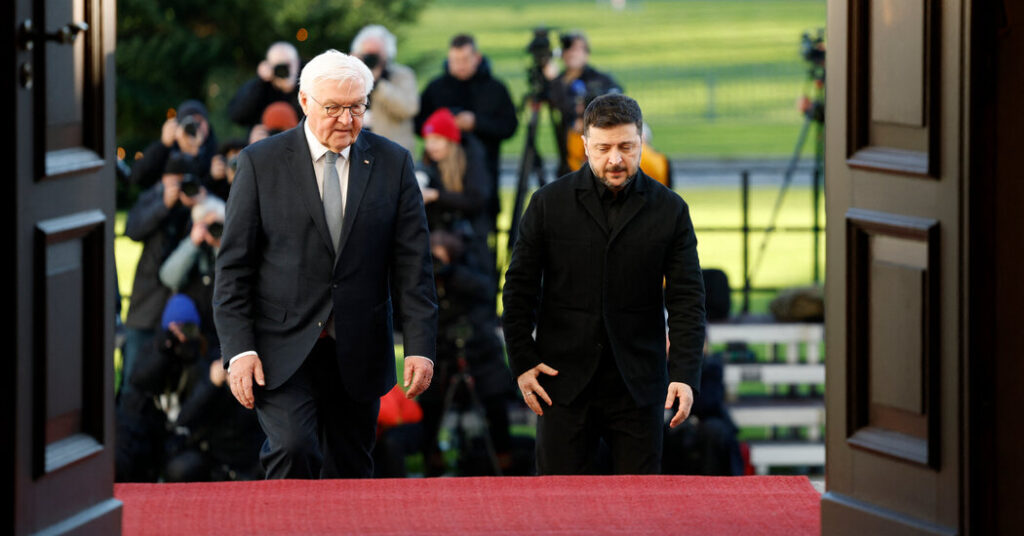
The United States, Ukraine and Europe have agreed on a NATO-like guarantee for the future security of Ukraine, two U.S. officials told reporters on Monday after negotiations over a peace agreement that they said President Trump thinks he can sell to President Vladimir V. Putin.
After two days of talks in Berlin, the American officials said they had resolved or significantly closed gaps on 90 percent of their differences on the 20-point draft agreement to end the war. But they acknowledged that the volatile question of where to draw a new Ukraine-Russia border in the Donbas, where much of the fighting continues, remained unresolved.
“For now we have different positions, to be honest,” President Volodymyr Zelensky of Ukraine said at a brief news conference on Monday. “But I think my colleagues have heard my personal position.” Mr. Zelensky has said it would be impossible for Ukraine to give up territory, mostly in Donetsk, that Russia has not taken on the battlefield. Mr. Trump has told him, officials say, that he should surrender that territory, because he will most likely lose it in coming months if the fighting continues.
Ultimately, the two American officials said, that negotiation would be left to Mr. Putin and Mr. Zelensky — and privately American and European officials say that is one of several issues that could derail what have been the most extensive negotiations on ending the fighting since Russia invaded Ukraine just shy of four years ago. The officials spoke on condition of anonymity under rules set by the Trump administration for the negotiations.
Most of the conversations over the past two days, the officials said, focused on the security guarantee, which is intended to deter Russia from invading Ukrainian territory again in coming years. The two officials were vague about the specifics, though they said that Mr. Trump was willing to submit any final agreement on American commitments to Ukraine to the Senate for approval. They did not say whether the guarantee would become a formal treaty — akin to what the United States has with Japan, South Korea, the Philippines and other allies — or whether any vote would simply be intended to show a bipartisan commitment.
Mr. Trump has said the United States would not contribute ground troops to a security force. But last summer he offered to patrol the skies, and enforce a no-fly zone, in addition to continuing to provide Ukraine with intelligence from U.S. satellites and signals intercepts. Senior officials say that offer still stands.
European officials, who had been skeptical of Mr. Trump’s willingness to play a central role in Ukraine’s security, said they emerged from the meeting impressed.
“In recent days, we have seen significant diplomatic momentum, perhaps the most since the war began on Feb. 24, 2022,” said Chancellor Friedrich Merz of Germany, standing next to Mr. Zelensky during the news conference on Monday. “We now have the opportunity for a genuine peace process for Ukraine,” he said.
But despite the enthusiastic characterization of the talks, there is plenty of reason for caution. The negotiations that were continuing Monday night with a dinner of European leaders, which Mr. Trump was expected to join by phone or video link, did not include Russia.
And in recent days senior officials have acknowledged that as the draft agreement is amended to address more of Ukraine’s concerns, the more difficult it will be to persuade Mr. Putin to sign on. His strategy so far, senior American officials say, has been to encourage the conversation while continuing to pound Ukraine’s electrical and heating infrastructure with near-nightly missile and drone attacks, in hopes of breaking the will of the Ukrainian population over a long, cold winter.
Mr. Zelensky has been pressing since February, when he had his surprising televised confrontation with Mr. Trump in the Oval Office, for ironclad guarantees that Western allies would come to Ukraine’s aid if Russia attacked anew, either directly or indirectly. Mr. Trump was resistant for months.
“Only reliable guarantees can deliver peace,” the Ukrainian leader wrote on X over the weekend, recalling that the guarantees in a 1994 accord, called the Budapest Memorandum, failed to deter a war that has resulted in more than 1.5 million casualties.
Reporting was contributed by Jeanna Smialek from Brussels and Maria Varenikova from Kyiv, Ukraine.
David E. Sanger covers the Trump administration and a range of national security issues. He has been a Times journalist for more than four decades and has written four books on foreign policy and national security challenges.
The post Ukraine and Allies Agree on Security Guarantee for Peace Proposal appeared first on New York Times.