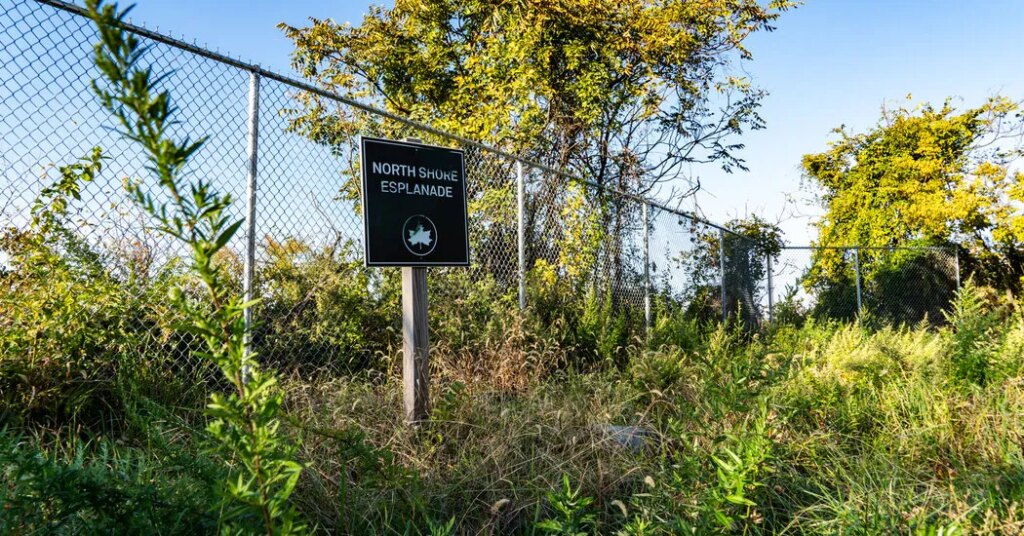
Rose Uscianowski scrambled around thick clumps of overgrown weeds along Staten Island’s north shore to reach what had once been a popular path for strolling, sitting and watching boats sail by.
New York officials had closed it more than a decade ago to make way for the New York Wheel, a 630-foot Ferris wheel that aspired to rival the London Eye and draw visitors to Staten Island. The Ferris wheel never happened, but this stretch of city-owned waterfront has yet to reopen.
“Over here, it’s kind of a no man’s land now,” said Ms. Uscianowski, 36, who wants public access to the waterfront restored. “I’m like, ‘Why is our community ruined because of a giant nonexistent wheel?’”
Slivers of land known as greenways — like that scraggly patch on Staten Island — have emerged as a surprising cause for New Yorkers who passionately defend the network of linear, car-free paths that they view as vital links connecting neighborhoods to parks and open spaces. They are also an occasional source of friction.
While greenways have existed for more than a century, they increasingly have become contested ground in a congested city where any open space is coveted. Greenways don’t even have to be green — some have no trees or lush plants and are simply strips of pavement or asphalt.
New York has more than 500 miles of greenways, from linear parks like Manhattan’s High Line to bike lanes, open streets and waterfront esplanades. Aficionados of greenways say they are a path to healthier lifestyles, safer commutes and cleaner air.
In recent years, New York has added bike lanes and remade streets to welcome pedestrians. And it has repurposed old industrial spaces as part of a global movement to reclaim space from cars, said Sarah M. Kaufman, executive director of the Rudin Center for Transportation and Urban Futures at New York University.
“We saw places like London and Paris making great strides in greenway development, and it opened our eyes to what a city can do,” she said. “There’s a laundry list of benefits, and I think the more that people see what’s possible, the more they’re calling for them locally.”
But many greenways are not on protected parkland or even well marked, leading to conflicts among pedestrians, cyclists and drivers claiming the same space. Roughly one-third of New York’s greenway network veers onto streets, according to a city report.
Drivers have routinely parked in a bike lane on West Street in Greenpoint, Brooklyn, that is part of a hard-fought waterfront greenway, said Hunter Armstrong, executive director of the Brooklyn Greenway Initiative.
He recently spotted a truck blocking another stretch of greenway on Third Avenue in Sunset Park, Brooklyn — which he called disrespectful and dangerous because it forced cyclists and pedestrians to dart into traffic.
In Astoria, Queens, another popular greenway winds through private property at Shore Towers Condominium and is enclosed by a black ornamental fence. The path consists of a wide expanse of pavement with scuffed-up benches looking out to the East River. On either side of the path are gates that were propped open the other day.
City building officials have issued violations to Shore Towers, most recently in 2023, for closing the gates and blocking access to the greenway. John Tamayo, 73, said that he has walked over, only to find the gates locked. “I hate when I get here and I see it’s closed, and I have to go around,” he said.
Still, Kathi Markou, 68, who lives in Shore Towers, said the greenway has generated noise at night and ignited safety concerns about strangers lingering. The constant flow of people has caused wear and tear on the promenade, which the condo’s residents maintain. “I’m an outdoor person, but the burden shouldn’t be on us,” she said.
New York City’s first greenway, which opened in 1894, is a pedestrian and bike path along Ocean Parkway in Brooklyn. Robert Moses, the influential city builder who left a mixed legacy, included greenways in several of his plans for highways, including the Hutchinson River Parkway in the Bronx.
New York officials adopted a citywide greenway plan in 1993 that aimed to link neighborhoods to parks, open spaces and waterfront areas. But the resulting network of greenways, which was developed by multiple agencies and groups, was often fragmented and overlooked.
“I definitely think not enough people know what greenways are, or where they are,” said Mr. Armstrong, who is co-chair of the New York City Greenways Coalition, which was formed in 2021 by transportation, environmental and civic groups to push for more city investment in greenways.
In response, city officials in 2022 mandated a new citywide greenway plan. The result was a 2025 report, called Greater Greenways, which outlined the city’s plan to expand greenways. It included more than 40 miles of additional bike and pedestrian paths to fill in gaps between greenways, especially in the boroughs outside Manhattan.
On Staten Island, the developers of the New York Wheel canceled the project near the ferry terminal in 2018, leaving behind the base of the wheel and a large parking garage. The wheel had stalled amid soaring costs, extensive delays and a legal dispute between the developers and the construction team that was hired to design and build it.
Today, the waterfront along Staten Island’s north shore is being rebuilt as part of a $400 million plan released in 2023 by the New York City Economic Development Corporation. It includes building 2,400 homes, creating more than 20 acres of public space and generating 7,500 jobs.
Even before the waterfront site was closed in 2015 for the Ferris wheel, it had been heavily damaged by Hurricane Sandy in 2012 and other coastal storms.
The economic development agency said that the reconstruction of the damaged shoreline was completed earlier this year, which will allow the design and reconstruction of the esplanade to move forward.
The new greenway will not come soon enough for Ms. Uscianowski. She said it would create more open space in a neighborhood with not enough, and encourage people to walk and bike.
“On Staten Island, part of the reason that we have such a strong car culture is because we don’t have the infrastructure to get people out of cars,” she said. “This could eventually create changes in how we get around.”
The post Greenways Are Designed to Unite Neighborhoods. Sometimes, They Divide. appeared first on New York Times.