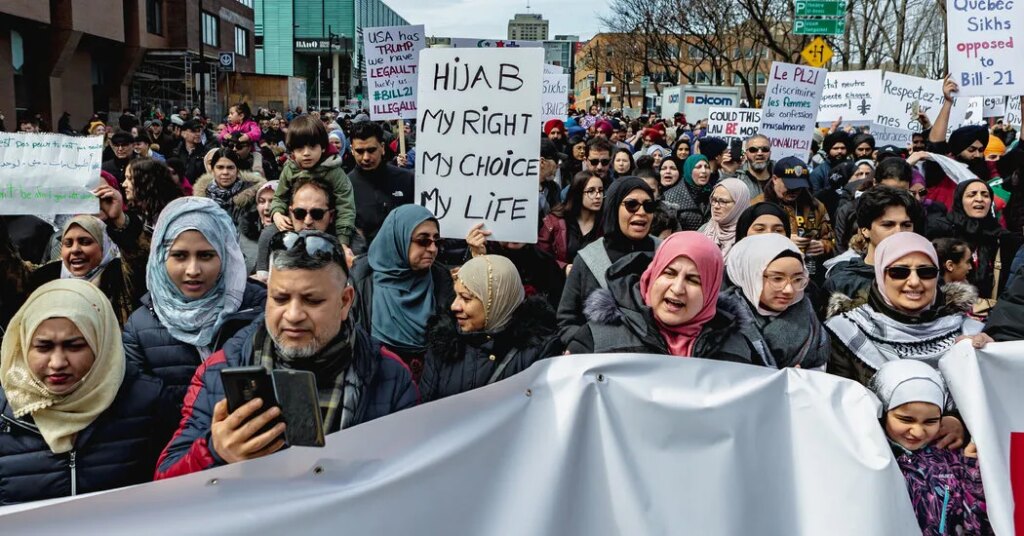
Canada’s top court ruled on Friday that Quebec had the right to prohibit certain public workers from wearing religious symbols as part of a law on secularism, a landmark decision that likely averts an immediate political crisis for the country.
The Supreme Court upheld Quebec’s use of the so-called notwithstanding clause of the Constitution to pass legislation in 2019 that reinforced secularism in the French-speaking province. The law overrode some rights in the Canadian constitution by barring public schoolteachers, police officers and other public workers from wearing religious symbols while on duty — leading some linguistic and religious minorities to call it discriminatory and a violation of the Canadian Constitution.
But the long-anticipated ruling was a not a total victory for Quebec and other provinces that had fiercely defended using the clause to set aside parts of the Constitution. The court also ruled that, even as such legislation was allowed to stand, courts can still declare that they violate Constitutional rights.
That could open up such legislation to legal challenges in the future, and raise the political costs for governments using the provision.
But the Supreme Court on Friday made no judgment on whether Quebec’s 2019 law itself had violated the Canadian Constitution, mitigating any strong pushback from the province.
Quebec’s separatist premier, Paul St-Pierre Plamondon, called the ruling “a victory for Quebec’s secularism, which is a distinct and unique model compared to the rest of Canada.”
“It provides a certain legal stability in the short term for the Quebec government,” he said, but decried the court’s decision authorizing courts to weigh in on a law’s constitutionality.
For now, Friday’s ruling seemed unlikely to cause problems for Prime Minister Mark Carney, who has emphasized Canadian unity against threats from the United States and amid separatist sentiments in Quebec and Alberta. At hearings last spring, a federal government lawyer had asked the court to restrict the clause’s use.
Mr. Carney responded cautiously to the ruling, saying that experts were studying the ruling’s “complexities” and “implications.”
He said the federal government would not use the notwithstanding clause, adding, “I would remind that the benefit of constitutionally protected rights is most important for minorities, those most vulnerable in our society.”
In Quebec, some separatists had hoped that a strong ruling against the 2019 law would help stir nationalist sentiments in the province. In October, the separatist Parti Québécois returned to power for the first time in 12 years, promising to hold a referendum on separation from the rest of Canada after 2029.
Mr. St-Pierre Plamondon has focused his first weeks in power on asserting the province’s authority against the federal government. Mr. St-Pierre Plamondon has pledged to push Quebec secularism further, for example by barring students at public primary schools from wearing religious clothing or symbols.
Joe Ortona, the chairman of the English Montreal School Board, a lead plaintiff against the Quebec government, told reporters that the board was “obviously very disappointed with the decision,” adding that “the sun comes up tomorrow.”
At the heart of the case is a provision of Canada’s Constitution known as the notwithstanding clause. It allows governments to pass legislation that overrides some of the rights in the country’s Charter of Rights and Freedoms, and protects it from legal challenges. The override is valid for five years and can be renewed. Provinces have used it pre-emptively, trying to shield a law before anyone could challenge it in court.
Provinces have increasingly used the clause in recent years to pass laws geared toward local interests.
Alberta and Saskatchewan have used it to protect laws barring children under 16 from changing their names or pronouns at school without parental consent, laws that could otherwise conflict with the rights to free expression and equality. Ontario used it to protect a law limiting election advertising and another that ended a strike by education workers, shielding them from claims that they violated free speech and the right to organize.
Stephen Brown, the chief executive of the National Council of Canadian Muslims, said the ruling reinforces the increasingly casual use of the notwithstanding clause.
“It was intended to be an instrument of last resort, and now it has become an ordinary instrument of government,” he said.
The use of the clause grew after Quebec passed the 2019 secularism law, known as Bill 21, that overrode the Charter’s protections for religions, conscience and expression. Quebec’s nationalist, right-leaning government argued that the law was crucial to protecting secularism in Quebec. The Roman Catholic Church once held enormous political influence and control in the province, including over public education. Religious symbols worn by some public employees, the government said, would undermine the neutrality of the state, as well as the separation of state and religions.
In its ruling Friday, the Supreme Court said that Quebec’s 2019 law “is rooted in Quebec’s legitimate and historical commitment to ensuring the laicity of the state in a free and democratic society.” Laicity is a term used in Quebec and in France to refer to secularism.
But some minority groups — including the English Montreal School Board, as well as Muslim and Sikh organizations — sued the Quebec government, arguing the law was discriminatory and that it violated their rights to religious freedom and equal treatment under the Canadian Constitution. The law was upheld by two lower courts, ultimately reaching the Supreme Court. In a sign of the case’s significance, the Supreme Court last spring devoted four days to hearings on the case, one of the longest in its history.
At the hearings, plaintiffs pressed the court to strike down the 2019 law and restrict the use of the notwithstanding clause. Quebec and other provinces opposed any changes to the clause. The Canadian government asked the Supreme Court to restrict its use and let courts declare a law enacted under the clause to be a violation of rights.
Beyond its implications in Quebec, the use of the notwithstanding clause touches upon a historically sensitive issue in Canada, the balance of power in its federation.
In the early 1980s, Canada updated its Constitution by ending Britain’s remaining control over it. Canada adopted its current Constitution — and a newly created Charter of Rights — in 1982 but only after a political comprise: the inclusion of the notwithstanding clause, which pacified provincial leaders who feared handing too much power to judges.
The post Quebec Can Keep Its Ban on Religious Symbols, Canada’s Top Court Rules appeared first on New York Times.