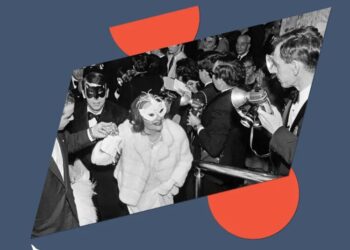
On a January evening in 1970, Charlotte Curtis arrived at Leonard and Felicia Bernstein’s two-story penthouse on Park Avenue without an invitation. The couple was hosting a fund-raiser in support of 21 members of the Black Panthers who had been indicted on flimsy allegations of conspiring to blow up several New York City buildings. The party was not the first or last held that season to raise money for the arrested activists, who were eventually exonerated. But it would stand as the only one to sustain the interests of history.
Nearly 90 guests mingled between the two grand pianos in the Bernsteins’ vast living room: artists and writers — Otto Preminger, Adolph Green, Peter Duchin, Sidney Lumet — along with socialites and leaders of the Panthers’ New York chapter. The party was closed to the press, but Curtis, then nine years into her tenure as a reporter and editor at The New York Times, was brought along, the story goes, by an actress friend who lived in her Greenwich Village building. Wearing a chic but inconspicuous black dress, she stood with her notebook in the corner, near soaring windows framed by green velvet drapes.
The party began stiffly but gained momentum, the disparate groups, Curtis wrote, “studying one another cautiously over the expensive furnishings, the elaborate flower arrangements, the cocktails and the silver trays of canapés.” Leonard Bernstein, then at the height of his fame as conductor of the New York Philharmonic, navigated the crowd in Black Watch tartan slacks. One Panther assured a white woman that she would not be killed just because her husband was an avowed capitalist.
Curtis recorded everything. The piece that appeared the next morning under her byline, absent embellishment or condescension, was a portrait of elite obliviousness. Especially damning were bits of a conversation she caught between the heiress Cynthia Phipps and the Panther organizer Henry Mitchell. Mitchell was complaining that he often waited six or seven minutes for a dial tone on his phone.
“I have the same problem. They really ought to do something about it,” Phipps said.
Mitchell, though, was talking about interference from F.B.I. wiretaps.
Bernstein had also made himself vulnerable to derision. Part of the proceedings involved a formal question-and-answer session between him and Donald Cox, the Panthers’ “field marshal.” Curtis quoted Cox claiming that if Black people were denied “full employment,” then the Panthers would “take the means of production and put them in the hands of the people.” And then Bernstein’s reply: “I dig absolutely.”
Reading Curtis’s story, the Bernsteins were furious — both at the content, which they felt was snide, and at the placement in the society pages, which they viewed as trivializing. The piece ran on The Times’s wire service as well, which meant it was printed in papers around the world, exposing the couple to wider denunciation.
Remarkably, the Times editorial board also weighed in, accusing “the politico‐cultural jet set” of romanticizing the militant Panthers in an act of “elegant slumming.” Protests broke out in front of the Bernsteins’ building. In Miami, Jewish picketers who considered the Panthers antisemitic demanded the cancellation of a documentary in which Leonard Bernstein was central.
Six months after the fund-raiser, Tom Wolfe, who had also crashed the party that night, published his own take in New York magazine. “Radical Chic,” his gleeful 25,000-word evisceration of the cosmopolitan left, soon and forever supplanted Curtis’s straightforward account in the cultural memory, but in a sense he had just built upon her lead. As Wolfe later explained admiringly, “It wasn’t anything she wrote that infuriated them. It was that she put down exactly what they said. That’s always what seems cruelest of all, to hold up a mirror to people that way.”
For Curtis, the piece was merely another expression of her news-making approach to society coverage. Long considered disposable and unserious, it became a chronicle of dubious belief systems and mindless self-regard. At villas and parties and horse races and resorts, the rich showed Curtis who they really were. When she interviewed Warren Avis, founder of the rental-car company, at his enormous vacation house in Acapulco, for example, he told her that he “wanted a house where you’d never see the servants and you don’t.”
Back in 1961, when Curtis was hired by The Times as a fashion reporter, it would have been impossible to foresee the kind of influence she would eventually leverage. Nearly everyone else in the newsroom with any authority was male, and the society pages, where she was later relegated, provided little more than wedding announcements and travel itineraries.
It was Clifton Daniel, the paper’s assistant managing editor at the time, who encouraged her ambition. A pharmacist’s son who had married Harry Truman’s daughter, Margaret, Daniel maintained an outsider’s fascination with moneyed subcultures and believed that Curtis could write about the rich in a way that was neither tediously prosaic nor deferential — as “sociology.”
His instincts were right. Curtis, a Vassar graduate and the daughter of a wealthy Ohio family, took herself beyond New York, drawing meaningful distinctions among the various social orders of Denver and Boston, San Francisco and Miami. In 1966, she covered Truman Capote’s historic Black and White Ball at the Plaza Hotel, a gala that famously broke open the longstanding social barriers between uptown and down, assembling poets, intellectuals, socialites, movie stars, businessmen and the Maharani of Jaipur. Curtis published the 540-person guest list in the paper, making it impossible for anyone to lie about whether they had gotten an invitation. She had received one.
By the early 1970s, Curtis had become the most powerful woman at The Times. In 1974, she was named editor of the Op-Ed page, the first woman to hold the position, one she would occupy for the next eight years. The page was still a new venture for the newspaper. It required an editor of independent mind, one comfortable publishing a range of opinions, including ones with which she disagreed. As she had done with the lifestyle pages, Curtis aligned the section with the preoccupations of the moment, calling on younger contributors like Erica Jong to write about a culture untangling the old mores. This led to misperceptions. Just as socialites were surprised that someone who looked like a compatriot could embarrass them in print by publishing what they had actually said, feminists were confused by Curtis’s resistance to public advocacy.
In 1986, a year before she died at the age of 58, The Times conceded to pressures to incorporate “Ms.” as an honorific. Curtis was skeptical. “This afternoon the managing editor is going to have a meeting to take up the matter of Ms., pronounced miz, the new title for ladies,” she wrote to her husband. “The liberated ones want to be called Ms. I don’t.”
The same year she was named Op-Ed editor, seven women at The Times brought a class-action suit against the company for gender-based pay disparities. They won but Curtis, to lasting consternation, had not supported their case, claiming that as a manager she had to remain neutral.
And yet these public intimations of ambivalence did not line up neatly with the private reality. In 1968, she covered a protest of the Miss America Pageant in Atlantic City that had been organized by the feminist activist Robin Morgan. Decades later, in a letter to The Times, Morgan said that when she went to check on demonstrators who had been arrested, she discovered that they had been released on bail, the cash put up by a woman named Charlotte Curtis. When Morgan called to thank her, Curtis asked to keep her breach of journalistic ethics between them.
“Those dreary gray guys running The Times,” she told Morgan, would not be amused.
The post The Society Page Reporter Who Outraged the Jet Set appeared first on New York Times.