When Puma Shen entered the race to be Taipei’s mayor six months ago, few expected him to seriously challenge the incumbent.
He had a mop of unruly hair and no experience as a local candidate. He also had a record of confronting Beijing — making him an unlikely prospect in a city long dominated by politicians who favor a more conciliatory approach.
With a haircut and a campaign focused on schools, child safety and easing traffic snarls, Mr. Shen, a criminologist, has turned the election into an unexpectedly close contest. When Taiwan votes on Saturday in island-wide local elections, a win for Mr. Shen could confirm him as his party’s rising political star, and be a fresh setback in Beijing’s efforts to shift Taiwanese politics in its favor.
Mr. Shen, 44, known in Taiwan as Shen Po-yang, wants to be the first politician from the Democratic Progressive Party in nearly 28 years to be mayor of Taipei. The incumbent mayor, Chiang Wan-an, represents the Nationalist Party, which favors cultivating ties with Beijing. If Mr. Chiang loses, or the Nationalist Party suffers unusually heavy setbacks in other key races, the outcome may fan doubts about the party’s prospects in a crucial presidential election in 2028. Nationalist candidates have lost the past three presidential elections.
“I’d say it’s very, very tight,” William Hsu, a Nationalist Party member of Taipei’s city council who is campaigning for re-election, said in an interview this week. He thought Mr. Chiang had a slim lead. “If we lose Taipei, it will represent an unprecedented crisis for the party.”
If Mr. Shen loses narrowly, the result may still bolster confidence that President Lai Ching-te, also of the Democratic Progressive Party, could win the 2028 race for a second term. That possibility is most unwelcome to China: Mr. Lai wants Taiwan to chart a future independent of Beijing, which claims Taiwan as its territory and shuns contact with Mr. Lai and his party.
Taiwan’s local elections, which are held every four years, are mostly fought over grass-roots issues and personalities. But this year the stakes feel higher, especially in Taipei, where the battle has been surprisingly intense, and also in a sprawling, neighboring city called New Taipei. Both are usually Nationalist-leaning, or “blue” in the slang of Taiwanese politics.
“Taipei is the capital of Taiwan, so what happens here will have a bearing with national politics. That’s why everyone is paying so much attention this year,” said Penny Chang, a 57-year-old supporter of the Democratic Progressive Party.
She was at a recent rally that drew a crowd of hundreds in her neighborhood, which has generally supported Nationalist Party candidates. “Taipei has so many blue voters, like my husband, but this year feels different. We could win.”
The incumbent mayor of Taipei, Mr. Chiang, had until recently been described as a surefire future presidential candidate. He is widely believed to come from party royalty: He has not confirmed nor denied speculation that he is the great-grandson — through a relationship out of marriage — of Chiang Kai-shek, who led the Nationalists to Taiwan in 1949 after their defeat in China at the hands of Mao Zedong’s communist troops.
Mr. Chiang has sought to shore up the Nationalist Party’s traditional base of voters, while appealing to younger voters detached from the two big parties. He has also promised to build a new artificial intelligence hub on land now used for an airport, a controversial idea among residents.
Mr. Chiang’s administration has come under criticism from opponents for its handling of child abuse cases and has faced complaints from parents about the quality of school meals. He and his advisers appeared slow to recognize the rising support for Mr. Shen, whose qualifications he has questioned.
“You really don’t understand city administration,” Mr. Chiang told Mr. Shen when they debated last month. Mr. Chiang’s supporters echoed that criticism, and some said a victory for Mr. Shen would be bad for Taiwan.
“We can’t let Taipei fall to the Democratic Progressive Party. That would also be dangerous for cross-strait relations,” said James Liu, a retiree, at a Nationalist rally.
Mr. Shen has pitched himself as an inclusive candidate, giving interviews to journalists aligned with the Nationalist Party, in an effort to win over some of its supporters.
“We’re all Taiwanese and residents of Taipei,” he said in an interview with a journalist with a Nationalist Party background last month. “If you divide up supporters by their political party now, how will they put their faith in you when you take office?”
But before his candidacy, Mr. Shen was focused on the more divisive issue of China and its threat to invade Taiwan. He was known for founding a civil defense group called the Kuma Academy that trains Taiwanese how to resist a possible Chinese attack and tracks online disinformation from China. That work drew the attention of Democratic Progressive Party politicians who secured his seat as a lawmaker nearly three years ago.
Running for mayor, though, Mr. Shen has sought to give voters who don’t share his politics on China other reasons to consider him. He has campaigned on child safety, traffic congestion, and the eradication of rats, issues that have riled residents, including many uncommitted voters. He has avoided wading into discussions about China.
“For hardcore supporters in both parties, they may still view the candidates through the lens of China,” said Wei-Ting Yen, a political scientist at Academia Sinica, a research institute in Taipei. “However, it is not possible to win local elections with hardcore voters, and for most swing and nonpartisan voters, China is not an issue in local elections.”
But Beijing is unlikely to treat a victory by Mr. Shen as a purely local matter.
In 2024, China’s office for Taiwan policy announced sanctions against Mr. Shen as a “diehard Taiwan independence separatist” for his leadership of the Kuma Academy. Last month, the office announced punishment of a business run by Mr. Shen’s father, which has bought goods from China. It described Mr. Shen as “inciting confrontation across the Taiwan Strait.”
Mr. Shen grew up in Taipei, and earned a Ph.D in criminology, law and society at the University of California, Irvine before returning to Taiwan to teach at a law school. He entered electoral politics formally in 2023. By contrast, his opponent, Mr. Chiang, 47, is a corporate lawyer who has been a politician for a decade.
Mr. Shen also had to overcome the political bruising he took for his involvement in an unsuccessful campaign to recall Nationalist Party lawmakers who had used their numbers in Taiwan’s legislature to block the government’s budget and other legislation. Opponents of the campaign said it was an abuse of the democratic process.
The recall effort failed to unseat any lawmakers, but it helped train advisers and volunteers to better campaign on the streets and online, and some are now helping Mr. Shen, said Lin Ping-yu, a politician in New Taipei who is a friend and adviser to Mr. Shen.
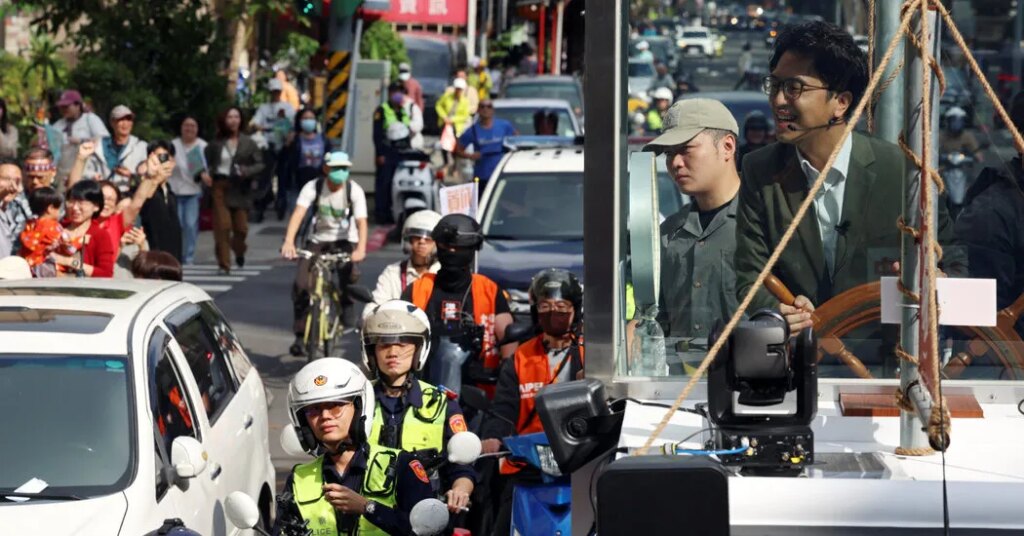
Mr. Shen’s campaign has stood out for how directly he has engaged with voters. At in-person events described as “soap box” sessions, he invited residents to line up and ask him questions.
His rallies have drawn tens of thousands of people, a phenomenon that his campaign calls “Ocean Current,” a play on the “yang” in Mr. Shen’s name, which means ocean. Mr. Shen’s hope is that the groundswell can lift him to victory — if enough supporters actually turn out to vote, outnumbering Taipei’s mass of firm Nationalist voters, said Mr. Lin.
“I was also turned off by politics before I went to my first rally for Shen Po-yang,” Hsiao Hsiang-ning, a 38-year-old psychologist, said at a rally for Mr. Shen. “And if even I am willing to step forward — physically show up on the scene here — then there should be others like me.”
The post A Critic of Beijing Turns a Mayoral Race in Taipei Into a Cliffhanger appeared first on New York Times.