When dawn broke in the skies above Mongolia, only four hours remained of my flight from London to Tokyo. I donned my sunglasses and looked through the Boeing 787’s cockpit windows to the brightening east.
Japan has been important to me since high school, when I spent a summer there with a host family, studied the language and dreamed of piloting the airplanes that made such journeys possible. Today, I continue to study Japanese, and I fly to Tokyo as often as I can.
Soon, we were lowering the landing gear over Tokyo Bay. We touched down on runway 34L at Tokyo International Airport, and I headed to my hotel in Yokohama, just south of Tokyo.
A Visit to a Shrine
Tokyo, one of the largest cities on Earth, is clean, safe and endlessly fascinating. My free time here usually involves a mix of favorite spots and aimless exploration.
But on this trip, I had a mission, and it involved a Shinto shrine and a daruma. A small, self-righting figurine — typically red, hollow and formed of papier-mâché — a daruma is associated with luck and perseverance. The eyes of a new daruma are blank; you paint the left eye when you set a goal and the right one when you achieve it. When I worked in Boston as a consultant in the late 1990s, my boss, a Tokyo native, gave me a daruma after I told her I hoped to become a pilot someday.
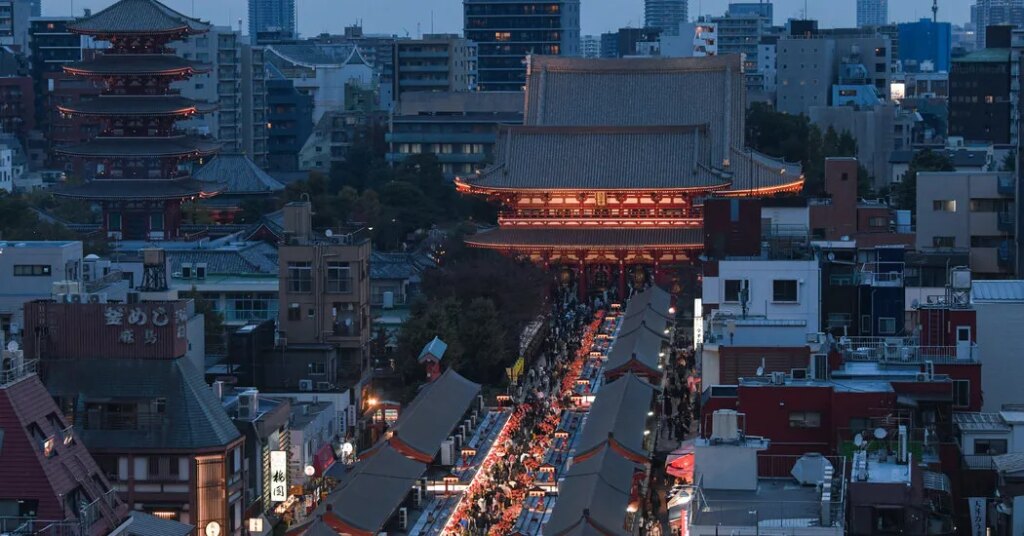
Traditionally, a daruma’s journey ends with a ritual burning at a Buddhist temple or a Shinto shrine. So I headed to Asakusa, the district where my former boss had purchased it. At a store on Nakamise, a busy shopping street, the white-haired proprietor marveled at the figurine’s circumnavigation of the world. She suggested I take it to a nearby Shinto shrine with a small cash offering.
I paid for a new daruma — a gift for a nephew in London who’s hoping to land a new job — then walked to Ushijima Jinja, a quiet, cypress-wood shrine by the Sumida River. It’s one of hundreds of small shrines that offer leafy, peaceful escapes from the bustle of the megacity. At the foot of the shrine, I spoke to a Shinto priest who wore a white robe and a blue-green hakama, a skirt-like garment. I handed him my daruma — its eyes both filled — and an envelope containing a crisp new 1,000-yen note (about $6.25). He nodded and took them away.
The Ultimate City
The story of Tokyo is best told at the Edo-Tokyo Museum, and I was keen to see the results of a four-year renovation that concluded last spring. I was transfixed by the entrance’s stylized vermilion torii, or gates, and animations of sumo wrestlers projected onto the walls and ceilings of an industrial-chic terrace. I loved, too, the exhibits of maps that reveal the historic geography of Tokyo’s bookshops, festivals and Shogun burial grounds, as well as the development of the city’s intricate public transport network.
For dinner, I walked west to the Platinum Fish Cafe in Kanda. A grand station designed by Kingo Tatsuno, the architect of Tokyo Station, once stood here. Now, a glass-enclosed abandoned train platform, surrounded by busy railway lines, is home to one of my favorite restaurants. I ordered a Japanese-style spicy curry with rice and read the news. Then, as dusk fell, I watched the trains, each a blur of metal, light and faces, roll by through the rush-hour rain.
The Snoopy Museum
The next morning, I ran along the Yokohama waterfront, showered and set off for the Snoopy Museum in Machida, around 10 miles northwest. As the only satellite location of the Charles M. Schulz Museum in Santa Rosa, Calif., the museum embodies the devotion of Snoopy’s many Japanese fans.
I skipped the nearby Peanuts Cafe — and its bowl of pasta carbonara arranged in the shape of Snoopy’s head, with an olive for his nose and crumbled nori seaweed for his ear — and headed to the yawning Snoopy mouth that forms the museum’s entrance.
Friends often joke about the influence of Snoopy (who dreams of both flying and writing) on my life. Museum highlights included learning more about Shuntaro Tanikawa, a poet who translated “Peanuts” into Japanese for roughly half a century; the views of Mount Fuji; and the gift shop’s beagle-shaped hashioki, or chopstick rests. Thanks to the bilingual displays, my Japanese language skills now extend to kabocha daio, or Great Pumpkin, and “I’m looking for the answer to life, Schroeder.”
East Meets West
I boarded a Den-en-Toshi line train that raced northeast to Shibuya, one of the world’s busiest stations. From there, I walked 25 minutes west to Komaba Park — home to Bundan, a cozy, hushed “no photos permitted” cafe in the Museum of Modern Japanese Literature. I browsed the stacks of manga comics and bookcases, then sat at a shared table and ordered the Breakfast Set of “Hard-Boiled Wonderland”— a shout-out to a 1985 novel by Haruki Murakami. The dish included sausage, salad, mashed potato and bread, for ¥1,500.
Komaba Park is also home to two connected houses: a 1929 Western-style structure and a 1930 wakan, or Japanese-style home. The houses were built by Marquess Toshinari Maeda, whose clan was powerful in Edo-era Japan.
I walked under a hirakaramon — a traditional, gabled gate — to the two-story wooden wakan, where I removed my shoes and stepped onto the tatami-mat floor. Somehow, I had the place to myself. I took slow, silent steps toward a garden, where maples and ornamental rocks were framed by translucent paper panels of shoji sliding doors.
On the Left Bank
From the park, I headed south toward the immaculately landscaped banks of a stream that forms part of the Meguro River. I followed this ryokudo, or greenway, east toward Meguro Sky Garden, a curving, up-sloping park that conceals an entire expressway interchange. From the park’s summit, I entered the tranquil Ohashi Library. I browsed the foreign books, startled to find my own first book, about flying, in the cooking section.
I left the library and followed the Meguro River to Coeur et Coeur, a tiny riverside cafe-restaurant I’ve loved for years. This year, the owner, Junko Shimoyama, is celebrating her cafe’s 30th birthday. On the walls are surrealist paintings by Takio Nakamura, an artist from Morioka, 300 miles north of Tokyo, whose works Ms. Shimoyama admires.
After greeting Ms. Shimoyama, I sat outside and recalled an early visit here, perhaps a decade ago, when a terrier on the sidewalk suddenly began to whimper. Ms. Shimoyama had explained to me that the dog had sensed a mild earthquake; she showed me a seismic report on her phone and told me that there was no need to worry, for it was already over.
As the afternoon light filtered through the boughs of the riverside cherry trees, I sipped an iced coffee and dialed up WaniKani, a program that helps me learn the characters used to write Japanese. Then I checked the Yokohama-bound trains and arranged to meet my colleagues by the station for a dinner of shabu-shabu — a style of hot pot that my home-stay family introduced me to when I was 17 — before sleep, a morning run and our midday flight home.
Mark Vanhoenacker is a London-based airline pilot and the author of “Skyfaring” and “Imagine a City.”
Follow New York Times Travel on Instagram and sign up for our Travel Dispatch newsletter to get expert tips on traveling smarter and inspiration for your next vacation. Dreaming up a future getaway or just armchair traveling? Check out our 52 Places to Go in 2026.
The post 48 Hours in Tokyo With an Airline Pilot appeared first on New York Times.