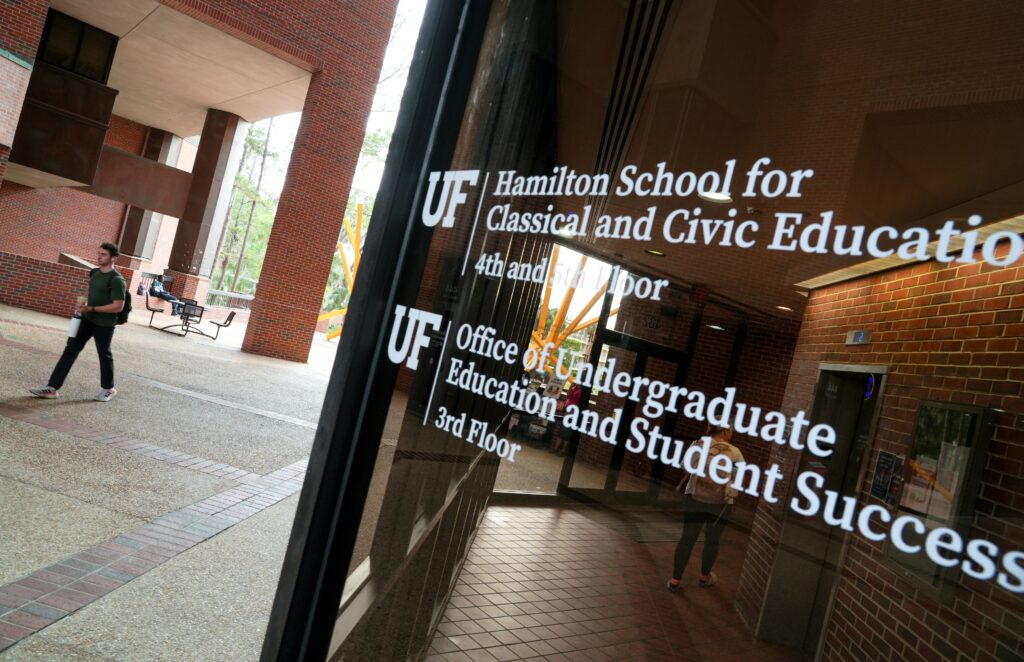
GAINESVILLE, Fla. — Intellectually exhilarating developments are occurring in hitherto inhospitable places. Socratic argument about civic virtues is flourishing where it has recently been rare: on college campuses. The educational menus of large state universities are being made more nutritious by small programs with far-radiating resonances. These schools of civic thought combat the deterioration of the nation’s civic life.
A self-selected 1,500 of the University of Florida’s almost 60,000 undergraduate and graduate students are feasting from the intellectual nourishment of the Hamilton School for Classical and Civic Education. It has more than 300 students majoring and 100 minoring in its offerings, and 61 impressively credentialed scholars. Like dozens of similar schools flourishing in every region, Hamilton is demonstrating this: In academia, supply can precede, and prompt, demand.
Students who did not know what they were missing now know. Civic thought schools transcend blinkered social sciences that assume “what counts is what can be counted.” Data matter; ideas matter more.
Fittingly, Arizona made a singular breakthrough in addressing what Supreme Court Justice Sandra Day O’Connor, an Arizonan, called the “quiet crisis” of national amnesia concerning the intellectual pedigrees of America’s premises and processes. Arizona’s legislature mandated the 2016 creation of Arizona State University’s School of Civic and Economic Thought and Leadership.
Paul Carrese, who was SCETL’s first director, affirms in “Teaching America: Reflective Patriotism in Schools, College, and Culture” the proposition that such schools are “pre-partisan.” They provide shared intellectual ground for Socratic disputation between the left and the right. The perennial debate, Carrese writes, is about the proper trajectory for a nation founded (in the formulation of Harvard’s Harvey Mansfield) “not as a democracy but as a constitutional republic with democratic features.”
American citizenship is distinctively demanding. It must be learned because it has a profound intellectual dimension. American patriotism is not mere sentiment or instinct, it is creedal. America, in its founding moment, announced adherence to big ideas about human flourishing. Arguing about their implementation is America’s unending political argument.
The Hamilton School’s birth was assisted by William Inboden, who came from a similar place, the Civitas Institute of the University of Texas at Austin. He has returned to Austin as provost, and Texas is implementing a core curriculum by which 10,000 freshmen will engage with great writings, from Aristotle to Madison and beyond. The Civitas Institute, a small school of civic thought, is leavening an enormous university’s culture.
Today, the progressive left’s anti-patriotism, and the curdled patriotism of anti-Enlightenment, tribal “national conservatives,” are driving America’s temperate majority to flinch from civic life. And to become indifferent to the nation’s premises.
In the first paragraph of the first Federalist paper, Alexander Hamilton identified the radical American project: establishing a government not from “accident and force” but from “reflection and choice.” Reflection about this nation requires reading that enables making informed choices. George Washington’s Mount Vernon library contained more than 900 books. Books were bricks in the nation’s foundation.
Progressive critics say schools of civic thought are conservative and elitist. The schools can equably respond: Yes, of course — if those adjectives are used not polemically but thoughtfully.
Although the ethos of modern research universities obscures this fact, education’s primary function is to conserve, by transmitting, portions of civilization’s excellence. Today, the parlous condition of the humanities, which students are avoiding in droves, results partly from the humanities’ neglect of civic seriousness.
Too many political science departments dispense the thin gruel of “democracy education,” mere exhortations to “transformative” activism. Schools of civic thought offer deep intellectual engagement with the ideas undergirding the world’s longest-lived constitutional republic.
Education in the humanities is inherently elitist. It presupposes that a few enduring writings are forever especially worthy of serious study. And that those who study them, and take their adult bearings from them, will be immunized against ephemeral temptations, of which populism is but one.
The art of living free — it is a learned art — involves understanding this: The question is not whether elites, but which elites, shall govern. A successful society will get popular consent to government by worthy elites. Schools of civic thought can incubate these.
And can have a multiplier effect. They can furnish teachers for the rapidly multiplying “classical” K-12 schools.
This autumn, high school seniors applying to colleges should consider institutions that are hospitable to schools of civic thought. The Manhattan Institute’s sophisticated City Journal has ranked 115 colleges and universities, measuring them by 95 variables. The highest-ranked Ivies are Yale (10) and Princeton (15). The institutions ranked first and second? Texas and Florida.
The post This campus movement is battling the decay of American civic life appeared first on Washington Post.