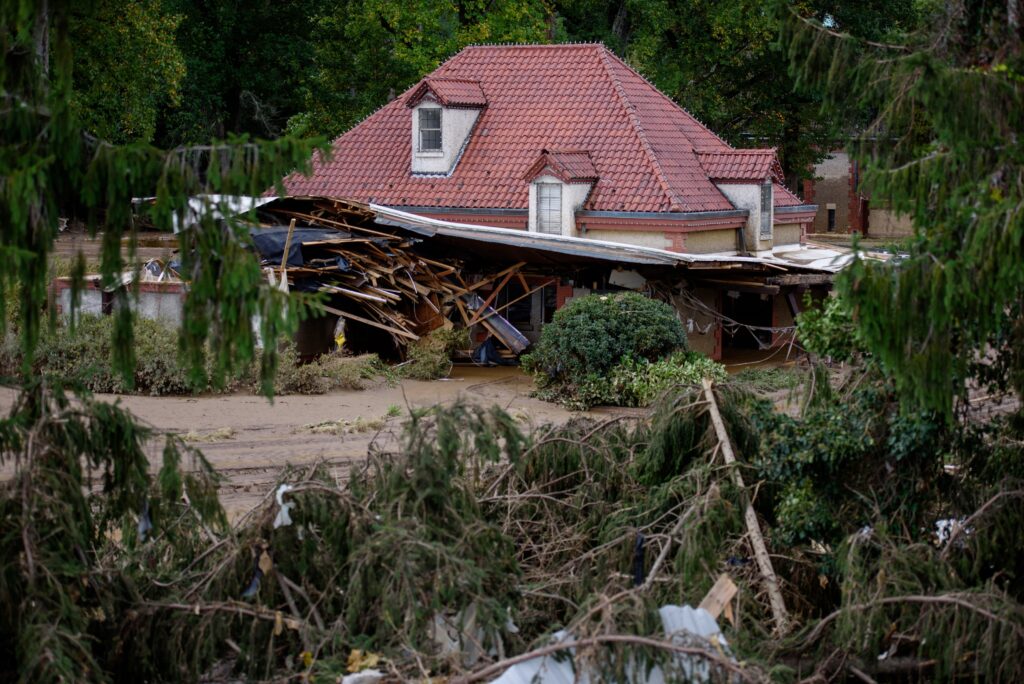
Most visitors to the sprawling Biltmore Estate outside Asheville, North Carolina, come to marvel at the 250-room mansion, built in the late 19th century by George Washington Vanderbilt II, or to check out its famous conservatory and winery.
But another group of visitors recently turned up looking for something else entirely: acorns.
At the end of October, U.S. Forest Service employees, working with groups such as the Appalachian Trail Conservancy and EcoForesters, scoured the grounds and collected a startling 27,744 white oak acorns.
The goal? To hasten the process of restoring forests devastated by Hurricane Helene in the fall of 2024.
“There are always fingerprints of Helene on everything we are doing right now,” said Matt Drury, associate director of science and stewardship for the Appalachian Trail Conservancy who is based in Asheville.
The acorn-gathering extravaganza at Biltmore was part of a broader collection across national forests, local parks and businesses in the region that netted 193,664 acorns, according to the Forest Service.
The agency said the acorns, which were gathered largely using rolling mechanical harvesters with tines that pluck them from the ground, will be sown this fall at state nurseries in Tennessee and Georgia. There, they will be tended to during the 2027 growing season.
In February 2028, workers plan to distribute the young trees to some areas hit hard by Helene, in hopes of helping restore the diversity and resilience of the forests, said Jason Rodrigue, a regional silviculturist for the U.S. Forest Service Southern Region.
“This planting allows us to guide or assist the natural recovery,” he said.
Helene battered forests throughout the region when it blew through in late September 2024.
The storm caused catastrophic damage across roughly a fifth of the region’s federally protected forests, according to the North Carolina Forest Service. Satellite data analyzed by the U.S. Forest Service’s Southern Research Station showed damage that stretched more than 200 miles through the southern Appalachians.
According to one North Carolina Forest Service report, more than 800,000 acres of woodlands were damaged by Helene, posing long-term consequences that include threats to wildlife habitat, elevated wildfire risk and the potential for more invasive species.
Forestry officials said the restoration work spans numerous tree species, including red oak, white oak, chestnut oak, hickory, spruce and butternut. But Rodrigue said mature oaks, which make up a significant proportion of the landscape in places such as the Pisgah and Nantahala national forests, were hit particularly hard by Helene’s fierce winds.
“Even though we don’t have the ability to restore oak across the entire landscape that got damaged, we can do our best to put it back” wherever possible, he said, adding that officials have used ecological models to identify areas where the trees once stood in large numbers.
Rodrigue said it also is beneficial to be able to collect acorns from trees that are already genetically adapted to local climate conditions.
“They have the best odds of growing in whatever climate is going to be here over the next century or so,” he said.
The recent acorn gathering is a small but vital part of the broader undertaking that began soon after Helene to rebuild the health and resilience of the area’s public forests.
State and federal workers along with nonprofits and other volunteers have helped restore access to trails and recreation sites. Crews have cleared fallen trees and other debris in an effort to reduce potential fuel for forest fires.
With access restored to nearly all recreation sites and trails, the Forest Service has shifted its efforts toward strengthening forest health, restoring damaged watersheds and preparing the landscape for future storms.
James Melonas, forest supervisor with the National Forests in North Carolina, said in a statement earlier this fall that those efforts require partnerships among state agencies, conservation organizations and universities. The work includes restoring critical watersheds, repairing wildlife habitat, rebuilding infrastructure, conducting prescribed burns and mitigating non-native species.
So far, Melonas said, more than 170,200 seedlings have been planted in areas damaged by Helene to help reestablish vegetation and bolster the long-term health of the forest.
Drury said his group and others collect acorns from numerous sites around the region every year. Most oaks, however, follow boom-and-bust cycles, only producing large numbers of acorns in what are known as mast years. This year, white oaks have been the most prolific.
The well-kept, gently rolling expanse of the Biltmore Estate, Drury said, is an ideal place to use the Bag-A-Nut mechanical harvesters that make acorn gathering much more efficient.
He said seedlings grown from this collection probably will be planted across the region, including in Buncombe, Yancey, Mitchell and Avery counties.
In addition, Drury said, there was a poetic aspect to this fall’s acorn collection at such a famous site. “Biltmore is the cradle of forestry in North America,” he said.
Frederick Law Olmsted, the renowned landscape architect whose work includes Central Park and the U.S. Capitol Grounds, was the mastermind behind the design of Biltmore’s gardens, grounds and vast forests.
By 1891, according to the Forest Service, Olmsted had planted 300 acres with white pine. In 1892, he hired trained forester Gifford Pinchot, who worked on the Biltmore Estate for several years before becoming the first Forest Service chief.
In 1914, George Vanderbilt’s widow, Edith, sold approximately 86,700 acres of the estate’s forested mountains to the federal government. That acquisition led to the creation of the Pisgah National Forest and the Cradle of Forestry, a 6,500-acre site that was home to the nation’s first forestry school.
Now, that cradle is helping provide acorns for the next generation of trees in these mountains.
“The overall effort is going to take many years, probably a decade or more,” Rodrigue said of the regional restoration plan. “We have to start ourselves on the right footing, and that’s what we are trying to do now.”
Simon Ducroquet, Niko Kommenda and John Muyskens contributed to this report.
The post How 193K acorns gathered this fall could help restore Helene-damaged forests appeared first on Washington Post.