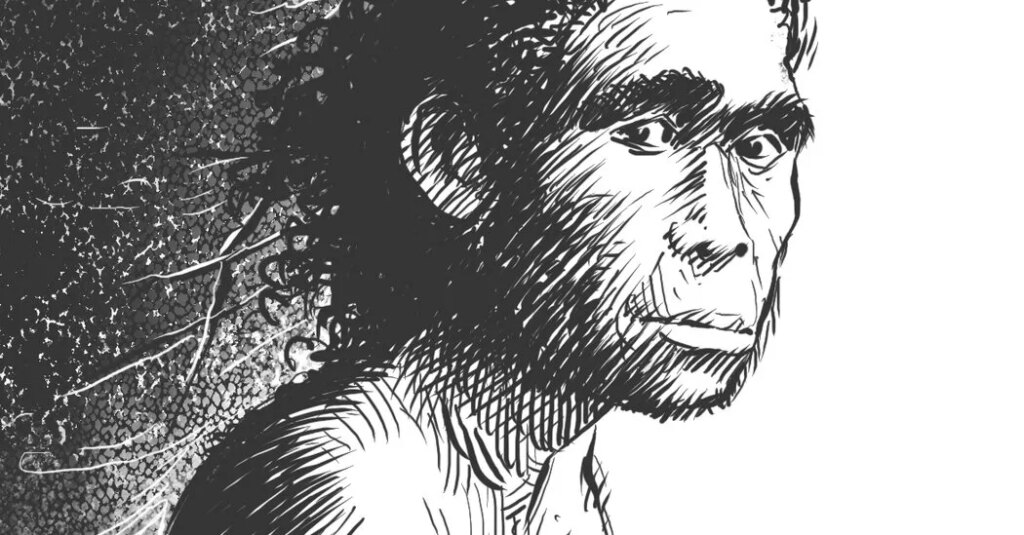
READING THE BONES: Homo Naledi and the Mysteries of Human Evolution, by Marc Aronson and John S. Mead; illustrated by Tim Foley
Ask any archaeologist: Their work can be boring. Squatting in the dirt for hours, cleaning broken pottery with toothbrushes, sifting mounds of refuse for a few stray seeds. Dullsville.
The discovery of Homo naledi was not that kind of archaeology. In 2013, spelunkers in South Africa slithering through a labyrinth of caves made an astonishing discovery: a 315-square-foot chamber littered with humanlike bones, including skulls.
In fact, as the Sibert Medal-winning nonfiction writer Marc Aronson and the science teacher John S. Mead note in “Reading the Bones,” the chamber was so densely packed with fossils that anyone crossing it had to “stretch extremely carefully to move from place to place, as if they were playing the ‘Floor Is Lava’ game.” No one knew how the bones ended up there, or why.
Lee Berger, an American paleoanthropologist in South Africa with a background in television broadcasting (who in 2012 had written, with Aronson, “The Skull in the Rock: How a Scientist, a Boy, and Google Earth Opened a New Window on Human Origins”), assumed control of the site, which presented unique excavation challenges. Even reaching the chamber, the authors explain, required scientists to scramble up an “underground hill, jagged like the back of a stegosaurus,” and contort their bodies through spaces seemingly engineered to trap them. One crevice they wriggled through was just under seven inches tall. Panicsville.
Berger was too fleshy to squeeze into the chamber, so he recruited six young scientists to excavate for him — all women, who were more petite and flexible. They became known as the Underground Astronauts. When one of them fell a few feet to the bottom of a shaft and gashed her shin, she had to crawl back out under her own power. No stretchers fit down there.
The Astronauts recovered thousands of fossil fragments, some of them passed to the surface bucket-brigade style in a cereal bowl that had recently contained some “seriously dodgy leftover potato salad,” the authors write. From these fossils, a new human relative emerged: the quarter-million-year-old Homo naledi, an odd chimera with tiny human feet, a burly Neanderthal chest and gibbon-like shoulders (as portrayed in Tim Foley’s atmospheric illustrations).
Berger shared these findings more or less in real time with the world, including Mead’s sixth-grade class in Dallas, after Berger spoke at their school once and kept in touch. Indeed, Mead’s collection of Berger’s announcements formed the foundation for the book’s narrative. Especially in a title for children, it would have been nice to hear the students’ voices more, but the thrill of discovery remains palpable.
More controversially, Berger recruited videographers to film his team working, and installed Wi-Fi routers and thousands of feet of cables in the caves, to ensure that he could live-tweet the initial dig. To say this was unusual is a galactic understatement.
Paleoanthropologists routinely take a dozen years or more to publish descriptions of their fossils, often holding colleagues and students hostage until they deign to make pronouncements. This sort of gatekeeping is frequently derided, and the old guard’s anger over Berger’s flashy ways can come off as sniffy and self-serving. (Some critics even accused Berger of selecting all women for the excavation team simply to gin up media attention.)
If nothing else, the field would benefit immensely from others following Berger’s lead and quickly releasing measurements of important fossils. This way, colleagues could 3-D print replicas to study on their own, and commence the debates and discussions necessary to push any scientific discipline forward.
That said, Berger sure has done some dumb things. Like sending priceless Homo naledi fossils into space on a rocket ship — a stunt that had zero scientific value and risked their destruction.
Critics also charge that he blundered in interpreting the cave site — in particular citing his insistence that the occupants deliberately buried their dead in symbolic rituals. As Aronson and Mead write, this theory “seemed to skeptical scientists to be anything from pure fiction to wild overreach. They took it as one more grab for attention.”
Then again, Berger and company may get the last laugh. A recent analysis (published in the journal Cell, after “Reading the Bones” went to press) indicates that all the Homo naledi skeletons are female, which may imply some sort of deliberate funeral ritual.
After a few fawning descriptions of Berger at the outset (“He is a leader, at once at ease and in charge”), I feared the book would devolve into a fairy-tale version of Homo naledi’s discovery, but no: There are warts aplenty.
The book also provides valuable lessons in how science actually gets done. It’s not the Vulcan display of logic that appears in polished journal papers. There are fights and insults, false starts and compromises.
At one point, “Reading the Bones” promises to reveal a “new kind of science.” If the authors mean a new approach to a stodgy discipline, then the book delivers.
Berger’s antics undoubtedly go too far. But in a field where powerful professors hoard their bones as dragons do gold, a new approach — despite the missteps — seems welcome.
READING THE BONES: Homo Naledi and the Mysteries of Human Evolution | By Marc Aronson and John S. Mead; illustrated by Tim Foley | (Ages 10 and up) | Farrar, Straus & Giroux | 192 pp. | $20.99
The post How Underground Astronauts Excavated a New Human Relative appeared first on New York Times.