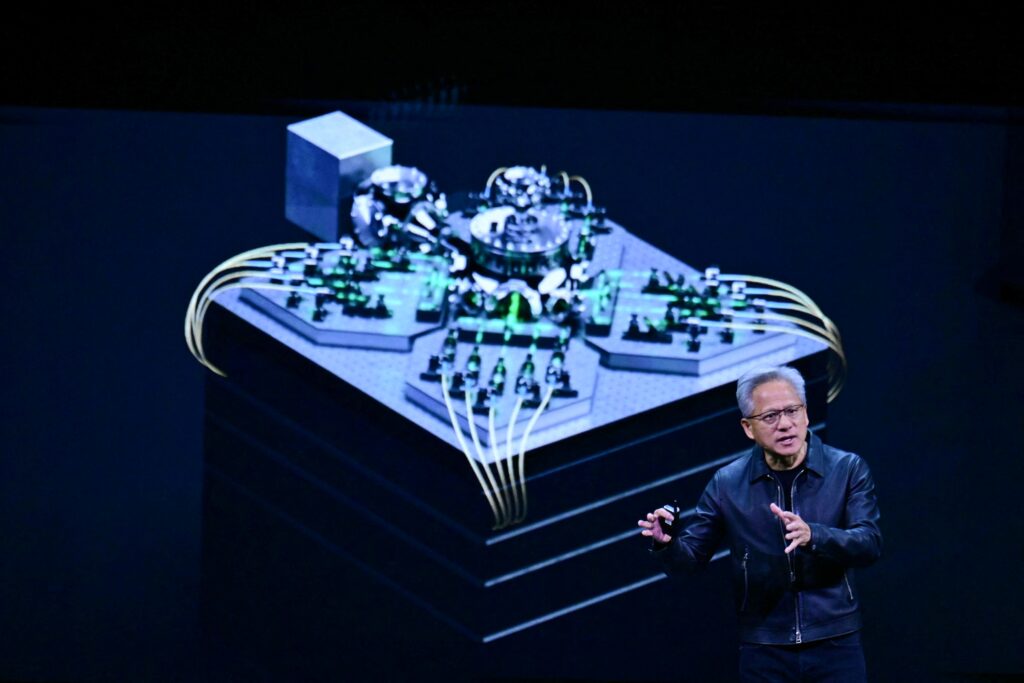
SAN FRANCISCO — When chip giant Nvidia’s chief executive Jensen Huang was reinstated 11 days after resigning in a cloud of controversy, much of the tech world celebrated the reversal of what they had seen as a grave error.
Nvidia’s shares shot up, and President Donald Trump called into CNBC to explain how he had assured the company’s board that the government didn’t believe Huang posed any national security concerns. But hours after Huang’s comeback, the U.S. government banned Megaspeed, the Nvidia customer at the center of the scandal from receiving American computer chips due to national security concerns.
The contradictory messages underline the fact that despite Huang’s return, the future for Nvidia and the AI revolution it has helped drive remains uncertain. Democrats and Republicans in Congress have vowed to investigate Huang’s relationship with Alice Huang, a former Megaspeed executive believed by the government to be linked to Chinese intelligence services. Nvidia’s own board says its investigation of Jensen Huang will continue. And the government’s recent move to close a loophole that allowed Nvidia to sell chips to Asian companies that let Chinese AI firms access them remotely could cut into the company’s revenue.
“They threw him off the Titanic and then they brought him back on,” said Jay Goldberg, a senior semiconductors analyst with Seaport Research Partners. “The icebergs are still out there.”
How Huang navigates the coming months could have far-reaching impacts on the AI boom and the global competition over the technology between the U.S. and China. His ability to return Nvidia to business as usual and sell billions of dollars worth of chips to companies serving Chinese customers will influence whether the two countries’ AI industries remain integrated, or split apart completely. And his position as a key funder of the AI boom itself will be tested, as investors begin to lose faith in the industry’s ability to turn a profit.
Some tech and venture capital leaders had warned that without Huang, Nvidia might pull back on its role as a central investor in other AI firms, making it harder for those companies to grow and succeed. After his resignation, share prices for AI data center operators like CoreWeave and Nebius that had been funded by Nvidia fell sharply. When he returned, they rose again.
But investors’ growing concerns that AI companies have overextended themselves are focused on more than just who is Nvidia’s CEO right now. The Nasdaq-100, a collection of tech-focused stocks, bumped up when Huang was reinstated, but it is still down more than 10 percent this month.
“The last week has been brutal for the entire AI and semi[conductor] space,” Stacy Rasgon, an equity analyst at research and brokerage firm Bernstein said in a note to clients on Monday. “The concerns driving the move were not all Jensen-related, with investors increasingly worried about AI spending achievability and sustainability.”
Many in the industry have also seen Huang as an important counterweight to the power of the top AI model companies, Google, OpenAI and Anthropic. Nvidia has been working to develop its own “open-weight” models, which other companies can use free. Huang has also advocated more broadly for open-weight models, which right now are mostly built by Chinese AI companies. OpenAI and Anthropic have accused Chinese companies that are building open-weight models of copying outputs from U.S. models to improve their own, a process called distillation.
In July, Nvidia published a letter co-signed by a range of tech companies that argued distillation was a legitimate technique for model development.
The fight over how to develop future AI models touches on the broader question of how the U.S. should engage with the Chinese AI industry. Many American start-ups and larger companies alike use Chinese models because they are free to download and in many cases just as capable as expensive U.S.-built ones. But China hawks in Congress have criticized the practice, and last week, the House Committee on Homeland Security and the House Select Committee on China released a joint report calling for the removal of all Chinese open weight models from federal government computer systems.
“We should not wait five years to discover that much of the world, and much of the United States, runs on AI shaped by the [Chinese Communist Party], leaving policymakers with little choice but another costly rip and replace effort,” the two committee chairs, Reps. Andrew Garbarino (R-New York) and John Moolenaar (R-Michigan) wrote in the report. “The time to act is now, while we still have the opportunity and leverage to do so.”
Huang is set to appear at a closed-door briefing in Congress on Dec. 1.
Over the past several years, Huang has been a key advocate for selling more AI chips to China, arguing that giving up the world’s second-largest market for the computer chips fueling AI would weaken the U.S.’s standing in the long term. On earnings calls, he has talked about the billions in revenue that would be unlocked should the company be allowed to sell more chips to China.
In December 2025, Nvidia and Trump struck a deal allowing the company to sell an older version of its most advanced AI chip directly to Chinese companies in exchange for a cut of sales going to the U.S. Treasury. Commerce Department documents released last week, dated in May, show the administration approved the sale of almost 580,000 Nvidia chips to China under the deal.
The value of the chips is redacted in the Commerce documents, but Nvidia interim CEO Colette Kress said last week on the company’s earnings call that Nvidia had made $2.4 billion from chip sales to Chinese customers in the third quarter of 2026. On the same call, Kress said the company had stopped shipping the chips to China, without elaborating why.
Whether Huang starts those sales again is a key question. The Chinese government has said it does not want or need Nvidia chips, but the country’s AI companies have benefited from using them, either through physical smuggling or by accessing them remotely through data centers in other countries.
A spokesperson for Nvidia declined to comment for this story.
Though Commerce is officially moving to crack down on these practices, it’s unclear how strictly the new rule will be enforced, said Kyle Chan, a fellow at the Brookings Institution think tank and an expert on U.S.-China relations.
Leading Chinese AI companies including Tencent, Alibaba, ByteDance and Moonshot have all remotely accessed Nvidia chips through data centers in Southeast Asia, Chan said. Huang, who has often met with officials from Chinese AI firms, has “played such a strong role in trying to tie in the two ecosystems,” he added.
Even though the official Chinese government position is that they are focused on building their own computer chips, Chan said, the CEO’s return will likely be welcomed by Beijing.
Still, the world has changed in the last month, and Huang’s ability to push for policies that benefit Nvidia may be limited. Incoming Democratic leaders in both chambers of Congress have pledged to dig deep into Huang, Nvidia’s business in Asia and how it influenced the Trump administration.
“He’s back but he’s diminished,” Goldberg said. “There are all these big, unanswered questions that are looming out there.”
By reinstating Huang, the Nvidia board has sent the message that he is “untouchable,” said Dorothy Lund, a corporate governance expert at Columbia Law School. But the company and its CEO is now under strict scrutiny, she said. “I wouldn’t be shocked if they screw up again.”
And whatever assurances Trump gave the Nvidia board that Huang hadn’t damaged America’s national security may be withdrawn by whatever administration comes into power in 2028, Lund said.
“The Nvidia board bought themselves a quiet Thanksgiving,” she said. “But there’s going to be a lot of uncertainty.”
The post What Jensen Huang does next could shape the global race for AI dominance appeared first on Washington Post.