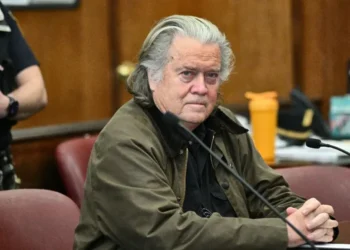
A Wisconsin judge ruled on Monday that there was sufficient evidence for two men to face trial on charges that they illegally tried to keep President Trump in power after his 2020 election loss.
The two defendants are James Troupis, a lawyer and former judge who is accused of being an architect of the plan to deploy fake electors in a number of states that Mr. Trump lost; and Mike Roman, a top staff member in the 2020 Trump campaign. The preliminary hearing for a third defendant, Kenneth Chesebro, another lawyer who also faces charges, was delayed amid questions of whether statements he had made to investigators were admissible.
The defendants face 11 forgery-related charges in connection with the drafting of false elector certificates, representing an alternative outcome to Wisconsin’s presidential election that year, when Mr. Trump lost to former President Joseph R. Biden Jr. Defense lawyers argued that their clients were seeking to preserve Mr. Trump’s options should a long-shot court challenge to the official results succeed.
“I think that the mistake here and the error that really permeates this entire case is the idea that this is a forgery,” Joseph Bugni, an attorney for Mr. Troupis, said.
He argued that the certificates in question were a legitimate effort to preserve the rights of the president’s campaign. Prosecutors claim that the documents were not genuine because they were not signed by official electors.
Prosecutors in a number of states, where similar fake elector schemes have been charged, say the Trump campaign carried out a broad effort to pressure state officials and defy the results of multiple vote counts, recounts and certifications, as well as the court rulings that upheld them. A key part of the plan, prosecutors allege, was to create a dispute in seven key states over which slates — the fake Trump electors or the real ones backing Mr. Biden — were legitimate, and to have a majority of Congress and Mike Pence, then the vice president, certify the Trump slates. Mr. Pence refused to do so.
Judge John D. Hyland of Dane County Circuit Court in Madison ruled on Monday that the signatures that defendants had “sought to be presented to Congress” constituted a “representation that was not true at the time based on the record of litigation, based upon the certifications.”
The judge said that at the preliminary hearing stage, in which the court determines whether there is enough evidence to hold the defendants for trial, the state did not yet have to prove its case “beyond a reasonable doubt.”
Wisconsin is one of five states that brought criminal charges related to the Trump campaign’s circumvention efforts, though many of those cases have been dismissed or faced significant hurdles. This year, elections cases in Georgia and Michigan have been dismissed, while cases in Arizona and Nevada have encountered procedural setbacks.
The Wisconsin case, which has the smallest number of defendants of any of the state cases, was brought by the office of Josh Kaul, the state attorney general. A federal elections case against Mr. Trump himself was dropped after he won the 2024 presidential election.
The defendants’ communications have been a key point of discussion in several cases. Mr. Troupis has drawn attention for an email exchange with Mr. Chesebro after the 2020 election in which the two men discussed how the Trump campaign could get the false-electors documents into the hands of members of Congress.
Mr. Roman was Mr. Trump’s director of Election Day operations in 2020. Email and text traffic has shown that he had blocked efforts to add language to the documents signed by the fake electors that would have stated that they were acting only as a contingency. Instead, the certificates said that the signatories were the state’s “duly elected and qualified electors.”
At Monday’s hearing, the defense called Lawrence Lessig, a law professor at Harvard University, to testify remotely. He reiterated his view that the state prosecutions were misguided.
“In the context of how this played out, at least in the case of Wisconsin, I don’t think that it could be deemed to be fraudulent,” he said during his testimony.
The 10 Wisconsinites who acted as fake electors accepted Mr. Trump’s defeat as part of a 2023 civil settlement. One of them, Andrew Hitt, the former chairman of the state’s Republican Party, said at the time that he regretted the part he played.
“The Wisconsin electors were tricked and misled into participating,” he said, adding that they “would have never taken any actions had we known that there were ulterior reasons beyond preserving an ongoing legal strategy.”
Danny Hakim is a reporter on the Investigations team at The Times, focused primarily on politics.
The post Wisconsin Judge Allows Election Case to Proceed Against Trump Advisers appeared first on New York Times.