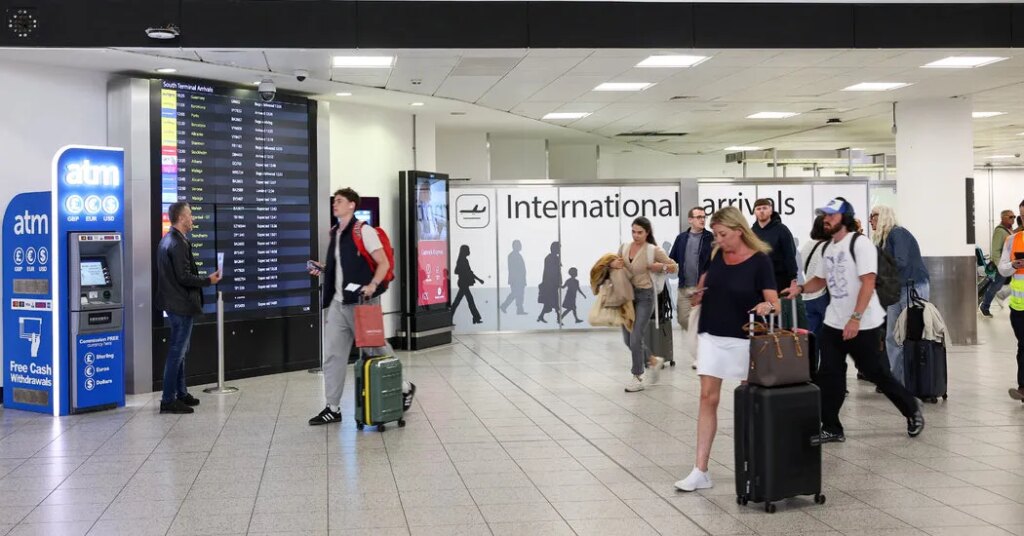
Net migration to the United Kingdom has fallen to 77,000, its lowest level in almost three decades, excluding the Covid pandemic, according to official figures released on Thursday.
The latest statistics, which are provisional estimates for a 12-month period ending in June, underscore a huge drop in recent years as successive British governments have worked aggressively to cut both legal and illegal immigration following a public backlash.
Leaders around the world have seized on migration as a major political issue, with populist parties making gains in several countries and pushing the political center toward stricter rules on immigration. As migration crackdowns have played out across the United States and Europe, the flow of newcomers has slowed in many places.
“This is something which we are also seeing in other high-income countries,” said Ben Brindle, a senior researcher at the Migration Observatory, a research group based at the University of Oxford. In places like Britain, “it’s mostly the result of policy changes.”
Meghan Benton, director of the global program at the Migration Policy Institute, said that she thinks of some national policies, like Canada’s, as “topiary” — trying to trim migration around the edges in response to political pressure and practical needs — and others, like that of the United States, as “chain saw.”
Britain, she said, falls somewhere in the middle.
“Generally, the overall trend is to respond to this public trust crisis by reducing numbers overall,” Ms. Benton said, explaining that the public are worried about high-profile instances of uncontrolled migration.
The latest figures for Britain will likely be seen as a political win for the center-left Labour Party government, which has promised to drive down net migration numbers, which many of its predecessors had failed to curb.
British voters decided in 2016 to leave the European Union partly after a campaign in which immigration featured prominently. But net migration peaked after Brexit at more than 900,000 in the year ending in June 2023, after new rules were introduced by Boris Johnson, who was prime minister at the time.
Amid growing public discontent, the most recent Conservative prime minister, Rishi Sunak, put in place measures to scale back immigration, for example, by restricting the right of foreign students to bring spouses, partners or children into the country.
Since winning the general election in 2024, the Labour Party government, first led by Keir Starmer and now by Prime Minister Andy Burnham, has extended the measures introduced by Mr. Sunak.
Shabana Mahmood, the home secretary, said on Thursday that the fall in net migration showed that the government had “restored control” — an echo of the promise made by Brexit supporters in their 2016 referendum campaign to “take back control” of Britain’s borders.
“We have brought net migration to 77,000, down 92 percent from its peak under the previous government,” Ms. Mahmood wrote on social media. “Where they failed, we have delivered for the British people. This didn’t happen by accident. It happened because this government took action.”
The fall in net migration did little to assuage some of Britain’s leading anti-immigration campaigners, including Nigel Farage, the leader of the populist right-wing Reform U.K. party. He said on social media that a generation of Britons had been “replaced” by migrants.
Similar language can be heard across Europe.
Net migration has not fallen by quite as much in Europe as it has in Britain, but it has been on the decline. After peaking in 2022, the number of newcomers fell and the number of people leaving the 27 nations of the European Union increased in both 2023 and 2024.
While more recent data is not yet available, the number of undocumented arrivals to the European Union fell both this year and last.
The shift has come as many nations have hardened their stances toward migration. For instance, a group of five European countries is in talks to begin deporting rejected asylum seekers to Rwanda, even if the deportees have no previous link to the country, to deter potential newcomers. The plan resembles one that Britain tried — and failed — starting from 2022.
Even left-leaning governments across the continent have seen taking a hard line on migration as politically advantageous.
Prime Minister Mette Frederiksen of Denmark, a social democrat, is currently facing a backlash for using language — “ethnically Danish indigenous tribe” — that seems to resemble what is often called “replacement theory,” or the idea that nonwhite migrants are replacing white populations.
Rob Jetten, the centrist and socially liberal prime minister of the Netherlands, on Thursday listed migration among one of Europe’s top priorities.
“Europe needs to focus on its security, on competitiveness and on migration,” he told reporters in Brussels.
Net migration represents the number of people who arrived to live in a nation, minus those who left.
The fall in Britain, from 204,000 the previous year, takes the indicator to its lowest level since 1997, aside from the period when Covid-19 restrictions on travel were in force, according to the Office for National Statistics.
The reduction was driven mainly by a drop in people arriving from countries outside the European Union. That figure fell by more than 100,000, while the number of people emigrating from Britain remained broadly stable from the year before.
That said, the number of people leaving has been much higher in recent years than it typically is.
Analysts warned that the drop could have economic as well as political ramifications.
The sharp fall reinforces “that the U.K. does now have control over immigration, given the reduction is a result of a series of policy measures taken by governments over the past three years,” said Marley Morris, an associate director at the Institute for Public Policy Research, a center-left think tank.
“But the government must make sure it doesn’t overreach,” he added. “Its mission to ‘reindustrialize’ the U.K. requires an immigration system that helps to recruit workers critical to our industrial strategy.”
Slow population growth is already becoming challenging in some parts of Europe. For instance, Prime Minister Giorgia Meloni of Italy has historically been tough on migration. But her government has quietly reopened the door to some economic newcomers, expanding legal pathways for care workers and others who are needed as the Italian population ages.
That shift is not yet widespread.
In Britain, the crackdown remains firmly intact. Voters remained concerned about irregular migration amid highly visible crossings of the English Channel by small boats, said Ms. Benton of the Migration Policy Institute. And they often blame competition from migrants for high housing costs.
The post Net Migration to U.K. Falls to Lowest Level Since 1997, Excluding Pandemic appeared first on New York Times.