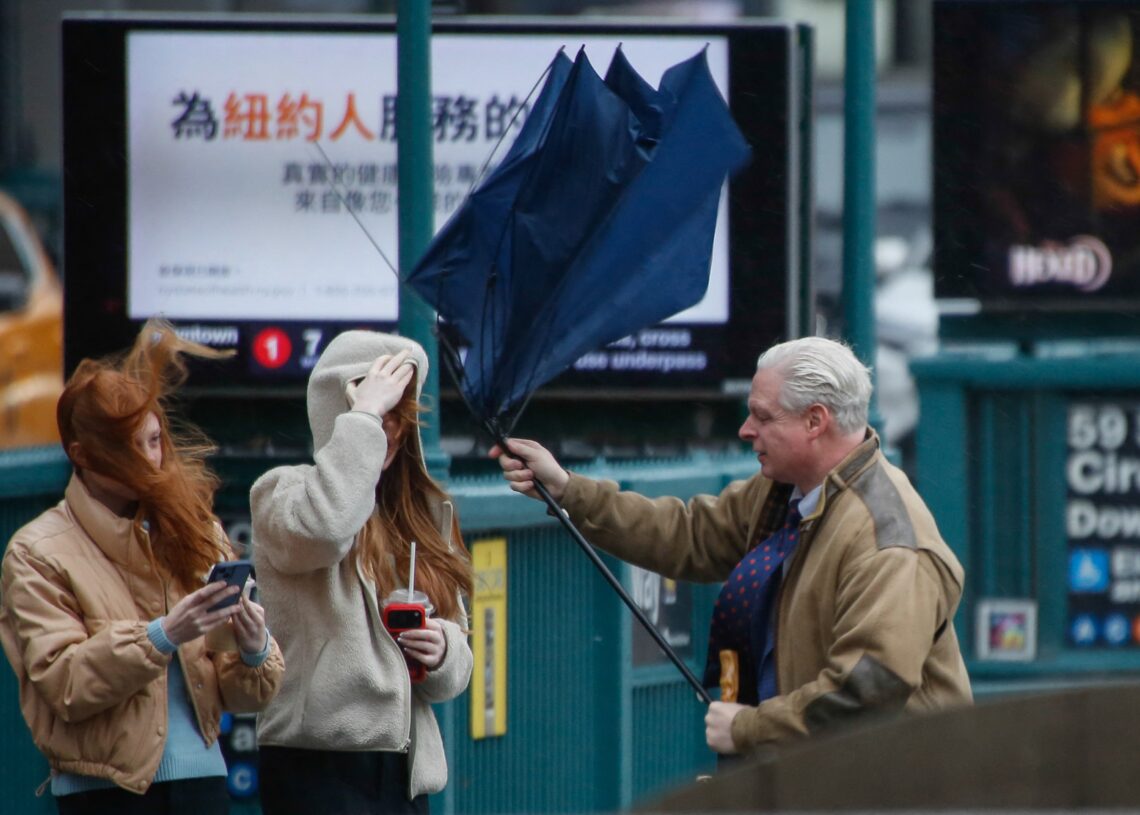
NEW YORK — The worst Thanksgiving Day storm on the East Coast in decades barreled across the region, disrupting holiday travel, flooding many coastal communities and leaving more than 700,000 people without electricity due to severe winds.
The storm progressed Thursday and affected tens of millions of Americans from North Carolina to New York as widespread 60 to 70 mph gusts were reported and ocean tides swelled to record levels in some areas.
Flights were cancelled, major bridges were closed and property damage was reported throughout Hampton Roads, Virginia, coastal New Jersey and the Washington-Baltimore region.
In suburban Maryland, nearly 2 million residents in Montgomery and Prince George’s counties were asked to conserve water due to intermittent power outages at filtration plants. The Washington Suburban Sanitary Commission (WSSC) asked residents to use “only water that is necessary” and limit showers, toilet flushing and the use of washing machines and dishwashers.
“Following the guidance … could help preserve water for system storage and fire protection until the storm passes and power reliability is restored,” WSSC Water said.
The storm led to the closure of the Chesapeake Bay Bridge in Maryland for several hours on Thursday afternoon while the Commodore Barry Bridge connecting New Jersey and Pennsylvania is expected to be closed at least until Saturday after maintenance equipment was damaged by the wind.
Winds gusted to 61 mph in Washington as 70 mph wind gusts swept across Atlantic City. Fierce waves damaged fishing piers in Virginia Beach and Avon, North Carolina.
The deluge also forced the postponement of the Macy’s Thanksgiving Day Parade until Saturday, the first weather delay in the event’s 100-year history. Officials said they made the decision on Wednesday because of concerns that participants and spectators would encounter dangerous conditions.
“Safety is and always will be our top priority,” New York Mayor Zohran Mamdani (D) said.
Philadelphia also canceled its Thanksgiving Day parade.
Strong winds ripped the roof off a building in Ocean City, Maryland, on Thanksgiving morning, leaving debris scattered across the area. pic.twitter.com/1KhyQlLmDu
— 7News DC (@7NewsDC) November 26, 2026
Battering waves and storm surges flooded streets in coastal communities in North Carolina, Virginia, Maryland, Delaware, New Jersey and New York, officials reported.
The city of Lewes in Delaware experienced a 5.5 storm surge and Atlantic City had a surge of 3.7 feet.
Several communities saw record high water levels. A six foot rise in water levels was measured in Wachapreague, Virginia, breaking a record that stood since 1998 by more than 2.1 feet.
Cape May in New Jersey saw a record tide of 9.4 feet, while waters in Ship John Shoal, New Jersey, rose 10.3 feet, also a record, according to preliminary data from the National Oceanic and Atmospheric Administration (NOAA).
Local media outlets and emergency managers reported scores of downed trees and scattered property damage, including a roof that had been partially blown off a building in Ocean City, Maryland.
Kensington @MontgomeryCoMD – large tree fell on occupied house, no injuries, building inspector notified https://t.co/c740jl5Seh pic.twitter.com/TuG0CDPptm
— Pete Piringer (@mcfrsPIO) November 26, 2026
More than 743,000 customers were without power across seven East Coast states as of 6 p.m., according to PowerOutage.us.
That includes more than 226,000 customers in Pennsylvania and over 170,000 n Maryland.
Dominion Energy reported nearly 123,000 customers without power in Virginia and North Carolina, including more than 20,000 in Fairfax County, near Washington.
Several other utilities along the coast reported more limited impacts. Pepco, which serves customers in Maryland and Washington, said more than 22,000 customers were without electricity, while Baltimore Gas and Electric reported over 102,000.
Officials warned that power outages could stretch into the weekend.
During the storm, a tree that fell into a house in Maryland trapped and landed on the legs of a woman in her sixties who was taken to an area hospital, according to Mark Trowbridge, assistant chief at the Mechanicsville Volunteer Fire Department.
“She was very lucky,” Trowbridge said.
Farther north, local officials in New Jersey and New York were bracing for conditions to deteriorate throughout the evening..
New York Gov. Kathy Hochul (D) issued a state of emergency for New York City, Long Island and Westchester County.
For much of the afternoon, heavy rain fell in New York City, and local officials responded to street flooding on some major thoroughfares. Mamdani warned that the rain could lead to flash flooding, and he urged residents who live in low-lying neighborhoods or basement apartments to closely monitor conditions.
In New Jersey, all 21 counties are also under a state of emergency after Gov. Mikie Sherrill (D) warned that residents faced a “serious storm that requires us all to exercise caution.” Sherrill urged residents to stay off the roads during the worst of the storm.
Scott Wahl, the borough administrator in Avalon, New Jersey, said he believes the high tide and storm surge resulted in “a top three or four” flood of all time in his community.
“This was not quite Hurricane Sandy but pretty close to Winter Storm Jonas, which we consider the second-highest ever recorded,” Wahl said, referring to a storm in 2016.
Wahl said major flooding closed some streets and damaged or destroyed about a dozen vehicles, but preliminary reports did not show major structural damage.
“Fortunately, lot of people heeded the warning and did not come onto the seashore to spend Thanksgiving at their beach homes,” he said. “There was ample notice.”
HAPPENING NOW: Severe coastal flooding is affecting streets along Bay Avenue in Ocean City as a powerful Thanksgiving Day nor’easter brings strong winds and elevated tides to the New Jersey coast, USA. (Footage: OCNJ Local via Instagram) pic.twitter.com/hlXCRkPeC2
— Weather Monitor (@WeatherMonitors) November 26, 2026
In Delaware, Gov. Matt Meyer (D) said residents should keep cellphones charged and have flashlights, extra food and medications handy.
“Be ready for power outages and difficult travel,” Meyer said in a statement Wednesday evening. “Adjust your plans if you need to and follow instructions from emergency officials.”
Around midday Thursday, officials in Maryland closed the Chesapeake Bay Bridge. State policy states traffic is halted on the bridge when sustained winds exceed 55 mph for at least 10 minutes. The bridge reopened to traffic about 4 p.m.
But the Commodore Barry Bridge, which crosses the Delaware River in suburban Philadelphia, is expected to remain closed until at least Saturday.
“The closure is a precaution to protect motorists while crews make repairs,” the Delaware River Port Authority said in a statement.
While many flights were able to take off, hundreds of others were delayed or canceled at key East Coast airports, disrupting thousands of travelers trying to join family or friends for Thanksgiving.
As of 6 p.m. there were more than 2,000 delays and 428 cancellations for flights within, into or out of the United States on Thanksgiving Day, according to flight tracker FlightAware.
Baltimore-Washington International Marshall Airport logged the most cancellations of any U.S. airport so far — with 47 flights, or more than a fourth of all those scheduled to leave the airport Thursday, canceled, and 24 percent delayed, according to FlightAware.
Amtrak trains traveling near Trenton, New Jersey, experienced 90-minute delays on Thursday evening due to downed power lines.
On the eve of the holiday, Transportation Secretary Sean P. Duffy warned that travel would be “challenging” amid incoming storms. Calling this week the Super Bowl of U.S. air travel, Duffy wrote on X that the country logged the busiest day for flights in 16 years Tuesday — with 52,000 flights in all.
The storm-related cancellations add to travel chaos already feared amid high holiday volume and recent tech glitches, including a Nov. 22 Delta system malfunction that delayed over 1,000 flights, and a Nov. 13 nationwide ground stop due to contractor work replacing old copper telecommunications lines with fiber at a remote Federal Aviation Administration facility.
The instigating storm system organized over Florida on Wednesday evening, and it was energized and steered westward by an approaching upper-air disturbance.
The storm swung north toward the Carolinas overnight, bringing gusty onshore winds, very heavy downpours and thunderstorms. As the system moved into the Mid-Atlantic strong winds occurred.
The low-pressure center was forecast to trek north up the Appalachians, much farther inland than conventional East Coast storms. The storm’s actual low pressure elongated and stretched from West Virginia to near Washington. D.C.
Winds were expected to be less dramatic in New England Thursday evening, though Cape Cod, Nantucket and Martha’s Vineyard could see a few gusts topping 50 mph.
The same storm system also dumped 5 to 8 inches of rain on the St. Louis metro region and 12 to 15 inches in far southeast Missouri.
The storm system will gradually weaken Friday as it sends rain and mountain snow showers over the Ohio Valley and northern Appalachians.
Improving weather and sunshine are likely in the Northeast on Saturday.
Liam Scott contributed to this report.
The post Flight delays, flooding and power outages grow as storm batters East Coast appeared first on Washington Post.