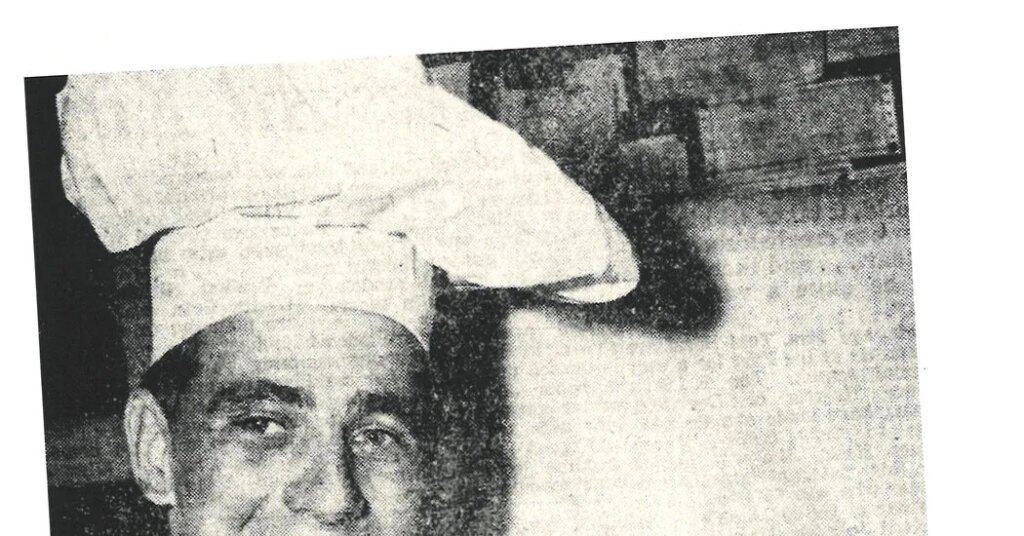
Dan Carney, who founded Pizza Hut with his brother Frank, transforming a single location in Wichita, Kan., into one of the most recognizable restaurant chains in the world, thanks to ambitious franchising and a distinctive red roof, died on Nov. 13 at his home in Wichita. He was 95.
The cause of death, his son Michael said, was chronic obstructive pulmonary disease.
The Carney brothers, who were of Irish descent, became pizza kings by happenstance. In 1958, Dan was 26 and running his family’s corner grocery, Carney’s Food Market, when the owner of a tiny brick building nearby came in with a copy of The Saturday Evening Post and a proposal.
She wanted to oust her tenant, a tavern that sold burgers and beer, and showed Mr. Carney an article in the magazine about a new culinary trend.
“She said, ‘How would you like to go into the pizza business?’” he recalled in an interview for the 2025 documentary “Slice of Life: The American Dream. In Former Pizza Huts.” “And I said, ‘Yeah, OK.’ We knew nothing.”
He brought in Frank, who was then 19 and attending the University of Wichita (now Wichita State University), and they borrowed $600 from their mother to open the restaurant. They found their first pizza chef through their sister Sally: Her neighbor, an airman named John Bender, had worked at a pizzeria in Indiana. Mr. Bender, who developed Pizza Hut’s early sauce recipe, became the third partner. (Several years later, he sold his share of the business to the brothers.)
That first restaurant, at the intersection of Bluff and Kellogg Streets, was around 500 square feet. (The building is now a museum on the campus of Wichita State.) Dan’s wife Beverly made the curtains and tablecloths. The pizza ingredients came straight from Carney’s Food Market. And the pizza oven was found discarded behind an Italian restaurant.
Despite its humble beginnings, Pizza Hut was an immediate success, in part thanks to the Carneys’ community ties, but also because of the novelty of a Neapolitan dish in a meat-and-potatoes Midwestern city. They opened five restaurants in just over a year.
Within a few years, as the brothers sold franchises, Pizza Huts spread — from Kansas to surrounding states, including Missouri, Oklahoma, Colorado and Nebraska, and eventually across the United States and as far as away as Australia and China.
The story of Pizza Hut is not about that first successful restaurant, but about the second one, and the third and the fourth, and so on, Jay Price, a professor of history at Wichita State, said. The brothers were early adopters of the franchise model, Dr. Price said in an interview: “The idea of having another one, another one, another one. The food is consistent; the service is consistent.”
Frank, the more outgoing brother, was the front-of-the-house guy and unofficial spokesman, while Dan preferred the back-of-the-house role dealing with logistics, contracts and other details related to business growth.
It was Dan who gave the American landscape the two-tiered red roof — as iconic a piece of roadside architecture as the golden arches of McDonald’s.
The first Pizza Huts were a hodgepodge of architectural styles based on available space. But by the early 1960s, Dan recognized the need for a branded building that would set Pizza Hut apart from competitors like Shakey’s Pizza.
He hired an architect, and the resulting design — a red roof topped by a cupola, with unusual trapezoidal windows below, said to have been inspired by the shape of pizza slices — was “conspicuous, noticeable and standardized,” Philip Langdon, an architecture and design writer for The Atlantic, told The New York Times.
It was also enduring. Forty years later, that design had become the architectural equivalent of comfort food.
“People walk into these buildings and straightaway know it’s a Pizza Hut,” said Matthew Salleh, who co-directed “Slice of Life,” about the repurposing of former Pizza Hut buildings to house other businesses, including churches and marijuana dispensaries. “What an amazing achievement of design to make a building that owns a common shape.”
Michael Daniel Carney was born on Oct. 6, 1931, in Kansas City, Mo., one of seven children of Mary Frances (Compton) Carney and Michael Carney, a meatpacker who opened a grocery store in Wichita.
When he was a teenager, his father died and he stepped in to run the business. At some point, Mr. Carney’s son Michael said, he reversed the order of his first and middle names, becoming Daniel Michael Carney.
After graduating from the University of Wichita in 1953 with a degree in business administration, Mr. Carney spent two years in the Air Force. During his downtime, he studied the concept of franchising. His eventual ambition, he told the “All Things Pizza” podcast in 2021, “was to put as many Pizza Huts in as I could.”
By the mid-60s, there were 145 Pizza Huts across the country. By 1971, Pizza Hut had become the world’s largest pizza chain, with some 1,000 restaurants around the world.
Mr. Carney prized personal relationships and favored handshake deals, and the business had in some ways outgrown his skill set and capital: Going global requires corporate structure and marketing power. In 1977, he and his brother sold the company to PepsiCo for $300 million (the equivalent of about $1.7 billion today).
Frank stayed on with the company until 1980, and then tried various other business ventures that mostly failed, losing millions. Later on, much to Dan’s dismay, Frank became the owner of a Papa Johns franchise and appeared in a commercial for the rival chain. He died in 2020 at 82.
Dan went from founder to franchisee, for a time owning Pizza Huts in Florida and Mexico. As a prominent business and civic leader in Kansas, he also served on charitable boards and backed younger entrepreneurs.
Mr. Carney married Beverly Singleton in 1954. She died in 1998. He married Gayla Coulter in 2001. In addition to his son Michael, she survives him, along with another son, Matthew; three daughters, Karen Carney, Tricia Kaufman and Polly Vickers; 15 grandchildren; and 22 great-grandchildren. A fourth daughter, Kay Carney, died in 2008.
In recent years, Pizza Hut has struggled to attract customers. In June, a private-equity firm bought the restaurants in the United States and around the world, except those in mainland China, which were sold to another company.
Nevertheless, generations of diners remember the chain fondly as a destination for family nights out, where bonding took place over breadsticks and deep-dish pan pizza. The affection is such that the locations that retain their original red roofs and familiar décor have become a popular draw.
Throughout his life, Mr. Carney remained humble about his business achievement. It was the right time and the right place, and they had a good product, he told interviewers.
On coming up with the name, he told the “Slice of Life” filmmakers, “The little hut we had was, in fact, a hut. So it didn’t take big brains to call it Pizza Hut.”
The post Dan Carney Has Died. He Co-Founded Pizza Hut and Then Made It Ubiquitous. appeared first on New York Times.