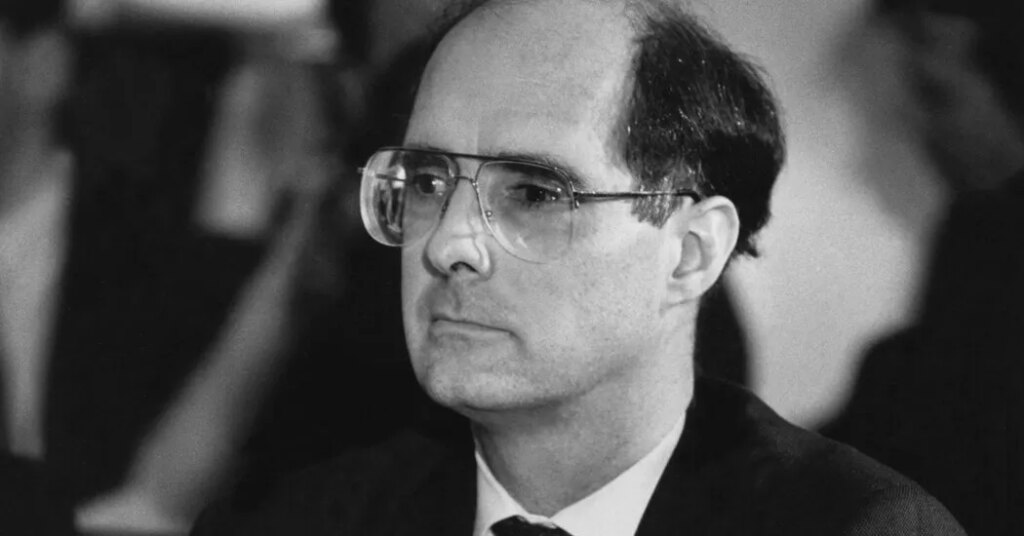
Strobe Talbott, a powerful figure in the foreign policy establishment whose career led from Time magazine to the State Department to the presidency of the influential Brookings Institution, died on Thursday at his home in Springs, N.Y., a town on Long Island. He was 80.
His son Devin confirmed the death.
Doors swung open for Mr. Talbott throughout his life, none more wondrously than when Bill Clinton, his Rhodes scholar housemate at the University of Oxford in the late 1960s, was elected president in 1992 and brought him into the State Department.
As deputy secretary of state, the No. 2 job, for most of the two-term administration, Mr. Talbott was Mr. Clinton’s chief Russia whisperer, as the president pursued a personal relationship with Boris N. Yeltsin, the Russian leader, to advance reform after the breakup of the Soviet Union.
Mr. Talbott (pronounced TALL-but) was patrician and ambitious, a third-generation Yale graduate who majored in Russian studies and successfully campaigned for the chairmanship of The Yale Daily News, primarily overseeing the editorial page. He knew it would almost certainly help him land a job at Time, then one of the world’s most influential publications.
In 1969, after working as an intern in Time’s Moscow bureau, he was back at Oxford writing his graduate thesis when the magazine asked him to translate and edit hundreds of hours worth of transcripts of secret recordings that had been smuggled out of the Soviet Union.
They were the dictated memoirs of Nikita S. Khrushchev, the Soviet premier who had been ousted from power in 1964, placed under house arrest and deemed a nonperson by the authorities. “After reading several pages,” Mr. Talbott later told Time, “I knew that I had in my hands one of the most fascinating and unusual documents ever to emerge from the Soviet Union.”
The first volume, “Khrushchev Remembers,” was published to acclaim by Little, Brown & Co. in 1970, when Mr. Talbott was 24, and it brought him lasting renown.
Translating the memoirs, however, foreclosed Mr. Talbott’s dream of becoming Time’s Moscow bureau chief, a job for which he was being groomed. The Soviet Union called the tapes fake and, when the second volume appeared in 1974, vilified Mr. Talbott as a “young sapling of the C.I.A.”
As a rising journalist and author, Mr. Talbott radiated gravitas and the sense that big things awaited him, perhaps the top editorship of Time. He cultivated friendships high in the Carter and Reagan administrations, including with the arms negotiator Paul H. Nitze, a hero of Mr. Talbott’s authoritative history of nuclear arms control, “Deadly Gambits” (1984), which portrayed Reagan as a “detached, sometimes befuddled character.”
“We are in the presence of something more than journalistic history; this is novelistic journalistic history,” the historian Theodore Draper wrote in a review of “Deadly Gambits” in The New York Times Book Review. Walter F. Mondale, the Democratic presidential nominee in 1984, cited the book twice in a debate with President Ronald Reagan.
During 21 years at Time, Mr. Talbott covered Eastern Europe, the State Department and the White House before being elevated to Washington bureau chief and then a foreign affairs columnist. His reporting included exclusive details of how government and diplomacy worked, which he wove into personality-driven narratives.
“Among practitioners of the slippery art of insider journalism, Talbott has always been one of those who seemed to come by their extraordinary access honestly,” Bill Keller, a former Moscow bureau chief and executive editor of The Times, wrote in 2002. “His sources talked to him not because he would flatter them, but because they knew he knew the subject.”
Mr. Talbott wrote more than a dozen books, including a trilogy on U.S.-Soviet arms control; a memoir, “The Russia Hand” (2002); and “Our Founders’ Warning: The Age of Reason Meets the Age of Trump” (2020).
He saw President Trump’s degrading of the NATO alliance in his first term as playing into the hands of Vladimir Putin, the Russian leader who smothered democratic reforms. “The shampanskoye — Russian champagne bottles — were popping their corks,” Mr. Talbott said in a 2017 interview with Politico after Mr. Trump refused to endorse NATO’s Article 5, the alliance’s mutual-defense pact.
Mr. Talbott traced his interest in Russian affairs to the nuclear brinkmanship of the Cuban missile crisis in 1962. At the time, he was a sophomore at Hotchkiss, the elite Connecticut boarding school. “I remember the headmaster summoned us all into the school chapel,” he recalled in a 1999 profile in The Times. “We got down on our knees and prayed that the world wouldn’t blow up.”
His self-discipline was apparent from the way he studied the Russian language. He would buy two copies of a textbook and then cut out the pages of one, pasting them in a notebook in order to write copious notes.
The Times profile, when he was deputy secretary of state, observed: “He is — what’s the polite term? — supremely self-assured in his role, partly because of his breeding, partly because of his record, partly because of his long relationship with the president.”
Mr. Talbott served in both Clinton terms, from 1993 to 2001. After he won Senate confirmation to his first post, as ambassador at large to the newly free nations of the former Soviet Union, Mr. Clinton swore him in personally.
Mr. Talbott described the transition from being a journalist looking through the keyhole of government to suddenly having a seat at the table as “a Bill Murray out-of-body comedy.”
“I would see people in the room who used to leak to me when I was a reporter,” he recalled in an oral history conducted by the Association for Diplomatic Studies and Training. “And I would usually go over afterward or see them in the hallway and say, ‘Don’t worry. You played it straight with me.’”
Raised by parents who were active in the United World Federalists, a nonprofit organization that promoted global governance, he believed in a liberal internationalist foreign policy that strengthened NATO and the European Union. But he was also a pragmatist.
In 1993, when Secretary of State Warren M. Christopher leaned toward fast-tracking NATO membership for Poland, Hungary and the Czech Republic, Mr. Talbott argued in memos and meetings that expanding the Western military alliance would provoke Russia. His view prevailed.
Later that year, after failures of U.S. policy in Bosnia and Somalia — where U.S. military helicopters were shot down by a local militia, and dead American soldiers were dragged through the streets of Mogadishu — Mr. Clinton sought Mr. Talbott’s advice about removing Mr. Christopher and replacing him with Colin L. Powell, the retired Army general.
Mr. Clinton ultimately left Mr. Christopher in place, but fired the deputy secretary of state and replaced him with Mr. Talbott. In that role, Mr. Talbott helped negotiate an end to the war in Kosovo in 1999, after the Serbian leader Slobodan Milosevic’s wanton violence had forced a million ethnic Albanians to flee the province.
Mr. Talbott was also the envoy in high-stakes talks with India after it tested a nuclear weapon in May 1998 and its bitter rival, Pakistan, carried out a test explosion weeks later. In an interview with The Times, Mr. Talbott called it “an extraordinarily serious situation” and one of “immense importance, complexity and, I would say, danger.”
He met more than a dozen times over more than two years with his Indian counterpart, seeking India’s signature on a global test ban treaty. India did not sign, but the talks laid the groundwork for Mr. Clinton’s visit to India in 2000, the first by a sitting U.S. president in more than 22 years.
Mr. Talbott never realized his ambition to become secretary of state. When Mr. Christopher resigned in 1997, the top job went to Madeleine K. Albright, the first woman to serve as the country’s top diplomat.
Mr. Talbott’s chances of winning Senate confirmation as secretary seemed to be out of reach after a surprising 31 senators voted against him for the job of deputy secretary in 1994. Conservatives objected to what they considered his rosy view of Russia’s leadership and his criticisms of Israel.
“I have decided a strong signal needs to be sent — enough promotions for Strobe Talbott,” Senator Bob Dole, Republican of Kansas, said in explaining his “no” vote. That effectively rang down the curtain on Mr. Talbott ever becoming secretary.
Nelson Strobridge Talbott III was born on April 25, 1946, in Dayton, Ohio, the eldest of four children of Josephine (Large) Talbott and Nelson S. Talbott, an investment banker. The family soon moved to the Cleveland suburbs.
After graduating in 1964 from Hotchkiss, a longtime feeder school to Yale, Mr. Talbott arrived at the Ivy League campus in New Haven initially planning to take pre-med courses.
“When he decided to drop pre-med and major in Russian studies, his parents asked me on a visit to their home in Shaker Heights whether or not he had become a communist,” recalled Derek Shearer, a Yale classmate who later became his brother-in-law.
In his junior year, Mr. Talbott and Daniel Yergin, a future Pulitzer Prize-winning economic historian, competed for the chairmanship of The Yale Daily News. Mr. Talbott, who politicked more aggressively among the staff and won an internal election, soon began to editorialize forcefully against the Vietnam War and helped circulate a statement by classmates who said they would refuse the draft. (Also in the class of 1968 was a future president, George W. Bush, whose Yale years were much different: An apolitical fraternity man and C student, he prioritized making friends.)
After earning a bachelor’s degree in 1968, Mr. Talbott went to Oxford, where he, Mr. Clinton and a third Rhodes scholar shared a narrow brick house. While Mr. Talbott labored over the Khrushchev translation work in Oxford, Mr. Clinton brewed pots of tea and scrambled eggs to sustain him.
In 1971, Mr. Talbott received his Oxford degree and married Brooke Shearer, the younger sister of his Yale classmate. Mr. Clinton briefly lived with the Talbotts in Washington after Mr. Talbott became a State Department correspondent for Time in 1974.
Ms. Shearer, an aide to the future first lady Hillary Clinton during the 1992 presidential campaign and then director of the White House Fellows program, among other positions, died of cancer in 2009. Mr. Talbott married Barbara Lazear Ascher, an author, in 2015.
In addition to her and his son Devin, he is survived by another son from his first marriage, Adrian; a stepdaughter, Rebecca Ascher-Walsh; a brother, Kirk; two sisters, Marjo Talbott and Page Talbott; and eight grandchildren.
After eight years in government, Mr. Talbott was named president of the Brookings Institution, the Washington citadel of center-left policy, in 2002. During his 15 years in that position, he oversaw the opening of outposts of the think tank in China, India and Qatar, and a large fund-raising campaign for its 100th anniversary in 2016.
The 35th reunion of the Yale Class of 1968 took place at the White House in 2003, where President Bush was host. One classmate, Steven R. Weisman, a former Times reporter and editor, recalled Mr. Talbott shaking hands with the president in the receiving line.
“Strobe had just recently become president of Brookings,” Mr. Weisman said. “Bush said to him, ‘You’ve got a really important job.’ Strobe was totally nonplused and said, ‘Well, so do you.’”
The post Strobe Talbott, Journalist Who Became Clinton’s Russia Whisperer, Has Died appeared first on New York Times.