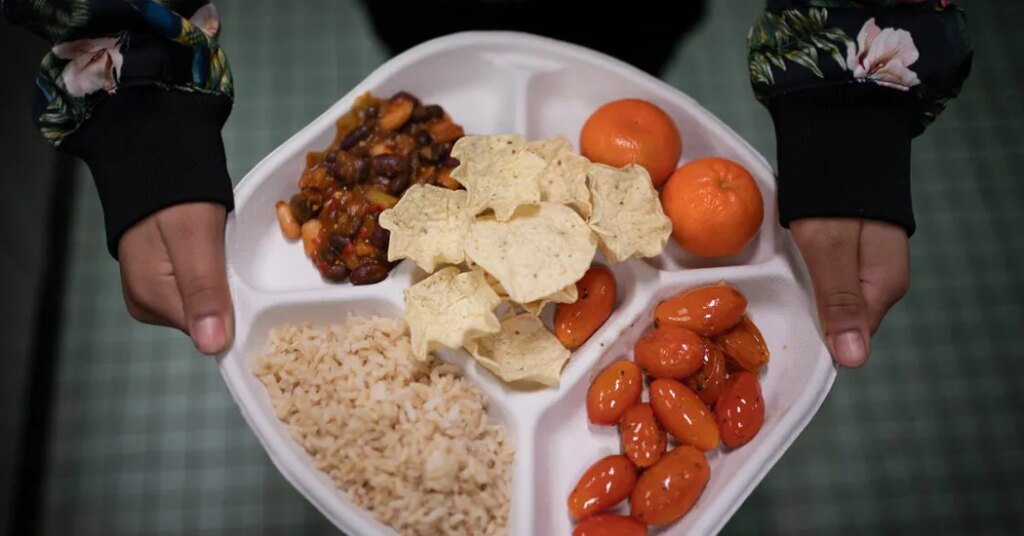
Millions of children are at risk of losing access to free school meals after cuts and proposed changes to the largest antihunger program in the country under the Trump administration.
It would be a significant reversal from a decade-long push to expand universal school meals, leaving students to rack up debt over meals or simply go hungry at a time when food costs remain high and charitable resources are strained.
Because the nation’s social safety net programs are often intertwined, changes to one can have cascading effects on others. In this case, cuts to the Supplemental Nutrition Assistance Program that Republican lawmakers enacted under the sweeping domestic policy bill last summer have pushed an estimated two million children off food stamps. That, in turn, has curtailed access to free lunch and breakfast in countless school districts across the country.
Even more children may stop receiving free school lunch starting next year as parts of the tax cut law take effect, schools reach the end of funding cycles and a new proposal by the Agriculture Department, which runs SNAP, limits eligibility further.
“As children fall off SNAP rosters, schools’ ability to continue offering free school meals to all students is going to decrease, and has this really negative ripple effect throughout the school and the household,” said Erin Hysom, the senior child nutrition policy analyst at the Food Research & Action Center, an anti-hunger nonprofit. “Hunger is going to rise.”
Critics have countered that the program is vulnerable to “widespread fraud and abuse.”
A 2024 proposal by conservative House Republicans called for eliminating a provision in a 2010 law that “allows certain schools to provide free school lunches regardless of the individual eligibility of each student.”
The community eligibility provision, as the policy in the 2010 law is known, made it easier and cheaper for high-poverty schools to serve school meals for free. Schools and districts where a significant proportion of students receive public assistance like SNAP can also receive federal funding, at reimbursement rates on a sliding scale, for providing free lunch or breakfast to all. About 55,000 schools adopted the policy in the 2025-26 school year, providing free meals to more than 27 million students.
But critics have argued that the policy is wasteful and subsidizes meals for children who are not truly needy. Project 2025, a set of conservative policy proposals outlined by the Heritage Foundation, also endorsed the elimination of the community eligibility provision and called on future Republican administrations to reject universal school meal programs.
The Trump administration’s cuts to SNAP and other safety net programs like Medicaid are, in effect, a step toward accomplishing those goals. Declining enrollment in those programs has led children to lose automatic certification for free school meals, which, in turn, has reduced schools’ ability to participate in the community eligibility provision and provide free school meals for all.
It is difficult to ascertain how many schools have stopped doing so and how many children are affected because schools opt in to the policy every four years and can choose to renew before their funding cycles are complete. But many — including some of the country’s largest urban districts and those in rural and remote places — have already announced an end to the program.
In Houston this fall, the Spring Branch Independent School District stopped offering universal free school lunch at 22 schools, or about half the district. More than 50 percent of students in the district qualify for free school lunch, but even a small decline in the number of students at one school can push the federal reimbursement rate below a financially sustainable level, said Michael Francis, the district’s director of school nutrition services.
“We’re going to continue looking for ways to make sure we provide quality meals to our students, and that’s never going to change on our end,” he added. “But this does make it harder and harder.”
In Laveen School District near Phoenix, 500 fewer students qualify directly for free school meals this school year in a district of about 8,000 students, said Jennifer Gordon, the district’s director of child nutrition. Should the number of eligible students continue to decline, Laveen may be forced to end its free meal program in two years. Arizona is the state where SNAP enrollment has fallen the most sharply.
Ms. Gordon listed the operational changes that would necessitate: shifting resources and personnel to handle paperwork and verify eligibility, navigating parental anger and confusion, managing meal debt and serving meals at a slower pace to account for payment processing.
“It would have a very drastic and unpleasant impact,” she said. “We would be focusing our efforts more on collecting applications and money for lunch accounts versus just feeding the kids and feeding them that high-quality meal that we’ve really worked so hard to make.”
This month, the Agriculture Department also proposed a regulation that would restrict SNAP eligibility further and, as a result, remove nearly 1.8 million children from automatically qualifying for free school meals. The vast majority of those children would still be eligible for the program, the agency estimated. But just how many will continue to receive free school meals is unclear.
Cindy Long, who oversaw nutrition programs under the Biden administration, said at a recent panel that the effects of the regulation, coupled with existing law, would be momentous.
SNAP cuts and further restrictions to food stamp eligibility “could be the last, frankly, the nail in the coffin for universal programs,” she said.
The post Cuts to Food-Stamp Program Threaten Free School Meals appeared first on New York Times.