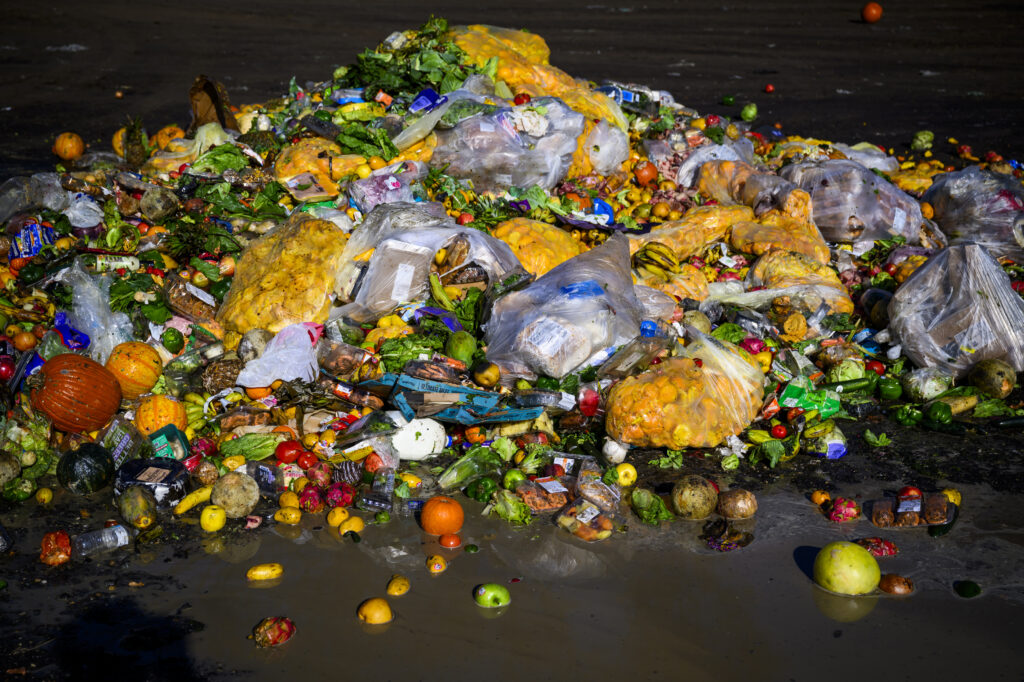
The pile smells funky: decaying fruit, rotten pumpkins, soggy lettuce.
The Prince George’s County Organics Composting Facility is the last stop of the day for Compost Crew driver Ian Steiner and Shawn-te Venable, who was assisting. They spent their early morning zigzagging across southeast D.C., scanning back alleys for orange and white bins.
For the mushy green bags bursting with chicken bones and half-eaten sandwiches, the late afternoon delivery to one of the largest compost facilities on the East Coast is a beginning, instead of the typical end as landfill trash. It’s also a glimmer of hope for reducing another big problem in the city: The rats.
That’s because keeping organic material out of landfills will not only have a climate benefit — because disposal areas are a source of planet-warming methane emissions — the compost collection could keep rats at bay if it adequately cuts off their food supply in dumpsters and trash cans.
With Mayor-elect Janeese Lewis George (D) soon to take office, Department of Public Works officials and zero-waste advocates alike hope her focus on reducing rodents could translate to a funding boost for the small but in-demand program.
The curbside compost program in D.C., which began three years ago this fall, grew from 9,000 to 12,000 households this year because of a roughly $1 million increase in funds. Still, 2,813 households are on a waiting list, and the program covers only about 10 percent of eligible residents.
On the campaign trail, Lewis George pledged to tackle the city’s rat problem in part, she said, by expanding composting.
“If rats don’t feed, they don’t breed,” she said in a campaign video.
A spokesperson for the mayor-elect’s transition team declined to comment for this report on Lewis George’s compost program plans.
This fall, the district also added 20 “smart” compost drop-off bins for a total of 51, the last of which was installed in Ward 4’s 16th Street Heights neighborhood this month. Since they were installed in February, residents have dropped more than 1 million pounds of food waste into the bins.
With only a few dozen across 68 square miles, not everyone has a bin nearby. John Johnson, program manager at the Office of Waste Division, would ideally add 150 more bins across the district, which he estimates would cost about $1 million.
The bins are the district’s solution for the majority of residents who live in multifamily housing and are not serviced by DPW’s curbside programs. The bins lock to keep out rodents and plastic trash; residents unlock them with code 2-0-2-5-# or the metroKEY app.
But the program’s leaders say there’s more to be done.
“We need more money,” Johnson said simply, standing beside one of the bins Wednesday near Marion Barry Avenue in Southeast Washington.
“We’re happy with the progress of the program,” he added, but “we’re looking to do bigger and better things.”
And for single-family residences, he said, the small size of the curbside program poses an operational challenge. Customers are spread across the district, so the collection routes are “not ideal.” The more customers who can participate, the more efficient the routes.
Environmental advocates say Lewis George has an opportunity to take local compost programs to a new level.
The district has a goal, originally established by the Sustainable DC plan in 2013, to divert 80 percent of its waste from landfills and incineration by 2040. In 2022, the most recent report available, DPW reported 28 percent was diverted (a new report is expected before the end of the year). About three-quarters of the diverted waste was mixed recyclables. Less than 1 percent was food.
Eve Hamilton, co-chair of the Sierra Club’s Zero Waste Committee for the D.C. chapter, praised outgoing Mayor Muriel E. Bowser’s administration for kick-starting the compost programs.
But, she said, much more remains to get the district on track to meet its zero-waste goals, including creating a plan to require commercial entities and local government departments to divert food waste, and allocating more funds.
“If we really want to achieve our zero waste environmental goals, we need to get [food] out of the waste stream,” Hamilton said. “You have to put the money behind it.”
The post Can composting fix D.C.’s rat problem? Zero-waste advocates hope the new mayor will boost city program. appeared first on Washington Post.