It all began with a wide-brimmed beaver felt hat.
That was the detail that caught Kent Monkman’s attention and led to his latest project, “Officer and Laughing Girl” at the Frick Collection. The project is, typically for this artist, as much institutional critique as art installation — a challenge not only to received notions of history, but to the museums that reproduce such notions.
The hat in question was worn by a figure in a Johannes Vermeer painting by the same name, a treasure in Henry Clay Frick’s trove. Vermeer made the painting sometime around 1657, when the southern tip of Manhattan was called New Amsterdam, the capital of New Netherland. The Dutch West India Company operated a voracious fur trade here. Water-repellent beaver pelts purchased from Indigenous hunters were a hot commodity, and the hats fashioned from them were the height of luxury in Europe.
For Monkman, a member of the Fisher River Cree Nation in Manitoba, Canada, that wide-brimmed chapeau pointed to an unspoken history of settler colonialism in North America buried in this mainstay of the European art historical canon. So he set out to reimagine the Vermeer from an Indigenous perspective.
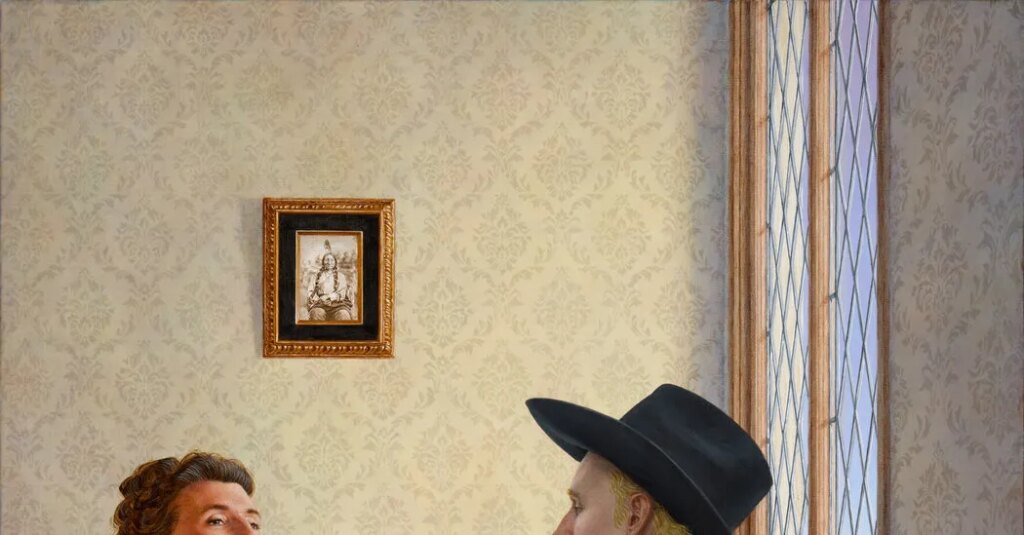
The result: five paintings by Monkman, rendered in a carefully realist style, installed in a small cabinet room on the ground floor. They hang on walls papered with Monkman’s bespoke design. At first glance everything seems perfectly at home in the Gilded Age mansion — until you look closely at the wallpaper and note beavers engaged in all sorts of shenanigans, such as drinking wine and making out.
Beavers, beavers everywhere: When Europeans arrived in North America, the population of these creatures was likely in the hundreds of millions. Today, there are somewhere around 10 million. Monkman, who said in a recent interview that he is in his “beaver era,” writes in the show’s handsome and succinct catalog that the destruction of the beaver population was a “harbinger and metaphor for the decimation of millions” of Indigenous people.
Monkman takes the basic key elements of Vermeer’s intimate canvas — the man, seen from the back, and a woman holding a wine glass, a map of the Netherlands on the wall behind — and runs with it, imagining five centuries of encounters between Native Americans and settlers.
In his series, Vermeer’s woman — who some art historians now suppose might be a sex worker — is played by Monkman’s alter ego, the time-traveling, gender-fluid Miss Chief Eagle Testickle. (Say the name out loud and you’ll hear it as “Mischief Egotistical”). In the first painting, the man hews closely to Vermeer’s Dutch soldier. In subsequent ones, he’s a fur trapper from the colonized territories known as New France; a stand-in for Lt. Col. George Armstrong Custer, who tried, and failed, to suppress a Native uprising at the Battle of Little Bighorn; a Christian missionary, whose attempts at forced assimilation of Indigenous people included ripping children away from their families to be re-educated at “boarding schools” (“residential schools” in Canada); and, in the last panel, a dead ringer for Jeff Bezos and the tech executives whose industry Monkman sees as poisoning the planet.
Over the course of the paintings, Miss Chief goes from fully and elegantly clothed in 17th-century New Amsterdam to stark naked 21st-century Manhattan. The soldier sheds his coat, his hat, and even his hair; the light through the window starts out frosty blue and ends up yellow hot, as the earth warms. And the map on the wall shifts, too. It starts out as a Cree “winter count” rendered on a hide — a collective history created to mark significant events — and is replaced by a map of Hudson Bay in the shape of a phallus. In the final work from the series, we find one of Monkman’s own paintings of Miss Chief trying to kiss a bison — a nod to Cree notions of kinship between human and nonhuman beings.
In each painting, Monkman’s alter ego coquettishly, even seductively, offers up to each of the men a carved pipe akin to those used in Native American ceremonies to mark treaties and alliances.
I won’t reveal the naughty Easter eggs Monkman includes in his images so as not to spoil the fun — but together they remind us that by virtue of living as a Dutch man in the 17th century, Vermeer and his work were touched by his country’s colonization efforts, extinction-level environmental devastation, and genocide halfway around the world.
Museums like the Frick Collection — and the Metropolitan Museum of Art, which invited Monkman to make work for its Great Hall Commission in 2019 — love bringing in contemporary artists, especially those from marginalized communities, to help “contextualize” their collections, drawing connections between the European and American canons and the havoc that those same cultures wreaked around the world.
While it’s edifying and entertaining for viewers when someone like Monkman, who has an equally fine sense of historical specificity and absurdity, does it, it feels a bit like a museum’s outsourcing of its responsibility — relying on artists to make visible the histories that curators have often sidestepped.
In the case of the Metropolitan Museum of Art — which collects Indigenous art but has been slow to ask for ownership histories and information from tribes about the items — Monkman’s intervention had the potential to change the institution, pushing it to acknowledge the way colonial history and Indigenous survival has shaped its collection and display.
But what about the Frick Collection, which focuses exclusively on work made before 1900 in Europe? Will it be transformed as a result of Monkman’s offering? Can it be?
Monkman tells us in the catalog that Miss Chief is attempting to interact with the colonizer over centuries, and keeps offering the peace pipe in the hopes of “altering their destructive and racist policies.” Alas, he says, it has “not always had the intended results.”
Do the museums that commission projects like this understand that they are playing the colonizer to Monkman’s Miss Chief? Not often enough, I fear. If Monkman’s installation succeeds as art historical intervention, it stumbles as institutional critique, because in the case of the Frick, the institution itself is immovable. If the artist is bothered by museums that welcome him in as a temporary guest, only to close the doors again and go on with business as usual, you wouldn’t know it. He persists, like Miss Chief, time and time again.
Kent Monkman: Officer and Laughing Girl Through Feb. 22, 2027, The Frick Collection, 1 East 70th Street, New York; 212-288-0700, frick.org.
The post A Cree Painter Upends Vermeer at the Frick appeared first on New York Times.