Fresh tariffs proposed by President Trump this week were a reminder to the world that he still intends to settle scores with trading partners he believes are hurting the U.S. economy, despite persistent political and legal pushback.
The administration proposed new import taxes on goods from dozens of other countries it accused of unfair trade practices related to “excess capacity.” For most countries, the tariffs would simply use a different legal authority to put back in place levies previously negotiated but struck down by the U.S. Supreme Court in February. The new tariffs are not set to take effect until early next year, following a public comment period and hearings that begin in January.
The latest battery of proposed tariffs revived President Trump’s focus on reducing China’s dominant role in supply chains. China was mentioned hundreds of times in the reports released to justify the levies.
Countries were blamed for failing to restrict Chinese investment and imports, acts that the Trump administration argued led to a “dependence on and vulnerabilities in supply chains for firms and in sectors critical to the functioning of the U.S. economy.”
China, in response to the tariffs, called the concept of excess capacity “a false premise” and a “pretext for political maneuvering.” Japan and India bluntly said their economies had no excess capacity.
In Singapore, a former official pointed out that the United States exported more to his country than it imported. In India, a former trade official called the threat of new tariffs “bait” to force countries into “one-sided” deals.
And while China looked relatively unscathed under a pause in trade hostilities that capped U.S. tariffs at 20 percent, the new proposal signaled that tariffs on Chinese goods could double if the cease-fire between the two countries expires in January. For the Trump administration, the aim is to preserve leverage if the two sides were to return to a full-blown trade war.
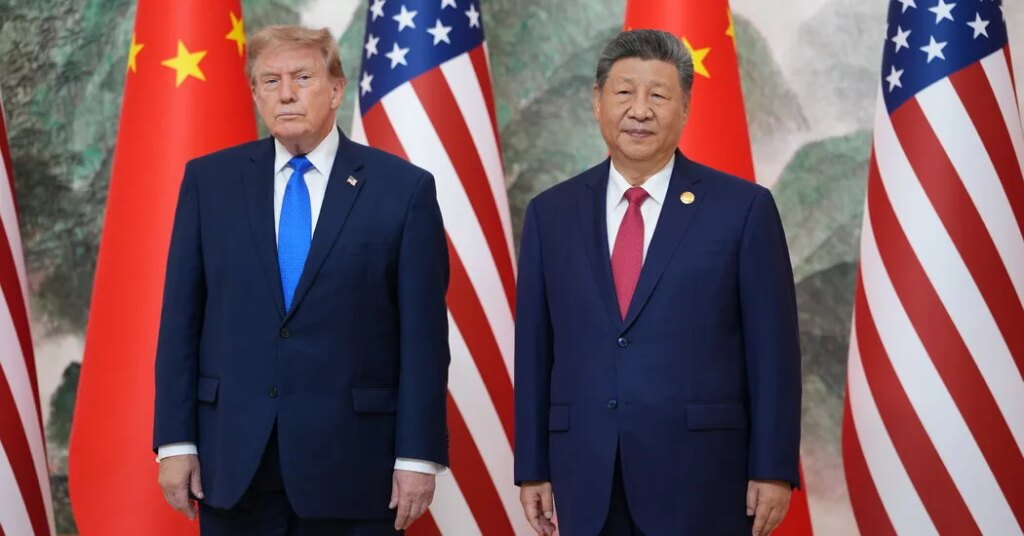
The latest tariff proposal will loom over an important meeting between Mr. Xi and Mr. Trump next month, experts said.
For nations in Asia that depend on trade and investment from both the United States and China, the new plan evoked Mr. Trump’s earlier calls to decouple their economies from Beijing.
The spate of tariffs also highlighted the differences between countries that have already negotiated with the Trump administration on tariff rates and those that have not yet done deals.
Relief for Those With a Deal
In Japan, South Korea and Taiwan, governments expressed confidence that their negotiated 15 percent tariffs would remain in place.
Japan on Thursday said that this was the rate it had negotiated following its pledge to invest in and help finance $550 billion in projects in the United States. South Korea also expressed relief that the 15 percent tariff cap on its exports, a provision secured under a $350 billion investment agreement with the United States, remained in place.
For others that had signed trade deals but not negotiated a cap on tariffs, like Malaysia, Indonesia, Cambodia and Bangladesh, there was more apprehension about what comes next. “The terms and conditions within the deal have changed for these countries,” said Deborah Elms, head of trade policy at the Singapore-based Hinrich Foundation.
While each country had signed deals with the Trump administration for an 18 percent tariff, now they faced the possibility that those tariffs could increase to 25 percent. Thailand was also in limbo, having agreed to sign a deal with an 18 percent tariff earlier this month, without finalizing it.
Risks for Those Without a Deal
Countries that have not signed trade deals with the United States appeared on shakier ground.
India and Vietnam stood out. Both countries, while still engaged in trade negotiations, face tariffs of 25 percent and 35 percent if they could not agree to the terms of a deal with the United States.
In Vietnam, where the pressure is most acute, officials have made clear to their American counterparts that they are cracking down on exports made in China and shipped through Vietnam. They have also said they aim to reduce dependence on Chinese suppliers and to build up a homegrown industrial base, while arguing that no country can be expected to completely decouple from China given its dominance in the supply chain of nearly every manufactured product.
The proposed 35 percent rate for Vietnam was among the highest in the world. Vietnamese officials expressed surprise but responded cautiously, mostly trying to downplay the latest tariff announcement.
“I must stress that this is a proposed tariff rate,” Chu Thang Trung, a senior official at Vietnam’s Ministry of Industry and Trade, said in an interview on Thursday. “It has not taken effect.”
In India, the tone from the government was more defiant. Its ministry of commerce said it had “engaged constructively throughout this investigation” and added that “India does not have structural excess capacity in any sector.”
India produces more than what its domestic economy can consume in some traditional industries, like carpet-weaving, as well as in basic foodstuffs, going from an importer of rice to a major exporter.
Increasingly, as India pushes its factories to expand in areas like consumer electronics and renewable energy, it is making more iPhones than its citizens can buy and more solar modules than its power distributors can connect to the grid.
India has been stuck in trade negotiations with the United States since April 2025. In its new report, the Trump administration said Indian goods could get a 17 percent tariff. Without a deal, their exports would be hit with a 25 percent tariff.
This offer was “bait,” said Ajay Srivastava, a retired Indian trade official, that was being dangled by the U.S. government in order to “force trading partners into signing one-signed trade deals.”
Damien Cave and Tung Ngo contributed reporting from Vietnam, River Akira Davis from Japan, Choe Sang-Hun from South Korea and Alex Travelli from India.
The post Trump’s Latest Tariffs Revive Focus on Pressuring China appeared first on New York Times.