From my perch atop the well house roof, my view stretched in every direction. Aside from the log cabin I called home, I could see the magnificent centuries-old wisteria draped in deep purple blossoms, archaeologists digging for colonial artifacts in the garden, and the Glencarlyn Library just a few steps from my backyard, my refuge whenever I needed a break from my parents’ crazy idea: convincing our family to live like pioneers.
In 1975, the summer before I started third grade, my parents traded our newly built suburban home for a deteriorating log cabin dating back to the mid-1700s, Historians said it is likely the oldest house in Arlington County, Virginia. The cabin, a small two-story addition built in the next century, and nearly an acre of surrounding land had recently been donated to the Arlington Historical Society by Marian Sellers, who understood the property’s historical importance. The society renamed it the Ball-Sellers House in honor of both Sellers and John Ball, one of Arlington’s first settlers and the home’s original owner.
The house had stood vacant for years and was in desperate need of renovation. So desperate, in fact, that the Arlington Historical Society struggled to find anyone willing to live on-site as caretakers during the restoration. That changed when my family volunteered.
Today the Ball-Sellers House is a beautifully preserved museum and field trip destination where students learn how early American settlers lived when Virginia was still a colony under British rule.
But when my family arrived in 1975, it was a different story: The farmhouse was rickety, full of termites and in extreme need of repair. Over time, electricity and a bathroom had been added. But everything was in dire shape, from rotten floorboards to plaster that crumbled off the walls in gravelly chunks, especially between the original ancient, weathered logs.
Occupancy code standards didn’t apply due to grandfather clauses. There was no insulation, and the only bathroom and the upstairs bedrooms were unheated. Pipes froze and fuses blew so frequently that it wasn’t uncommon for my parents to tell us we’d just have to use the nearby library if we needed drinking water, light for homework or a lavatory. Of course, this only worked during business hours.
Our move was driven largely by economics: in exchange for helping restore the property, my parents could live there free while renting out our modern house. But as kids, we only knew what we were told: that our family was fortunate, even special, to get the opportunity to live like 18th-century pioneers in the middle of 20th-century Arlington, just five miles from the White House.
Despite the sentimental framing, I missed my real home just one block away in the same Glencarlyn neighborhood. I yearned for its clean, spacious layout, its wood-paneled walls and gold shag carpeting, and the comfort of central air conditioning in the summer and central heat in the winter. Most of all, I missed my floral bedroom with its fancy dressing table and ruffled canopy bed, where another girl now slept.
At the outset, thanks in no small part to my love of Laura Ingalls Wilder books and the immense popularity of the “Little House on the Prairie” TV series, it was easier to accept the spin of the pioneer adventure. A theater kid in the making, I happily bounced around in my colonial costume complete with sun bonnet, spouting facts to whomever would listen.
“If you look closely at the walls, you can see horsehair mixed in to strengthen the homemade oyster shell plaster,” I would announce in my best docent voice when tour groups or curious neighbors visited.
And then: “The antique glass windowpanes are wavy because they were handblown by craftsmen” and “John Ball and his wife raised five daughters in this log cabin, when Arlington was a vast wilderness …”
But winter turned any game of make-believe I played into a harsh reality. As the temperatures dropped, our family of four spent months of at-home time confined to less than 350 square feet of heated living space. The heartfelt story of a simpler life quickly gave way to the daily discomfort of bygone-era living. As a self-proclaimed princess who’d thus far grown up surrounded by comfort, I now found myself sharing a tiny bedroom with my younger brother — our only heat source, electric blankets.
The dry, aged floorboards left deep splinters in our feet. Mice rustled in the walls at night. Insects were so constant that we gave up and learned to coexist. Cold drafts seeped through gaps in the floors and clapboard siding, and along with the house’s persistent mold and plaster dust, turned my allergies into a relentless cycle of ear infections and bronchitis. I remember waking to strange, crusted trails on my pillow, the aftermath of a burst eardrum and a release that finally ended the pain enough for me to sleep.
My brother fared no better; his colds often progressed into croup. I can still visualize my mother standing over the stove, boiling pots of water while holding him beneath an umbrella, desperately trying to ease his breathing with captured steam.
It’s why I roll my eyes when I see posts of perfectly styled tradwives on Instagram casually making their own preserves and bread before milking cows, collecting eggs and home schooling their children. Our foray into early American life wasn’t easy, even though my brother and I still went to school during the day and all our food came from grocery stores.
There are few photos of our time at the Ball-Sellers House, not only because people didn’t take many pictures back then, but also because my parents were too busy dealing with sick kids, challenging living conditions and arduous projects to pick up a camera.
Despite roughing it, I have fond memories of my time living in the Ball-Sellers House. In the summer, our yard was kid headquarters for long days playing one invented game after another. Our only job was to stay out of the adults’ way as they stripped wallpaper, spackled and painted.
We were spies hiding among the unruly hedges, crouching behind trees and leaving secretly coded notes in the home’s exposed knotholes. In Capture the Flag, apprehended enemies were caged in the wire chicken coop. Dusk meant picnic dinners, flashlight tag and ghost stories under the 200-year-old wisteria tree.
With the nation’s Bicentennial in full swing and Washington, D.C. just across the Potomac River, the Ball-Sellers House became a hub of celebration in 1976. Red, white and blue were everywhere. We joined parades that marched right past our log cabin. Patriotic fairs were held on the property and visitors frequently toured the house, eager to learn about colonial life. I happily found myself the center of attention, especially when I donned my Little House on the Prairie outfit and gave tours of our humble “working man’s estate.”
But, after only a year, my parents refused to take on another winter of ear infections and croup, and our time as “yeoman farmers” ended. I remember hearing Mom on multiple phone calls with our pediatrician who made it clear that leaving was the only way my allergy complications would improve. Our experience gave me a deeper understanding of why, historically, so many infants and children didn’t survive into adulthood.
Recently, after finding and joining the Ball-Sellers House Facebook page, I had the good fortune of connecting with its current director, Annette Benbow. She emailed me updated photographs of the property along with a copy of an article my mother wrote for The Washington Post about our year there, “A New Slant on Life in the Rough,” by Linda Page.
I was struck by how honestly Mom portrayed the experience. Unlike current-day tradwives, she didn’t romanticize our circumstances. Instead, she wrote candidly about the frustration of scrubbing endlessly yet never quite achieving a clean house. “Pots and pans put away clean usually had an occupied spiderweb in them by morning,” she reported, a line that instantly brought back buggy memories — there was simply no escaping the creepy crawlies.
She also described being reduced to tears by swarms of termites, coping with the damp root cellar that left dew on the floors each morning, and even enduring a closet ceiling that collapsed onto her head.
My parents never could’ve predicted how challenging day-to-day life would be during the Ball-Sellers renovation. I think they romantically believed we’d be cramped but cozy, as we enjoyed a simpler life. Thus, my note to today’s social media prairie girls: you really can’t understand what a historic “simpler” life entails without a time machine. Nostalgia is most useful when it tells the truth. As a child, I thought we were brave pioneers; as an adult, I realize we were pioneers with electricity and antibiotics … yet we still struggled.
A half-century later, I’ve been reflecting on what I gained from our move from suburban comfort to a ramshackle log cabin. What I’m most grateful for is a childhood lived before hashtags. If my family’s experiment happened today, especially to help raise donations for the historical society’s renovation costs, it would certainly unfold online, complete with curated posts, posed photographs and video reels. Instead, our adventure existed only in the moment, with minimal screens, supervision or schedules, giving me the freedom to spend long days outdoors with friends, guided by imagination.
It also instilled in me a love of history, particularly the stories of human resilience woven through it. Our year of discomfort barely scratched the surface of hardships people have endured throughout centuries. What fascinates me most about history is the strength of the human spirit and the ways ordinary people survive extraordinary challenges, whether those stories end up in history books or today’s headlines.
I’m also eternally grateful for a mother who encouraged me to love, and make time for, the written word, even when life gets hectic. Mom died in 2007, and it’s a gift to be able to read her account about this chapter of our lives and honor her with the full-circle moment of publishing in the same newspaper on the same topic. Like her, I’ve always worked as a freelance writer alongside my primary career. I’ve been a registered nurse for thirty-five years, and many of my articles focus on children’s health and advocating for a school nurse in every school. Perhaps the Ball-Sellers House shaped my life’s work more than I realized.
Today, the house stands as the Arlington Historical Society intended: a living history museum that transports visitors back to ordinary life in colonial Virginia.
I saw this firsthand when I returned last week for the time in fifty years. I came with my husband, stepson, daughter-in-law and grandchildren, Riley, 11, Camden, 10, and Cooper, 7, the very age I was when my family moved there.
Totally captivated as they explored the handmade log cabin, loft, and root cellar, our grandkids’ questions came nonstop: What meat did people eat most often? (Rabbit); Did children go to school? (Most learned at home while helping with farm work); Where did everyone sleep? (Parents and children often shared beds because space was limited, beds were expensive, and it helped keep everyone warm). Since our visit was close to the holidays, Cooper had a question of his own: Did Elf on the Shelf visit them? That one, admittedly, stumped me.
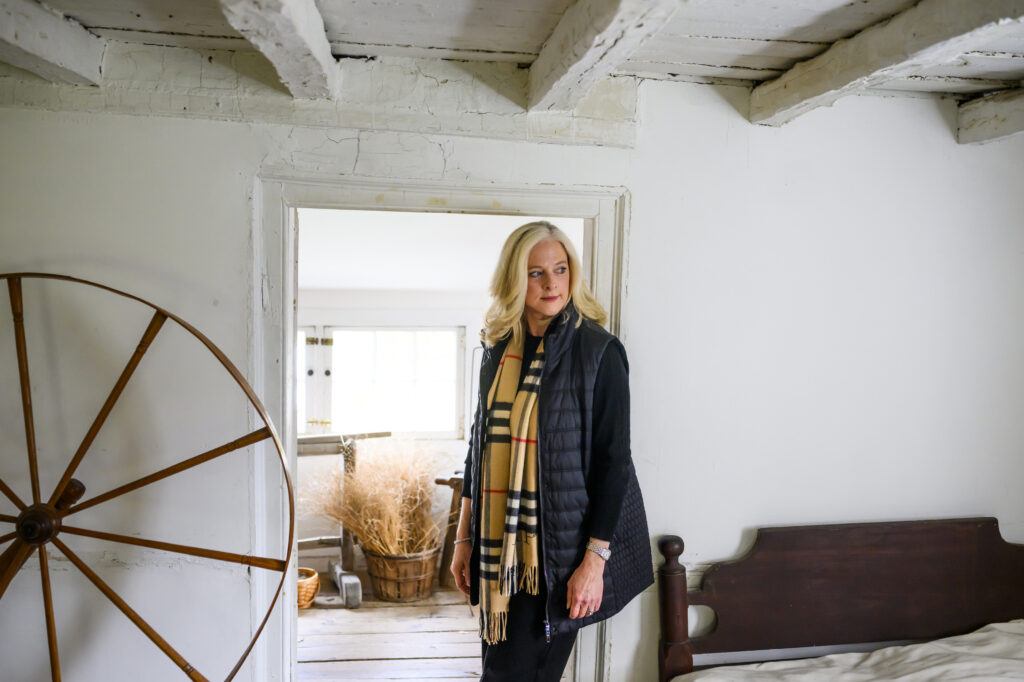
More than anything, the kids couldn’t believe that “GG” once lived in such an old tiny space. As I ducked beneath low doorframes, I loved watching their curiosity take hold as they explored the same uneven rooms that I once called home, now outfitted with rope beds, spinning wheels, and a brick hearth that bring early American life into view.
It took this meaningful visit for me to grasp that it was never about salvaging an old house, it was always about carrying John Ball’s story forward. I left feeling proud that my family played a part in the long effort to preserve this remarkable piece of Arlington’s history.
The post We spent a harsh year in a cold and moldy log cabin. I’m still thankful. appeared first on Washington Post.