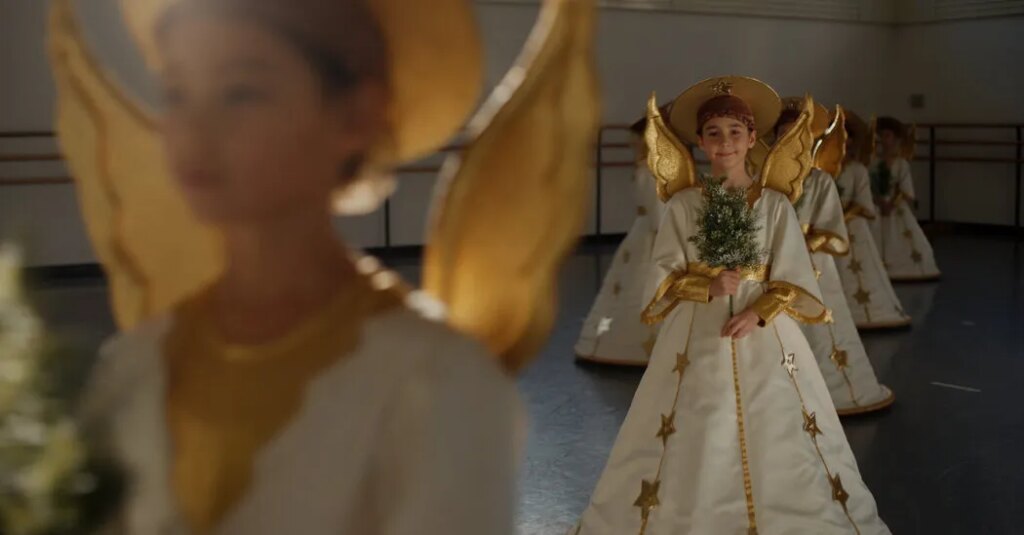
The Angels in “George Balanchine’s The Nutcracker” have many qualities, all leading to a state of the choreographic divine. But to understand her worth, an Angel must know just why she matters.
“Give me three adjectives of what we’re going to focus on while we do our Angel dance,” Dena Abergel, the children’s repertory director at New York City Ballet, said to the assembled Angels on a late October afternoon.
“Don’t walk,” one said.
While accurate — a “Nutcracker” angel must sail across the stage — it wasn’t an adjective.
“Smooth?” another offered.
“Smooth for sure,” Abergel said.
More words started to roll in: Soft. Flying. Elegant. Happy. Floating.
“Floating!” Abergel said, “That’s a good one. How about gliding? It’s those kinds of feelings while we glide across the door. You make the magic, so you have to have magical qualities.”
But, as these young Angels — most are 8 or 9 — know, attaining that sweet spot of efficiency and effortlessness is harder than it looks. For their transporting dance, the magic needs an assist. “The whole thing is counts,” Abergel said in an interview.
This year’s Angels, two casts of 12 each from the School of American Ballet, City Ballet’s feeder school, are making their debuts with the company in “The Nutcracker,” one of New York City’s most revered holiday traditions. (It runs Nov. 27 through Jan. 2.) A Nutcracker comes to life to rescue Marie, a young girl, from a Mouse King. After a fierce blizzard and the Waltz of the Snowflakes, they end up in the Land of the Sweets.
This is where our Angels come in. Theirs is a challenging role full of formations and precise lines that travel on geometric pathways. All the while, the Angels hold miniature Christmas trees. They wear long gowns that sway like bells as they move, strategically grazing the floor to hide their feet. And, yes, they count as if their lives depend on it.
They cover ground not with ordinary steps, but with a shuffling walk that makes it seem they are gliding. “It’s very mesmerizing,“ Makayla Francis, 9, said. “And it is also very difficult. It’s different from walking, because on a daily basis walking requires picking up your feet. Gliding doesn’t.”
It is with solemn concentration that the Angels master the counts to flow through their sweeping formations. There is a touch of Busby Berkeley brightened by the musicality and glow of Balanchine, a master at all things ballet, including choreographing for children.
Abergel sees the Angels as Balanchine’s training ground for dancers to learn “how to count music, how to learn spacing, and formations,” she said. “And how to move in a group, how to create beautiful shapes.”
The formations that the angels create are even more complex than the choreography of the Polichinelles, performed by the school’s most advanced children. Because the Angels have individual counts, meaning they don’t all move in unison, self-confidence is a must. For these celestial beings, Abergel has a formula: Magic plus math equals angels.
“If they don’t turn on their counts, it all becomes blurry,” she said. “It’s like watching a kaleidoscope. If it’s clear and clean and smooth, it really is magical and the audience feels it.”
‘If you mess up, the people behind you mess up’
Paying attention to counts — when to turn upstage or downstage, when to stand in place and how to find precisely where that spot is — is how the stage becomes a glorious moving picture.
Each Angel sets out on her path on a different count. They start in a horseshoe, splinter off into straight lines and break away into two widely spaced parallel rows; next, they peel off for an enthralling center stage cross as one dancer breezes past another. They split off into more lines, two sets of threes in front with six in the back and spin with a sparkle of Christmas tree ornaments.
After the arrival of the Sugar Plum Fairy, danced here by the City Ballet principal Emma Von Enck, the Angels form a diagonal line. It took a chunk of the rehearsal to nail it.
“Something I think is hard about it is the speed,” Navy Valins, 10, said later. “If you mess up, the people behind you mess up. So I think it’s hard to just stay on the right beat.”
Attempts at the diagonal kept going awry. Straight lines took snaky turns with little warning. “It’s like an S,” Abergel said. “We don’t want that to happen.”
It was less a line than a long and winding road. They tried again. “Stop where you are, don’t move,” Abergel said, trying not to laugh. “Girls, how does this diagonal look to you?”
Consensus: Not good. Abergel, lining them up, helped them to see where they should be in space, shoulder to shoulder. “Do you see how one inch in the front makes a big difference in the back?” she said.
Dancing as a group is about feeling those around you as much as seeing them. Abergel introduced the angels to the concept of peripheral vision. “Try this. Look straight front, and how far to the side can you see?”
Something clicked. The line became steadier and more like an arrow. “Who’d thought you’d learn that as an angel?” Abergel said. “Use your eyes. They’re an important part of dancing.”
Teen angels
In 1954 when Balanchine’s “Nutcracker” premiered, the Angels weren’t children but teenage girls and there were eight of them. Suzanne Farrell, a student at the school, made her City Ballet debut as a teenage angel: “We don’t do anything but stand, but I’m thrilled all the same,” she wrote in her diary (and quoted in her autobiography).
In those early years, the Angels didn’t have much to do: They stood at the back of the stage. Victoria Simon, 86, who performed Candy Cane for two years before being cast as an Angel in 1956, doesn’t remember performing any steps. “We did nothing as intricate as what the kids do now,” she said. (Balanchine remade the angels’ choreography in 1962 for young children and he also increased their ranks.)
Marlene Mesavage DeSavino, 86, said that there wasn’t much for Balanchine to demonstrate. “I mean, we just shuffled along,” she recalled. “He said, ‘Make sure that you’re very smooth.’ But we just filed in, we stood across the back of the stage and we watched all the divertissements.”
What no one can forget is the heaviness of the costume. The dresses were made of wool felt and oppressively hot. During one performance Martha Swope, who later became an important dance and theater photographer, fainted onstage. “She just keeled over and they pulled her offstage,” Mesavage DeSavino said. “The costumes were so, so heavy.”
There is a lack of consensus as to whether the Angels were onstage for all of the divertissements, but Janice Cohen Adelson, 89, will never forget being there for one: It happened just before Francisco Monción stepped onstage for Coffee, or the Arabian dance.
“Way up high, very, very high, one of the pipes had a slight leak and the drop fell on my nose,” she said. “And as he made his entrance and saw that tiny drop on my nose, he said, without looking at me, he said, ‘Don’t sneeze.’”
From teens to girls
Gelsey Kirkland, who became a star with American Ballet Theater, played an Angel the first year that children took over. She had nightmares about forgetting the steps, but she persevered. In her autobiography “Dancing on My Grave,” she wrote, “I was flattered that Mr. B delegated me the responsibility of leading the crisscrossing rows of little angels.” Catching Balanchine’s eye, she added, was “an event that would have a profound impact on my coming of age within the world of ballet.”
For Angels, responsibility doesn’t end with counts. Posture is important: Shoulders on top of hips, chests forward, chins up. Knees should be soft. There is also the quality of their movement. Changes of direction can be thorny.
“If you’re late for your count, you might want to go sharp,” Dorothy Lifshotz, 9, said. “But you’re supposed to go smooth even though you might be late.”
What if an angel trips? As Sophia Guo, 8, said, “We have to make sure we don’t walk or run or else you’ll step on the dress.”
Abergel drills the counts forcefully so that by the time the children step onstage, they’re prepared — not stressed or scared. They get it. “It feels, like, amazing to go on the right count because then you know what you’re doing and stuff,” Eloise Rahe, 8, said. “It feels like you are all together doing the right thing.”
They can’t wait to get onstage to feel that blissful angel feeling. “If you’re an angel, you’re up in the heavens, so you’re always happy,” Isabel Skinner, 9, said.
“I kind of feel proud of myself,” Nyla Dempsey, 8, said.
And for Lara Osei, 9, being an angel is a dream come true. “A few years ago, when I was watching ‘The Nutcracker,’ I saw the angels and I was like, ‘Oh, I don’t think I’m ever going to be in this show.’ And now I’m in the show!”
The post In ‘The Nutcracker,’ Magic and Math Make Angels appeared first on New York Times.