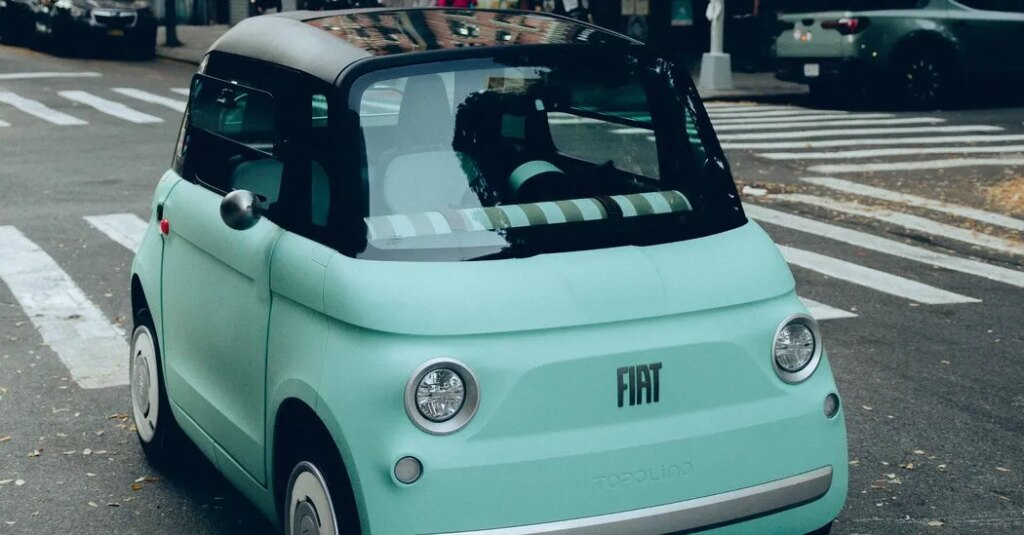
While teeny-tiny cars have long roamed European and Asian city streets, Fiat’s new weensy Topolino models stood out on a recent day in Manhattan. The company had brought the electric microcars to a spot near Grand Central Terminal for some spirited — albeit low-speed — city driving.
A quintessentially Italian brand, Fiat has been struggling in the United States, with employees, dealers and fans hoping that Stellantis, the company’s new owner after the 2021 merger of Fiat-Chrysler and PSA, can turn things around.
Last year, Fiat began offering Americans its decidedly left-of-center Topolino, which was introduced in Europe in 2023. The U.S. version, capable of going but 19 miles an hour, wasn’t legal on public roads. Instead, it was pitched as a kicky bauble for beach dwellers, owners of large properties and residents of private, gated communities with modest speed limits.
Seemingly against the odds, demand exceeded expectations, with unexpectedly strong sales in Florida and coastal enclaves in upper Michigan, according to Andrew Waterhouse, the head of the brand in the United States.
Since then, the tiny machines have become street legal, with a revised top speed of 25 m.p.h. That enables federal certification as Low Speed Vehicles, permitting their use on public roads with speed limits up to 35 m.p.h. “It’s kind of an experiment,” Mr. Waterhouse said. “Will it work in cities?”
A recent test drive suggests it might, for some. The many New Yorkers I encountered during a day’s driving were admiring, bemused or both, yet rarely dismissive. Many asked a single simple and not unreasonable question: What is it?
The Topolino is not exactly a car. Its top speed — easily exceeded by a determined DoorDash delivery person on an electric bicycle — rules out many routes. But it could make sense as cheap, emission-free transport on surface streets, offering spacious if not particularly comfortable seating for two occupants, along with pocketbooks, briefcases or backpacks, plus several shopping bags.
Measuring just 8 feet 3 inches long, the baby Fiat is usefully compact, half a foot shorter than the diminutive but highway-ready, two-seat Smart car, not sold here since 2019 but still out in force on the city’s mean streets. The Topolino’s strong suit is phenomenal parking ease.
The Topolino name, “little mouse” in Italian, reprises one of 127-year-old Fiat’s greatest hits, a small, two-seat car built between 1936 and 1955. Powered by a tiny gasoline engine, the first Topolino would become a familiar sight in the city centers and little villages of Italy and the European continent. Today’s Topolino, classified as a quadricycle, may be legally driven by people 14 and older on moped licenses in Italy, for instance. It has done well in Europe, with more than 75,000 units of the Fiat and its near identical Stellantis twins, the Citroën Ami (introduced in 2020) and Opel Rocks-E, sold, all built in the same factory in Kenitra, Morocco.
While such ubiquity here seems unlikely, the little car has a chance to make waves. Priced at $13,995 plus a $990 destination charge, the Topolino is the cheapest new car sold in America. Of course, the key difference between it and the aforementioned sub-subcompact Smart and a compact Toyota is that they are real cars, the kind you might drive on highways and take on vacation. (Toyota, soon, plans to sell a small Kei pickup in the States.)
The Topolino, meanwhile, is limited by law, horsepower and range to easing not very far down the road.
Tipping the scales at just 1,073 pounds, the Topolino is, far and away, the lightest car on sale in the United States today, barely more than a battery-powered golf cart.
The frequent comparison between the country club crawler and the Topolino is apt, if incomplete. Because while on paper it might seem a glorified golf buggy, the Topolino, costing little more than a high-end cart, has style, with nods to both retro and neo-futurism, and additional function.
The electric Topolino, with just 8 horsepower under the hood, whizzes and whirs enthusiastically but will not chirp its front tires when you floor the accelerator. Yet it will reach 20 m.p.h. from rest in under five seconds, which feels pretty nippy in Midtown traffic.
It will travel 46 miles between recharges, completed by placing its built-in plug into an ordinary 120-volt household outlet. That means no Level 2 or 3 charging stations or high-speed Tesla superchargers, with a full charge from empty taking approximately five hours.
To save manufacturing cost, the vehicle’s two doors are identical pressings rather than mirror images. Thus, while the passenger door is front hinged and swings open toward the front of the car, the driver’s door is rear hinged, opening to the back. The three available colors are all striking: Verde Vita Mint, Corallo Orange and Luna Greige.
Because the Topolino offers unabashed minimalist transport, it’s fair to note some of the things it omits: airbags, regenerative braking, modern crash structures, high-beam headlight setting, heat and air-conditioning, carpeting, adjustable passenger seat, lumbar support, seat rake adjustment, radio, infotainment screens and connectivity, spare tire and wind-down windows. Still, it offers many advantages over a golf cart, including three-point seatbelts, a windshield wiper, an adjustable driver’s seat and, in the closed models with roofs, a measure of security for items left behind, as well as protection from the elements.
(The convertible, Dolce Vita, omits doors in favor of a thick rope, while a new, third model, the Open Air, has the Dolce Vita’s folding canvas roof but adds proper doors.)
In my drive, the vehicle proved perfectly able to keep up with city traffic, aided by excellent outward visibility and an ability to nip into spaces where even the smallest ordinary cars might not fit. It responds with speed and accuracy to steering input and stops well with front disc and rear drum brakes, allowing the urban road warrior in you to jockey for position as the situation requires, all while burning no gasoline. A day of Manhattan driving used just over half its charge.
The ride was fast enough, but so stiff that several times it awakened childhood memories of being dragged along a bumpy sidewalk in a red Radio Flyer wagon. The Fiat has an independent suspension at the front, with semi-independent trailing arms to the rear, so improved ride quality is probably achievable, if Fiat makes adjustments. Cobblestone streets might be better avoided. Also, the standard hardtop’s glass sunroof, which provided an extraordinarily panoramic view of the city skyline, could use a shade, as bright sun was occasionally blinding.
All of which makes the Topolinos we drove, green in every sense of the word, very much short-distance competitors, leisurely sprinters, not marathon runners. In such a role, they can be quite useful, as well as charming, modern yet blessedly analog in a world of tech overload. While others smile and point, a dedicated city dweller with a little bit of patience and a modicum of eccentricity might just make a go of it.
The post The New Itty-Bitty Fiat Is a Nifty Fit for the City appeared first on New York Times.