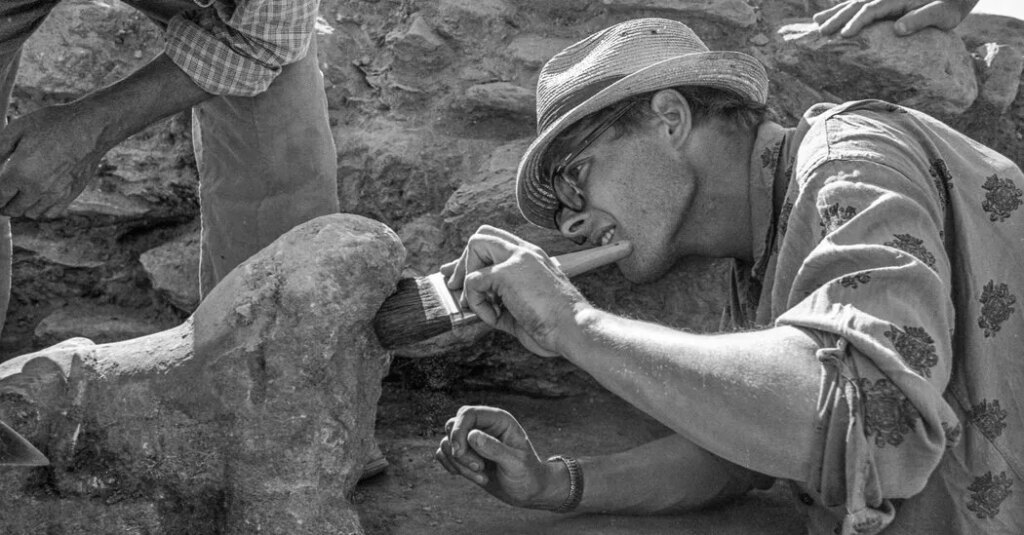
Andrew Ramage, an archaeologist who discovered the world’s oldest known gold refinery while digging near the ancient city of Sardis, in western Turkey, providing strong evidence to support the legend of the unbelievably wealthy King Croesus of the Lydians — often called the “world’s first millionaire” — died on Nov. 2 at his home in Ithaca, N.Y. He was 87.
His children, Joan Ramage Macdonald and Michael Ramage, confirmed the death.
Croesus ruled Lydia from about 585 B.C. to about 546 B.C., holding his own against Greek city-states to the west and the emerging Persian Empire to the east. The Lydians under Croesus were a military power, but also a commercial one, thanks in part to rich deposits of gold found in the region’s riverbeds.
After his defeat by Cyrus the Great and the Persians, Croesus became a near-mythical figure for the vastness of the wealth he had accumulated — even today, we might say someone is “rich as Croesus.”
But whether Croesus was, in fact, the world’s first 0.1-percenter remained a matter of archaeological debate for centuries. So did the claim by the Greek historian Herodotus and others that Croesus had introduced the first gold and silver coins.
In 1968, while he was a graduate student at Harvard, Dr. Ramage joined a dig in western Turkey sponsored by Harvard and Cornell. Working alongside Sidney Goldstein of Harvard and Richard Stone of the Institute of Fine Arts at N.Y.U., he uncovered a structure housing an array of crucibles, blowpipe nozzles, clay basins and traces of gold — the remains of a gold refinery, they concluded, and the oldest ever discovered.
Scholars believe that the refinery, outside the city walls, was a workshop where old coins were recycled into jewelry.
“His excavation and publication of the gold and silver refinery at Sardis gave us a whole new perspective on the production of ancient coins, in a region that witnessed the origin of coinage,” C. Brian Rose, a professor of classical studies at the University of Pennsylvania and a curator at the Penn Museum of Archaeology and Anthropology, said in an interview.
Dr. Ramage went on to a long career at Cornell, where he taught archaeology, and with the Harvard-Cornell Exploration at Sardis, for which he served as associate director. He continued to join expeditions in western Turkey until 2019.
Among Dr. Ramage’s other discoveries was a temple, complete with the remains of an altar for fire sacrifices, and a portion of Sardis’s once-immense city wall — so significantly eroded and covered in earth that other archaeologists had assumed it was just a small hill.
The long-running excavations at Sardis, which include not only Lydian but Greek, Roman and Byzantine ruins, involve 60 to 80 people at a time, an international mélange of archaeologists, art historians and conservators with specialties spanning thousands of years.
Dr. Ramage provided a linchpin for the rotating groups of scholars and laborers, balancing different priorities and projects with a well-honed sense of diplomatic finesse and humor.
“Andrew could talk with all those people,” Nicholas D. Cahill, an art historian at the University of Wisconsin-Madison who runs the Harvard-Cornell Sardis expedition, said in an interview. “He was fabulous with puns.”
Dr. Ramage often worked closely with his wife, Nancy Ramage, an archaeologist who taught at Ithaca College. They wrote “Roman Art: Romulus to Constantine” (1991) and, with the archaeologist R. Gül Gürtekin-Demir, the two-volume “Ordinary Lydians at Home: The Lydian Trenches of the House of Bronzes and Pactolus Cliff at Sardis” (2021).
More than once, reporters asked Dr. Ramage if he was disappointed not to have found the horde of King Croesus itself, like a real-life Indiana Jones. He rejected the idea.
“This offers more of a challenge than admiring the superb finish or awesome weight of the worked products,” he told The New York Times in 2000, “because one can now wonder at the imagination required to bring the unlikely looking raw material to a usable form, and at the skill required to produce gold of an almost perfect fineness.”
Andrew Ramage was born on April 21, 1939, in London. His father, John, was the president of a cloth trade organization, and his mother, Bessie (Appleby) Ramage, taught math at an elementary school.
As a teenager, he joined digs at Canterbury, in England, and at the palace of Knossos on the Greek island of Crete.
After completing a bachelor’s degree in classics and classical archaeology at the University of Cambridge in 1961, he moved to the United States to teach Latin and English at Windham College, a liberal arts school in Putney, Vt.
In 1965, he enrolled in the doctoral program at Harvard, where he met a fellow student, Nancy Hirschland. They married in 1969. In addition to their children Joan and Michael, she survives him, along with six grandchildren; a brother, David; and a sister, Susan. Another brother, Alex, died in 2002.
Dr. Ramage moved to Cornell — in Ithaca, a city named for another famous ancient location — in 1972. He took emeritus status in 2007.
It is unlikely that King Croesus’s gold will ever be found, at least all in one place.
One story holds that when the two foes met after the battle in which Cyrus defeated Croesus, they turned to look over Sardis, which Persian troops were in the process of ransacking, carrying off sacks of gold and silver.
“You have been defeated, and now my men are robbing you,” Cyrus supposedly said.
Croesus shook his head. “No, that is no longer my riches,” he replied. “They are robbing you.”
The post Andrew Ramage Has Died. He Found Receipts for the ‘World’s First Millionaire.’ appeared first on New York Times.