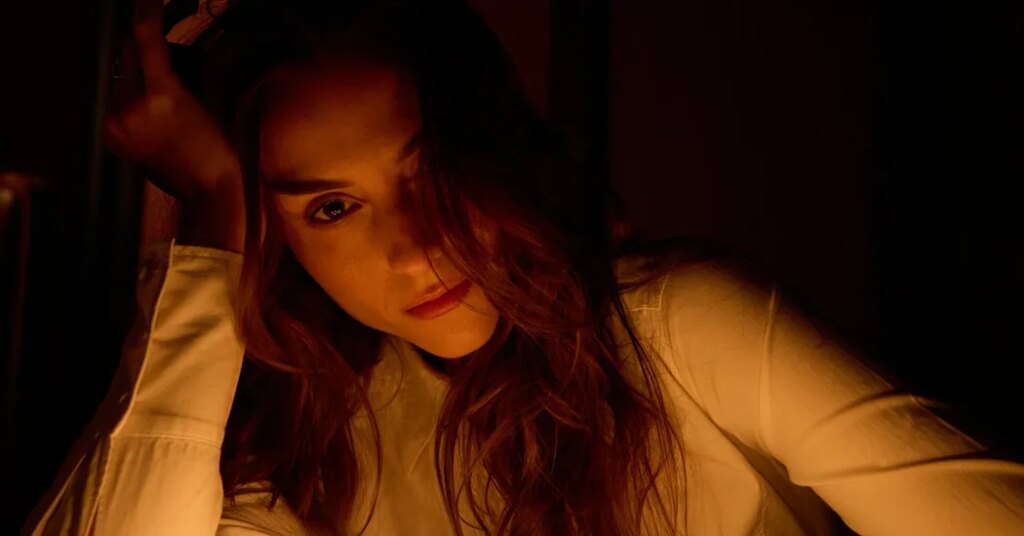
Quinn Shephard doesn’t want to get too mystical about it, but the day before she learned Netflix wanted to revive “The Body,” her long-dead television series, she got a snake tattoo.
Snakes are prominent in the creepy teen drama, and Shephard, 31, had wanted a tattoo of one ever since she first sold the show years earlier. But the series never happened, so neither did the tattoo. Then, in 2024, she decided to get it anyway.
The next day her agents called: Would she consider returning to “The Body” for Netflix?
The coincidence wouldn’t be out of place in the show, in which teenage girls begin seeing signs of the divine all around them. Set at a Catholic high school in 2004, it follows a dance team whose newest member falls into a coma after an initiation ritual. When her teammates claim to have visions of her, they set off a wave of religious hysteria in their town.
Shephard conceived of “The Body” in her early 20s, while living at her parents’ house in New Jersey. An actress since she was 3, she had recently written and directed her first feature, “Blame.” Soon after the film premiered, in 2017, she sold “The Body” to FX, but the network eventually shelved it. Netflix had shown interest, too, but ultimately passed.
“It was like an ex you couldn’t move on from,” she said in a recent video call from her home in Los Angeles. Her parents, visiting for the show’s premiere, were in the next room.
Years later, after developing the true-crime drama “Under the Bridge” for Hulu, Shephard revisited “The Body” with Gina Gammell, who became her co-showrunner. (Felix Culpa, Gammell’s production company with Riley Keough, produced both series.) This time, things moved quickly: Netflix ordered the show within a week or so of the pitch, and they were in the writers’ room two months later.
Now “The Body” has been a breakout hit, topping Netflix’s English-language TV chart with 9.5 million views in its first full week of release. The show has its detractors, too: Some Christian viewers have accused it of blasphemy, and a petition to cancel the series has drawn more than 200,000 signatures. But Shephard, who has long been fascinated by religion, wanted the show to be as playful as it was provocative.
“We’re not saying, ‘Oh, the tragedy of youth,’” she said. “I don’t think youth is tragic.”
“Being a girl is like, you’re experimenting,” she added. “And it’s going to be kind of scary, but it’s going to get better.”
Shephard discussed the evolution of “The Body” and how making the show changed her relationship with faith. These are edited excerpts from the conversation.
“The Body” is quite dark. Was that always how you imagined it?
The original version was much darker. When I first developed it, I was like, I’m making a serious thriller. This was pre-“Euphoria,” pre-“Yellowjackets,” before these more adult-style teen shows became so popular. I remember thinking, Why can’t we reach for the stars? Let’s try to make “Breaking Bad” or “Fargo” with teenage girls.
But you moved away from that.
Yeah. My last show, “Under the Bridge,” was really heavy and really intense. With true crime, it’s hard to tell a story in a way that feels morally right. We tried to be respectful, but at a certain point we were like, “Are we just convincing ourselves that we’ve been respectful?” I think it took something out of our souls. I came out of it feeling like, I never want to work in true crime again. I don’t want to do a dead-girl show.
What did you want to make?
I had this early version of “The Body,” and I brought it to Gina Gammell. We started going through it together and discovered there was a lot of humor in it. Gina encouraged me to embrace that, to dip a toe into satire, and that felt much more natural to me, much closer to my own voice.
You write about teenagers with such affection, even when they’re behaving badly. What draws you to these characters?
Writing about teenagers allows me to write about myself from a bit of a distance. A lot of what these kids are grappling with is stuff my writers and I are going through ourselves. We’re all still figuring things out. It’s just easier to swallow when it’s an 18-year-old being messy instead of someone my age. I hope that’s part of what speaks to an adult audience, too.
Growing up, I didn’t have access to many roles that felt fun or relatable or freeing. But I did work with some directors who made me feel so happy to be part of a project, and that was incredibly empowering. Now I’m like, Try to copy that person when you’re behind the camera.
Who comes to mind?
One of the best experiences I had as an actor was on “The Miseducation of Cameron Post” with Desiree Akhavan. It was my first time doing nudity, and I felt completely comfortable because of how she approached those scenes with myself and Chloë Grace Moretz. I still use that as my blueprint for how to direct intimacy and create a really respectful, peaceful set.
Gina and I are sensitive to the fact that if something feels wrong to the girls, it’s wrong. If a line doesn’t feel right coming out of their mouths, then the line has to change. And if they don’t feel comfortable doing something, they shouldn’t have to.
You’ve described girlhood as a kind of religious experience. What do you mean by that?
Everything is so intense when you’re a teenager. There’s such a parallel between the intensity and worshipfulness of religion and the way you move through the world as a teenage girl.
I was obsessed with religious themes in literature and film growing up. I think I was drawn to that tension between the longing for ecstasy and revelation and the shame that can come with it. There’s something so universal about that in the female coming-of-age experience, and especially in the queer coming-of-age experience, where you’re like, I don’t understand why I feel so drawn to something and yet feel so much shame around it.
Did you grow up Catholic?
No. But I was so fascinated by the culture of Catholicism that I would sometimes wear a Catholic-school uniform to my public school. With a cross.
My dad’s side of the family is very born-again Christian, and I spent a lot of time with them when I was little. I used to go to church with my grandma, who performed exorcisms and talked very openly about demons and the devil. There’s quite a lot of lore there, you know? I was fascinated by all of it, but then I witnessed something that had a big impact on me. It caused quite a rift in my family.
What did you see?
I think it was some kind of play about adultery and people burning in hell. I was 3 or 4, and I came home and told my mom the whole story. She was really upset. My mom went to Catholic school, so she knew what it was like to grow up with Catholic guilt. She didn’t want me to go through that. So she was like, “We’re banning Quinn from going to church.” But once I wasn’t meant to be reading my Little Girls Bible, I was like, What’s in this book that I’m not supposed to read?
Did making “The Body” change how you think about your own experiences with faith and religion?
The show has brought me full circle. I understand why people need religion in a way I didn’t before, and I feel like I can separate the beauty of faith from organized religion. Bizarrely, I think it has healed a lot. I feel better equipped to talk to the more religious side of my family now, because I understand where we align and where we differ. And I’ve never been more well-versed in the Bible. I quote my favorite passages now.
Were you expecting a backlash?
I expected some. I would love for the show to be seen as provocative but respectful. I think a lot of people assume from the marketing that “The Body” is critical of faith. But to me, it’s about how beautiful the desire for faith is, and how corrupting that desire for your own selfish advancement or power is toxic.
It’s funny when people are like, “The show is Satan-worshiping.” The people making this show are too scared to go anywhere near a Ouija board. We’re actually a pretty spiritual, faith-positive group.
“The Body” is about how you shouldn’t mess around with dark energy. Whether that’s because of the biblical devil or because of what inviting in darkness does to the human psyche, I’ll leave up to the audience.
The post ‘The Body’ Came Back From the Dead and Became a Hit appeared first on New York Times.