Was Prime Minister Sanae Takaichi of Japan snubbed during China’s big summit?
That question has dominated the headlines in Japan in recent days, with some officials saying that Beijing intentionally undermined Ms. Takaichi during her visit last week to Shenzhen, China, for the Asia-Pacific Economic Cooperation forum.
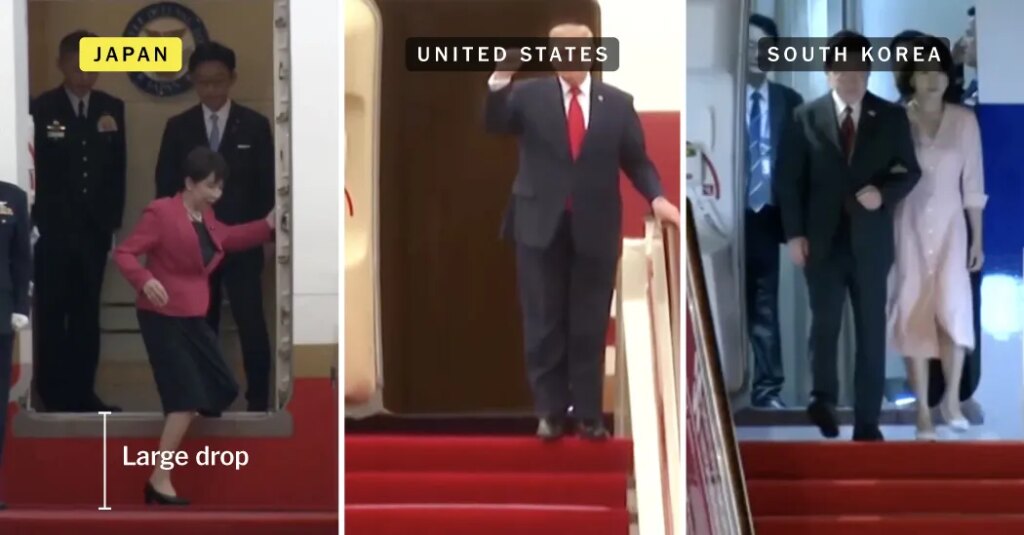
Japanese commentators drew attention to a sizable drop at the top of the stairs that greeted Ms. Takaichi’s plane, which forced her to descend awkwardly. They noted the lack of cheering crowds at the airport, a gesture that was afforded to other leaders. They pointed out that she was met on the tarmac by a low-ranking official.
The scrutiny comes as relations between the two countries are at a low point. China has been at odds with Japan since last year, when Ms. Takaichi suggested that Japan could be forced to get involved militarily in case of a Chinese attack on Taiwan. Beijing considers Taiwan, a self-governing democracy, part of its territory.
Asked about the pared-down welcome, a spokesman for China’s Foreign Ministry, Guo Jiakun, brushed aside the criticism at a recent news conference in Beijing.
“As the host,” he said, “China makes appropriate protocol arrangements for all participants in accordance with international practice.”
The Chinese Foreign Ministry did not respond to a request for comment.
Here is a look at how Ms. Takaichi was received in China, compared with other world leaders.
The Stairs
When Ms. Takaichi arrived in Shenzhen, she faced an immediate problem. There was a drop of roughly 16 inches between her aircraft’s doorway and the boarding stairs. Ms. Takaichi seemed surprised; she gripped the door and proceeded slowly down the first step.
Ms. Takaichi has said in the past that she has rheumatoid arthritis and an artificial joint in her leg. Japanese commentators said the incident posed a safety risk.
“What if the prime minister, who is disembarking in a skirt and high heels, were to lose her footing and get injured?” Yasuhide Nakayama, a lawmaker with the governing Liberal Democratic Party, wrote on social media. “We should demand a proper explanation from the Chinese side regarding the installation of the gangway and the safety checks.”
Still, some officials said it was unclear whether the discrepancy was purposeful, and that it could have been a simple malfunction.
Koichi Hagiuda, an L.D.P. official, said at a news conference this week: “I believe that the host nation, China, did not intend to be disrespectful. It was likely an unforeseen, spontaneous occurrence.”
The Crowds
China put on the pomp and circumstance for visiting leaders. President Trump, President Lee Jae Myung of South Korea and Vietnam’s leader, To Lam, were greeted on the tarmac by boisterous crowds, dancers, bouquets and a flowing red carpet.
But for Ms. Takaichi the crowds were gone, and there was no cheering, dancing or red carpet.
Akio Takahara, a visiting professor at Tokyo Woman’s Christian University who specializes in Chinese politics, said the reception showed that “some in China wanted to tell Takaichi that they didn’t like her and that she’s not welcomed.”
“Japan-China relations are a bit like U.S.-Europe relations: Both sides harbor a psychological complex toward the other side,” he said. “The Chinese — although they are objectively bigger and stronger than Japan — they still aren’t confident enough to get over this complex.”
China’s Foreign Ministry did not immediately respond to a request for comment.
The Greeter
China is known to choreograph every detail of major summits. So it was striking, analysts said, that the government dispatched a relatively low-level official, Zhang Qiyue, a retired Chinese ambassador to Greece, to welcome Ms. Takaichi on the tarmac.
By contrast Xi Jinping was there in person to accept a hug from Mr. Trump, the first time Mr. Xi had personally received a foreign dignitary at the airport as China’s leader. Vladimir V. Putin was met by Cai Qi, a trusted deputy of Mr. Xi’s and one of the most influential members of the Chinese leader’s circle. And Mr. Lee was greeted by a senior official from the Chinese province of Guangdong.
Still, as the APEC meeting got underway, Ms. Takaichi seemed keen to move on. She enthusiastically greeted Mr. Xi at a banquet a few hours later. The two shook hands briefly and posed for photos, their first encounter since the start of the diplomatic feud over Taiwan. They repeated the routine the next morning. After the forum concluded, Ms. Takaichi returned to the airport in Shenzhen, boarded her plane and headed back to Tokyo.
Hisako Ueno contributed reporting from Tokyo, Berry Wang from Hong Kong and Keith Bradsher from Beijing.
The post Was Japan’s Leader Snubbed at China’s Big Summit? A Visual Evaluation. appeared first on New York Times.