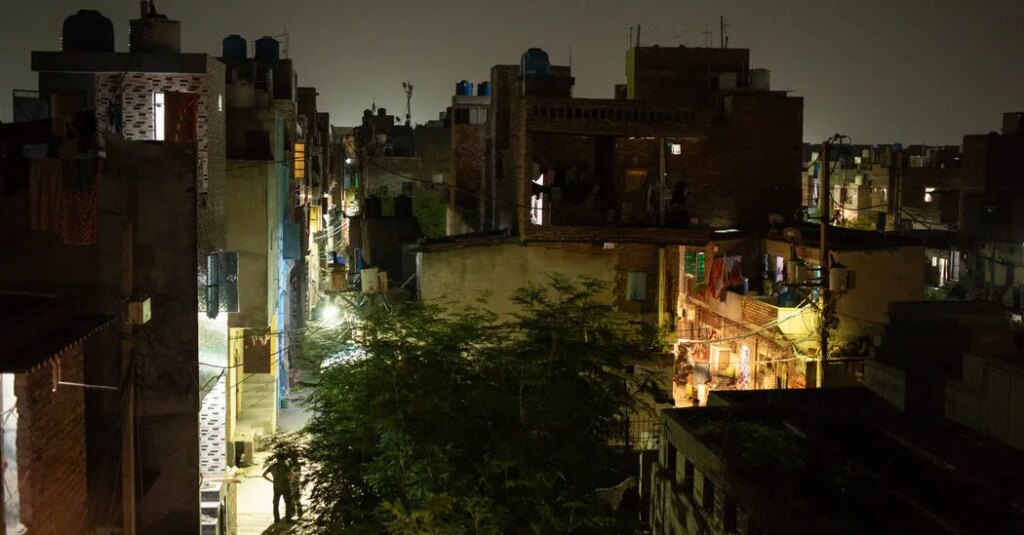
Madhu Kamal Varma, a tailor and cook in the Indian megacity of Delhi, had begun to adjust to its increasingly scorching summers. That was until the day’s heat started to spill over into the nighttime, turning her family’s one-room house into an oven that would not cool down long after the sun had set.
Once, she was rushed to the hospital after feeling suffocated — her blood pressure had plummeted because of the heat. Restless and unable to sleep one night not long after, as the ceiling fan circulated hot air and her two children sweated, Ms. Varma, 38, decided to leave both entrances to their house open. The ventilation brought enough relief for her children to fall asleep while she kept watch. The next morning, she and her husband, Kamal Varma, devised a plan.
From around 10 p.m. to 3 a.m., Mr. Varma, who works as a bricklayer and painter, would sleep while his wife stayed up to guard against break-ins that were common in their neighborhood. He then took over the watch while she rested before waking at 6 a.m. to start her day, making up for lost sleep in the midmorning. They have made the nightly trade-off between sleep and security for the past five summers.
“What can we do? We have to sleep,” Mr. Varma said.
The Varmas are among the hundreds of millions of people in India learning to cope with nights that are no longer guaranteed to bring the mercury down enough to cool their bodies and homes. The difference between the daily maximum and minimum temperatures is shrinking across vast swaths of the country, according to the India Meteorological Department. The weather agency this year recorded the highest mean nighttime temperature nationally for the month of August in 125 years.
To categorize a “warm night,” the department uses certain thresholds: The day’s maximum temperature has to be at least 40 degrees Celsius (104 degrees Fahrenheit) and the minimum between 4.5 and 6.4 degrees Celsius above normal. (Above that and it is classified as a “very warm night.”) Warm nights have been increasing more rapidly than hot days, it said.
Climate change has played a big role in increasing the Earth’s overall temperature — a primary focus as world leaders gathered this month in Antalya, Turkey, for the COP31 climate conference. And this year’s El Niño effect is hitting India especially hard.
But rapid urbanization in many parts of the world has driven nighttime temperatures higher. Mushrooming buildings, roads and other infrastructure — usually made of materials like concrete, brick and asphalt — trap heat during the day and release it slowly at night. Cars and industrial activity generate more heat. Forest cover gets stripped. Growing use of air-conditioning adds to outdoor heat even as it cools interiors. Humidity worsens things. These built-up areas become what scientists call urban heat islands.
Typically, air temperatures drop below surface temperatures around four hours after sunset, transferring heat to the atmosphere and cooling down nights, said Rajan Rawal, an architect and professor at CEPT University in Ahmedabad, who specializes in building science. But urbanization disrupts that process because of the gargantuan amount of heat produced by human activity. Tall buildings also narrow the pathways for daytime heat to dissipate.
“Materials do trap heat, but they do not find an opportunity to lose heat in the nights,” Mr. Rawal said. “And that’s why the nighttime temperature remains high.”
The consequences for India — the world’s most populous country and its fastest-growing large economy — are potentially severe given the scale of urbanization underway. Around 600 million of its 1.4 billion people live in cities and towns, and its urban population is likely to grow by around 200 million by 2050, according to a United Nations report last year.
Not Built for the Heat
Big cities like Delhi — which includes India’s capital, New Delhi, and has about 23 million people — can be several degrees warmer than surrounding areas, studies show. Those in low-income neighborhoods and informal settlements suffer the most, tossing and turning through nights of fitful sleep in poorly ventilated housing. Their fatigue builds up, leaving them irritated or ill, and cutting into their work hours and livelihoods — or preventing them from working at all. Those issues can have lasting consequences on health and wages, even when nights begin to cool down by October.
In July and August, I visited homes in Delhi and spoke to around 20 people, including community workers, researchers and dwellers of informal settlements. I interviewed bricklayers, day laborers, electricians, stay-at-home mothers, security guards, house painters, students and tailors.
Their houses were not built for the heat. They were made mostly of brick and cement, and many also used galvanized metal or tin sheets. The homes had low ceilings and small windows — some no bigger than a sheet of paper — or none at all. The lack of ventilation meant many left at least one door open when they could to let outside air in. Although that would not lower indoor temperatures, “at least it will not build up heat inside,” said Mr. Rawal, the architect.
India’s weather department has warned that warm nights can have a cascading effect that raises the following day’s maximum temperature, which together can increase the heat stress on people because the body can’t fully recover from daytime heat at night.
Sudershan, who goes by one name, lives alone in a windowless, 9-foot-by-11-foot room with a roughly 7-foot ceiling, in Shahbad Dairy, a residential and industrial area in northwest Delhi known for cowsheds and dairy shops. He sleeps on a twin bed and makes a living as an electrician and painter.
When he gets home, he has to wait at least 10 minutes before entering because of the heat it traps. Local authorities have paved the path in front of his house twice, raising it by more than a foot and shrinking his doorway, cutting off more air. By 11 p.m., he is in bed, with the door shut and a fan rigged on a wooden ceiling bar running at full speed.
“Between 2 a.m. and 3 a.m., I wake up because of the heat,” Mr. Sudershan said of the brutal summer months of May and June. He faces a nightly predicament: Should he go back to sleep when sunrise is just around the corner? Sometimes, he whiles away the hours to dawn sitting outdoors. At other times, he manages to go back to sleep until about 6 a.m., when the neighborhood comes to life.
In another corner of the neighborhood, Noor Jehan, a mother of four girls, leaves the door to her house open late into the night. To cool down, she sprinkles talcum powder on herself and her children, bathes multiple times a day and dips her dupatta, or scarf, into water to wrap around herself, but it starts smelling after repeated use. “I feel so revolted,” she said.
Ms. Noor Jehan has taken to switching off her 17-year-old fridge at night because the heat it generated was suffocating. “It feels a little cooler without the fridge on, so the children can also lie down with some relief,” she said.
Women are especially vulnerable. Kathy Baughman, who runs HERA, a climate adaptation nonprofit focused on women, said that women’s bodies suffer more from heat than men’s. Women often carry the physical and mental burden of caring for their families, including cooking and cleaning, and many women also work outside the home.
Ms. Baughman said studies also showed a direct link between excess heat and domestic violence. “The nighttime temperature just throws a flame torch over all of that,” she said.
The Cost of Progress
Delhi’s ability to cool down at night has dropped by 9 percent, according to a study by the Center for Science and Environment, a New Delhi-based think tank. The core of the city cools down 3.8 degrees Celsius less than the areas around it.
Delhi’s frequent heat waves and the urban heat island effect have pushed up sales of air-conditioners. Panasonic, the Japanese electronics manufacturer, said in July that demand in India for its residential air-conditioners had shot up by 50 percent from a year ago. But the more people cool indoor areas like homes, malls and offices with air-conditioning, the more heat the machines release into the atmosphere.
Upendra Thakur, a barber, and his wife, Sunita, a construction worker, live in Sawda Colony, a residential neighborhood in west Delhi. When I visited on July 16, the weather department had recorded an above normal maximum temperature of 39.3 degrees for the day, and a minimum of 30 degrees. An off-the-rack sensor I carried recorded an indoor temperature of 33.1 degrees inside the Thakurs’ house around 7:30 p.m. Outdoors, it hovered around 34 degrees.
As they got ready for dinner with their family, who lived on two upper floors, Ms. Thakur observed how Delhi had changed since she moved to the city four decades ago. “There weren’t as many factories and workshops, there weren’t as many cars, to contribute to the heat,” she said. “But now, there’s more of an impact.”
Inside the couple’s brick-and-mortar room, a bed was pushed against one wall, blocking one of the two doors.
Mr. Thakur reminisced about his village in the state of Bihar, which would begin cooling down after sunset, since open land allowed heat to dissipate faster into the atmosphere. By 10 p.m., it would be pleasant. He observed how progress, in rapidly expanding places like Delhi, often comes at the cost of low-income workers like him.
“Every house has an AC, where is the temperature going to go? Outside,” he said. “Buildings should be built, dirt roads should be paved, but where is the heat generated going to go? Outside.”
The post The Unbearable Heat of Delhi’s Summer Nights appeared first on New York Times.