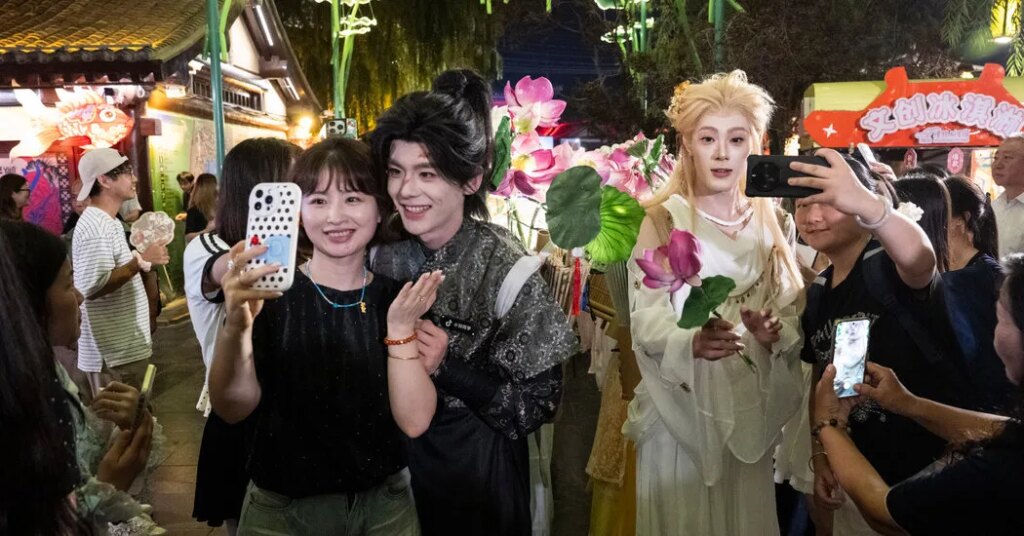
Toned, topless male dancers tear off their robes before sold-out theaters. Costumed actors at theme parks are pinched, pulled and photographed by hundreds of women. Strapping young men race up mountains carrying female hikers in their arms.
Across China, businesses are cashing in on a lucrative new market: women’s enjoyment.
Even as China’s economic growth slows and consumers spend less and save more, women with rising incomes are fueling the entertainment segment of the $1.5 trillion “sheconomy,” a phrase used by the Chinese government to describe women’s spending power.
Women flush with disposable income are pursuing virtual romances with A.I. companions, playing video games that appeal to female romantic fantasies and devouring television dramas and novels featuring women as business tycoons, military commanders and political leaders — characters not traditionally portrayed by women.
Among the fastest-growing offerings are sometimes risqué entertainment services that put men on display. The trend reverses the “male gaze,” in which women are objects of male desire, said Minglu Chen, an associate professor at the University of Sydney who studies gender and politics in China. Now women are paying to admire men.
The spending spree poses a dilemma for Beijing. For years, the government has tried to spur consumer spending to offset a prolonged property crisis. Yet its censors go into overdrive whenever feminism, gender and power become topics of national conversation. The state-owned People’s Daily recently warned businesses against “suggestive flirtation and indecent physical contact” and called for “strict regulation” after a video showing a male actor feeding a lollipop to a woman at a theme park went viral online.
For many women, the attention is long overdue.
“It’s finally our turn,” said Linda Xiong, 32, an office worker who paid $90 to see a performance by the Gonggou Theater, a troupe of toned men in their 20s billed as China’s answer to the Chippendales.
Onstage, bare-chested men in traditional Chinese embroidered skirts writhe to pounding drums as women scream from the audience.
“I found it incredibly joyful,” said Ms. Xiong, who is single. She noted that the show’s tickets had sold out in seven seconds. (She counted.)
“Whether in the past or modern times in China, wasn’t it always a group of beautiful women dancing for men?”
The show is so popular that, according to its founder Junyi Ge, most of its performances in the past 15 months have sold out. A discussion forum about the show on Douyin, TikTok’s Chinese sister app, has racked up more than 2.1 billion views.
“It has to be sexy, powerful, dripping with testosterone,” Mr. Ge said in a video interview with an online influencer. “That is our secret weapon.”
Theme parks are also realizing the power of the female gaze. Online job advertisements seek “sunny, handsome and outgoing” young men to pose for photographs and play interactive games with visitors. Some positions pay as much as $4,500 a month, more than six times the average monthly income of the country’s urban residents, with no degree required.
Tour operators at some of China’s most famous mountains are hiring tall, muscular young men to wear matching uniforms, promoting them as “security guard boy groups” to draw tourists. Other young men work as freelance hiking companions, providing fresh fruit, cheering women along and sometimes carrying exhausted clients uphill in their arms.
Driving the boom is a generation of increasingly affluent, educated urban women shaped by three decades of China’s one-child policy.
Official statistics show that the proportion of women among first-year undergraduates has risen about 20 percentage points over the past two decades. The gender wage gap has also narrowed to 13 percent from 23 percent over the past seven years, according to reports by Zhaopin, China’s biggest job recruitment platform.
Businesses are selling what is called “emotional value” services — or feel-good experiences — to women who are more financially independent than their mothers and grandmothers.
The success of these services “reflects dissatisfaction and also maybe disenchantment with romantic relationships in real life,” said Kailing Xie, an associate professor at the University of Birmingham who studies gender and society in China.
It exposes a mismatch, she said, between women’s growing economic power and men’s slower acceptance of female expectations for intimacy in relationships.
Chenglin Liu, 21, discovered an opportunity while struggling to make ends meet as a waiter. He started charging female hikers $100 to $150 to accompany them on six-hour treks up Mount Tai in eastern China. His social media account was widely followed after he and three other guides carried a woman who had lost a leg to bone cancer all the way to the summit.
But hiking up and down the mountain as often as three times a day battered Mr. Liu’s knees. He traded the trails for a job as an actor at a theme park in Kaifeng, a central Chinese city.
Now, he spends 90 minutes applying makeup to transform himself into an ancient scholar or warrior. He poses for photographs with, on some days, 200 visitors, most of them women.
For the men, the work can be rewarding, too.
“People come here to have fun — I naturally want to provide them with the emotional value they’re looking for,” said Ren Jisen, 23, an actor working at another theme park in Kaifeng.
Mr. Ren said he enjoyed the praise and compliments from visitors — attention he rarely received in previous jobs.
But the interactions can be “a bit awkward and uncomfortable,” he said, especially when women pinch him or ask him to rest his chin in their palms for photographs.
“We are just strangers,” he said.
Such encounters have elicited scrutiny. The People’s Daily called them vulgar and “borderline clickbait traps” in condemning the video that showed the actor in Shangrao, in south-central China, passing lollipops from his mouth to visitors’ mouths.
Theme parks across China responded by banning physical contact between actors and visitors, according to Xueying Wang, marketing manager at Wansui Mountain Martial Arts City where Mr. Ren works.
“Part of it is just the state constantly policing the boundaries of what the entertainment industry can do,” said Hanzhang Liu, an assistant professor of politics at Florida State University. She compared the crackdown to earlier restrictions on suggestive clothing worn by female workers.
What’s more, birthrates in China are plunging and the government has responded in part by promoting traditional roles for women in the family.
The government, Ms. Liu added, “may be particularly allergic to these kinds of consumption patterns.”
Still, demand is not slowing.
The Wansui Mountain theme park employs more than 1,500 actors and actresses and attracts more than two million visitors a month.
“Many visitors come specifically to interact with the actors,” said Ms. Wang, the park’s marketing manager. “People nowadays want to pay for emotional experiences.”
This shift goes beyond live entertainment. In popular television dramas with female leads, women run businesses, command armies and wield political power.
But consuming fantasies of female power is not the same as possessing it, said Ms. Chen, the University of Sydney professor. The changing gaze “does not alter women’s position in family, workplaces and the political sphere.”
Melissa Yuan, 32, sees that distinction clearly.
On a recent visit to Mount Tianzhu, near her home city of Wuhan, she reached the summit and found a line of handsome young men in sunglasses and blue-and-black uniforms. They had been hired to pose for photos with tourists.
The sight made her smile. Ms. Yuan has paid good-looking men to accompany her while shopping or eating, but she does not think such transactions change the balance of power between men and women.
Even when she is paying men to entertain her, she still “habitually and subconsciously” worries about their feelings.
“In my experience, consumption doesn’t directly translate into power,” Ms. Yuan said.
Jiawei Wang contributed to research.
The post In China, the ‘Female Gaze’ Is Driving a New Entertainment Boom appeared first on New York Times.