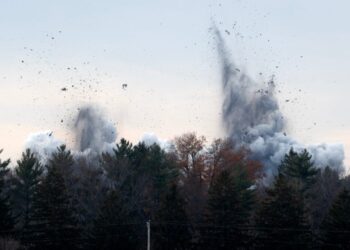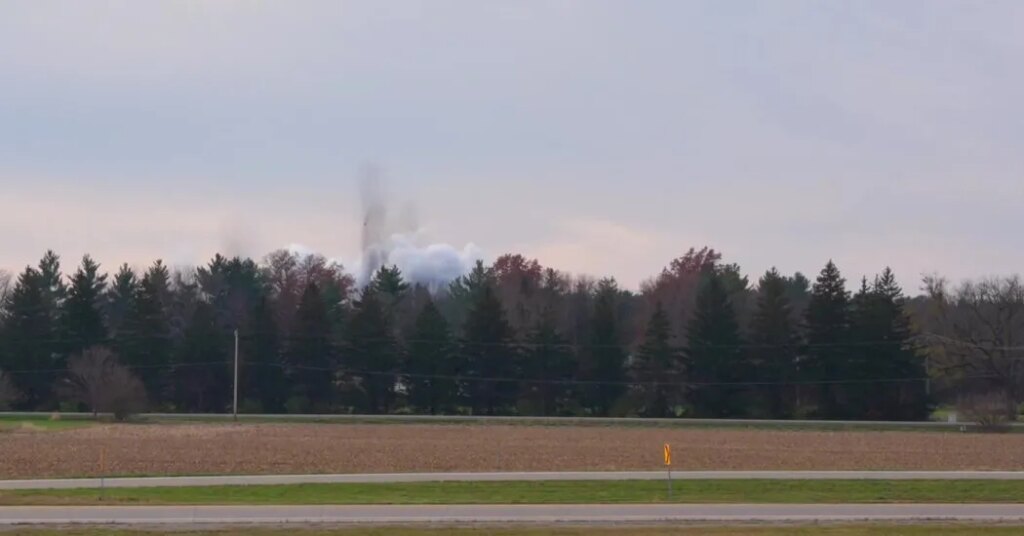
A plume of gray and white smoke rose hundreds of feet over southeastern Iowa on Wednesday morning after the U.S. Army detonated a stockpile of unstable explosives, triggering a tense wait across the region to see whether toxic lead dust had escaped into the air.
The blast at 9 a.m. local time at the Iowa Army Ammunition Plant in Middletown sent a deep boom rolling across the countryside. Reporters watching from a half-mile away saw debris fly into the air from the concrete bunkers that held the explosives. The detonation rattled windows for miles and echoed like dull thunder across small towns whose residents had been ordered to evacuate their homes or seal themselves indoors.
The Environmental Protection Agency said initial monitoring suggested that toxic dust had not left the blast site, and Army officials said their mitigation efforts had succeeded, though the blast did damage the bunkers, as expected. Maj. Gen. Eric Shirley, commanding general of the U.S. Army Sustainment Command, said he “would characterize the controlled detonation as exceeding expectations.”
“There was no secondary explosions,” he said in a livestreamed briefing. “There was no kickout.”
President Trump hailed the operation. But the Environmental Protection Agency administrator, Lee Zeldin, told CNN that the federal government still needed time to thoroughly assess any fallout.
Initial E.P.A. data posted online Wednesday showed real-time readings from just four air monitors equipped with lead sensors, a fraction of the broader network of air-sampling locations the agency said would track contaminants around the plant.
It was unclear if officials deemed the operation a success based on those four monitors or if they had additional information. When asked about the findings, the agency’s press office said it was “short staffed with the holiday and obviously very busy responding to queries about Iowa.”
Some of the mitigation efforts came only after a public outcry and a court challenge kept the Army from moving forward with initial plans to set off the detonation last Friday. The military had removed the metal blast doors to the bunkers in preparation by then.
On Wednesday, Mr. Zeldin confirmed that the government had layered on extensive precautions after public pushback delayed the detonation. He told CNN that the White House chief of staff, Stephen Miller, had taken charge of the effort and that agency heads were on phone calls in the middle of the night on Saturday to figure out ways to reduce the risks of a lead-laced plume.
Those additional measures included installing an array of water tanks and a wall of foam aimed at blocking lead dust from escaping, the acting Army secretary, Adam R. Telle, said.
The last-minute mitigation steps further unnerved critics of the federal government’s handling of the situation, which they called chaotic and lacking in transparency.
Rob Sand, the Democratic governor-elect of Iowa, said in a statement on Wednesday he was grateful to experts who made the detonation as safe as possible. Still, “the lead-up to the detonation should never have been so chaotic and unclear,” he said. “Iowans across the state are understandably alarmed and scared. There must be immediate transparency to understand how and why this situation became what it did.”
The operation was the culmination of years of bureaucratic delays around disposal of roughly 10,000 pounds of degrading lead azide, an unstable compound used to spark military detonators. The volatile chemicals had sat in earth-covered concrete bunkers since at least 2009. Army officials said they discovered in March that the that the contents of the barrels had deteriorated so severely that they could not be safely moved or even opened. Freezing temperatures, they said, threatened to fracture the crystals and trigger an unplanned explosion.
As independent scientists fanned across the region to conduct their own tests of the air and soil, military officials were going door to door on Wednesday, checking on residents who live near the Army plant. Drones were launched to investigate the blast site.
“It just went, boom, boom!” said Linda Ross, who lives about a mile away. “The windows rattled and the dogs started barking.”
She and her husband planned to stay inside for 24 hours to avoid exposure before going out to check on their chickens.
In Mount Hamil, Iowa, in the plume’s path, Gavin Thompson worried about the well at the house where he lives with his grandfather. The 27-year-old had secured two flats of water from Walmart the night before the blast.
“That’s the only thing we’re worried about,” he said of the well. “If that gets contaminated, what do we do?”
There is no safe level of lead exposure. The metal can affect nearly every organ system. Lead mimics calcium in the body and can cross the blood-brain barrier, jamming nerve signals and interfering with normal brain function and development. This can lead to loss of memory and vision, and cognitive and behavioral problems.
Lead is most dangerous for young children, whose bodies absorb more of it than adults, and it can affect behavioral and cognitive development. In pregnant women, it can cause miscarriage and premature birth.
Before settling on blowing up the stockpile, the Army had considered using chemicals to neutralize the munitions, which could have avoided a blast plume. But officials ultimately found that handling the explosives created an “unacceptable risk to human safety,” they wrote in regulatory documents.
Instead, military engineers rigged the two tennis-court-sized bunkers with roughly 3,000 pounds of C4 explosive charges. That created a combined blast force equivalent to 6,000 to 7,000 pounds of TNT. The water tanks used to mitigate fallout held more than 120,000 gallons. Layered foam blocks and two feet of fire-suppressing foam sat over containment screens and tarps, and misting units saturated the surrounding air and soil.
Even so, the Army’s pre-blast models showed that a plume of fine lead dust could drift southwest across 150 square miles and roughly 350 farms, reaching Clark County, Mo., 50 miles away, and potentially stretching up to 100 miles to the northeast.
A New York Times review of public documents showed that if the Army’s mitigation measures were to fail, far more toxic material could be released.
Officials urged residents within five miles southwest of the plant to evacuate their homes and warned those within 20 miles to shelter in place, shut off heating and cooling systems, and keep doors and windows closed for 24 to 48 hours.
Health officials emphasized that, despite the metal’s toxicity, a brief encounter with airborne lead dust is “rarely a medical emergency,” according to Dr. Dan McCabe, medical director of the Iowa Poison Control Center.
The greater concern is long-term surface contamination if lead settles onto soil, playgrounds and leafy crops, said Murray McBride, an emeritus professor at the Cornell College of Agriculture and Life Sciences. He said the heavy metal was unlikely to penetrate edible corn and soybeans or enter meat and milk. The Army has pledged to clean up any soil contamination exceeding federal thresholds.
Still, for many residents across the rural landscape, the assurances did little to ease the sense that they had been left at the mercy of the wind.
In Mount Pleasant, Iowa, about 19 miles from the plant, state officials recommended that farmers bring livestock indoors. On her family farm, Jill Holler, 51, looked out at her cattle, their breath misting in the cold air as a few tilted their heads back at her. There was nowhere for them to go.
“They’re going to stay out here,” she said.
Ms. Holler and her husband, Marcus, had worked until 2 a.m. days earlier to finish harvesting their soybeans and paid to test their soil for base line lead levels. Until last week, Ms. Holler had never attended a protest, let alone organized one. But frustrated by what she saw as a lack of notice and transparency, she created a Facebook event, printed signs and drove to Middletown to demonstrate outside the Armed Forces Reserve Center. It felt, she said, “like they were trying to rush and hope nobody says anything.”
At dusk the night before the blast, Ms. Holler watched the sun set behind a gauze of clouds, casting the rolling pasture in a mauve glow. Though her farm appeared just outside the projected plume path, the wind kept shifting.
“You don’t want this beauty to be tainted by toxins,” she said.
Jesus Jiménez, Maia Spoto and Ann Hinga Klein contributed reporting from Iowa, John Ismay from Washington, and Nina Agrawal from New York.
The post After Extraordinary Iowa Blast, Officials and Scientists Assess Fallout Risks appeared first on New York Times.