Landing in the valley surrounding Paro, Bhutan, after a two-hour flight from New Delhi was disorienting.
The Indian capital had been heaving with people, noisy with bleating car horns, blazingly hot and chokingly polluted. Paro, home to Bhutan’s international airport, was sparsely populated and eerily silent, the air pristine and the weather uncannily temperate.
We were in Bhutan on a family trip — me, my husband, our 6-year-old daughter and my 88-year-old father — spending five days in the tiny Himalayan kingdom.
I had thought of Bhutan existing as if behind a scrim, somehow beyond the imprint of contemporary life and visited by only the most seasoned and well-heeled travelers. After all, some of the world’s most luxe hotel brands, Six Senses and Aman Resorts, each have five locations in a country that is only slightly larger than Maryland.
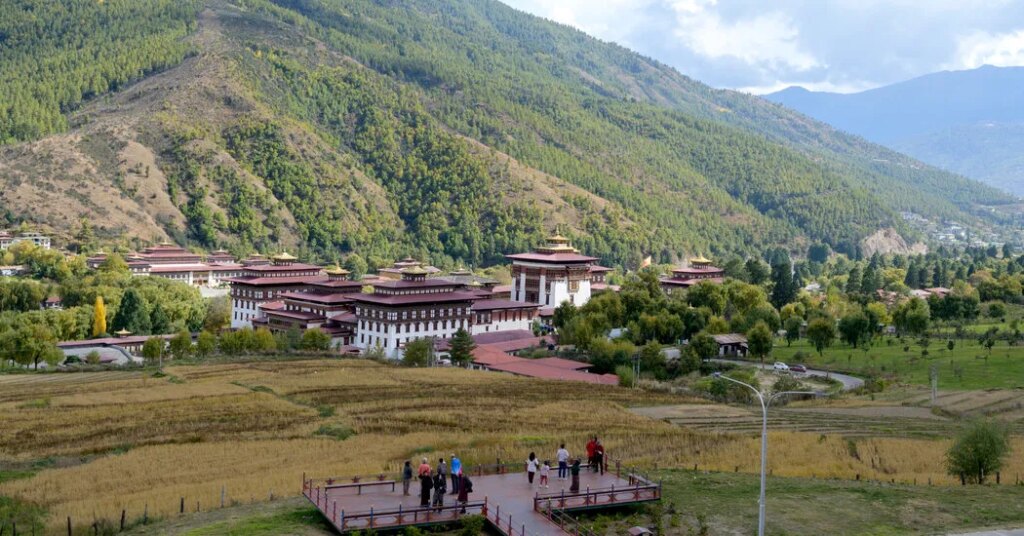
The Bhutanese monarchy has long encouraged the country’s image as isolated and unchanging. It mandates a dress code for its citizens and an architectural one for buildings. While working for the government or in tourism, Bhutanese men are required to don the knee-length, robe-like gho with long stockings, while women wear the kira, a patterned, ankle-length skirt, accompanied by a short jacket. And most of the nation’s buildings follow a distinct Himalayan architectural style characterized in part by colorful, ornate woodwork around windows and doors.
During our hour-and-a-half drive from the airport to the capital, Thimphu, the country looked as timeless as I had expected. We crossed from the verdant Paro Valley into the equally lush Thimphu Valley, connected by a sinuous river. Tiny homes resembling Swiss chalets dotted the side of the wide basin.
Then, looking out the car window, I noticed a woman hunched over her phone as she worked in a roadside rice paddy. Whenever we entered a temple, I found Buddhist monks in traditional vermilion robes reading their mantras from the screens of their phones, and locals make digital payments through QR codes at most stores and restaurants.
The embrace of technology represents a remarkable transformation for a kingdom once determined to keep modernity at arm’s length. Among the last countries to admit television and the internet, Bhutan allowed both in 1999, followed by cellphones in 2003.
A New Kind of Tourist
Until recently, the government’s strategy encouraged what it calls “high-value, low-volume” tourism, by requiring visitors to book through agencies registered with the government and charging a daily tourism fee that rose as high as $200 in U.S. currency per adult traveler. That kept visitor numbers low and ensured that only wealthy travelers would make the journey.
But starting in 2022, it allowed travelers to book their trips independently (although they still need a credentialed guide when visiting tourist sites, such as temples, monasteries and forts) and then slashed the daily fee in half.
The change in rules has drawn new budget travelers like Alene Yang, 32, from Shanghai. She said she decided to come to Bhutan with her boyfriend, an Israeli citizen, because the visa process was now straightforward for them both and the financial burden had been lessened. They had found a hotel for $30 per night and were planning to stay only two nights.
We, too, were part of that new wave, encouraged by the lower daily fee. Unlike Ms. Yang, we used an agency to book our travel, with everything paid for in dollars. I was thrilled to finally experience a country I’d understood to be steeped in Buddhist tradition and that is rapidly — albeit belatedly — welcoming the 21st century. My husband, too, had long wanted to visit Bhutan, and in particular, looked forward to climbing the mountain trail leading to the Tiger’s Nest monastery.
We spent the first night at the Namgay Heritage Hotel, located in central Thimphu. It was also reasonably priced at $45 a night. The next morning we visited the Royal Takin Preserve in Motithang, with our guide Jigme Yeshi, who accompanied us for the duration of our trip. The preserve is a sanctuary for wildlife unique to the upper Himalayas such as yak and the mythical-looking takin, described by Jigme as having the body of a cow and the head of a goat. My animal-enthusiast daughter was delighted to encounter creatures she would unlikely find elsewhere.
Beyond ‘Gross National Happiness’
Today, Bhutan’s creative class — artists, chefs and filmmakers — are forging a new modern identity, including shying away from the country’s emphasis on what it called “gross national happiness,” an answer to the idea of measuring a country’s success by its gross domestic product. The metric became a byword for the nation itself, much praised by think tanks and journalists.
These days, the index appears a bit cynical, obscuring a reality that includes a youth drug problem and a struggling economy that has sent many young people overseas, with Australia as a particular draw. Not one person mentioned gross national happiness to us — though we did hear a few times about Gelephu Mindfulness City, a special economic zone in the country’s south, set up to encourage foreign investment.
After the preserve we headed to lunch at Project ZZA, a wood-fired pizza restaurant opened by the restaurateur and chef Jamsel Gyaltshen in 2019 after he returned from New York City, where he’d spent seven years working and studying. “Pizza has always been a thing of mine,” said Mr. Gyaltshen, 33, who’d worked at Café Boulud and Mission Chinese, both in New York, after attending the Culinary Institute of America.
Mr. Gyaltshen described his pizza as somewhere between a New York slice and a Neapolitan pie. While there are a couple of other longstanding pizza joints in Bhutan’s capital, he noted they cater more to local tastes. He strives to make his pizza as authentic as possible, sourcing mozzarella and tomatoes from outside Bhutan. At first, Mr. Gyaltshen tried to use sourdough and char the crust, but it didn’t go over well with his local clientele and he abandoned that approach. “I take a lot of extra steps to get what I want,” he said.
The restaurant was filled when we arrived. My daughter devoured the pizza with mushrooms that arrived on our table, immediately declaring it “delicious.” Two Korean business travelers enjoying their margherita pie next to us said they’d been happy with the array of food options — burgers, Korean cuisine and Japanese ramen — they found in the three weeks they had been in Bhutan on a project bringing artificial intelligence data centers to Gelephu Mindfulness City.
After more sightseeing, we headed to Giku-Na Village, an 18-month-old cafe opened by the Australian Carolyn Hamer-Smith and her Bhutanese husband, Kinzang Chhogyal, whom she met in the country when she worked at the United Nations two decades ago. The clientele, as well as the menu of pork tacos, tofu bowls, harissa eggs and bagels, was cosmopolitan.
That night, sticking with the theme of visiting restaurants opened by Bhutanese who’d left the country and returned, we went to Solé, a year-old Italian restaurant, for dinner. The 34-year-old chef, Sonam Dema, spent nearly a decade working in restaurants in Milan, then came back to Thimphu to open her chic, well-appointed restaurant in the Bebena neighborhood, where she grew up. “I wanted to be closer to my family and what I was familiar with,” Ms. Dema said.
Solé’s menu showcases a fusion of Bhutanese flavors and Italian classics, like a revelatory yak ragù, made with fresh pasta and yak meat simmered for up to six hours. “The yak was so tender, and the flavor kept reinventing itself in the best way,” my husband said.
The next day, we traveled back to Paro, where we toured the National Museum of Bhutan, housed in a cylindrical watchtower built in the 17th century. There, we learned how the country first came together in the 1630s when Ngawang Namgyal, a Tibetan-born religious leader known as Bhutan’s unifier, brought rival fiefs under one government.
After a visit to the seventh-century temple Kyichu Lhakhang, built soon after the introduction of Buddhism to the region, we drank iced matchas at Your Café, tucked within the renovated 500-year-old Neyphug monastery and overlooking bright green paddy fields. Started by a revered Buddhist lama, the monastery was constructed with pounded earth that is typically used in older buildings.
The Climb to Tiger’s Nest
No trip to Bhutan is complete without visiting the 17th-century Paro Taktsang, or the Tiger’s Nest, a monastery perched some 3,000 feet above Paro Valley. The hike to the monastery, which takes up to six hours to complete, is Bhutan’s biggest tourist draw, yet even this iconic sight has seen changes in recent years.
When Bhutan closed its borders during the pandemic, the government took the opportunity to refurbish, expanding a teahouse at the midway point and replacing the dirt path with flights of stone stairs to ease the climb from the teahouse to the monastery.
A stomach bug I’d brought from India had sapped my energy, so my daughter and I rode horses to the teahouse, where we waited for my husband and Jigme to return from the top. She played with the resident dogs while I drank a cappuccino and gazed up at the monastery on the cliff above.
The atmosphere at the teahouse was lively, as travelers, including a large group on a work retreat from India, stopped for a bite and a drink before continuing their ascent. Others like me and Ms. Yang, the budget traveler from Shanghai, waited for their companions to return from the second half of the trek.
My husband returned nearly three hours later, exhilarated from the mountain air and from his visit to the dense warren of sacred temples. While the monastery looks like one structure from below, there are actually four main temples open to visitors in addition to a series of caves, one of which, according to legend, held the tiger that gave the monastery its name.
My husband spotted at least a couple dozen monks deep in prayer, reinforcing the sense of the Tiger’s Nest as a living monastery rather than as a monument to Bhutan’s past.
Horses aren’t allowed on the descent, so we all walked down the mountain together.
It was our last night, and we spent it at a hotel called Amba Paro ($410 a night), which features circular structures reminiscent of Bhutan’s historical forts, called dzongs. The hotel sits in a valley below the Tiger’s Nest, and we sat on the lawn drinking masala tea and eating pakoras as the majestic monastery stood sentry above us.
Anita Jain is a writer and editor in Brooklyn.
Follow New York Times Travel on Instagram and sign up for our Travel Dispatch newsletter to get expert tips on traveling smarter and inspiration for your next vacation. Dreaming up a future getaway or just armchair traveling? Check out our 52 Places to Go in 2026.
The post The New Bhutan: Wood-Fired Pizzas and Monks With Cellphones appeared first on New York Times.