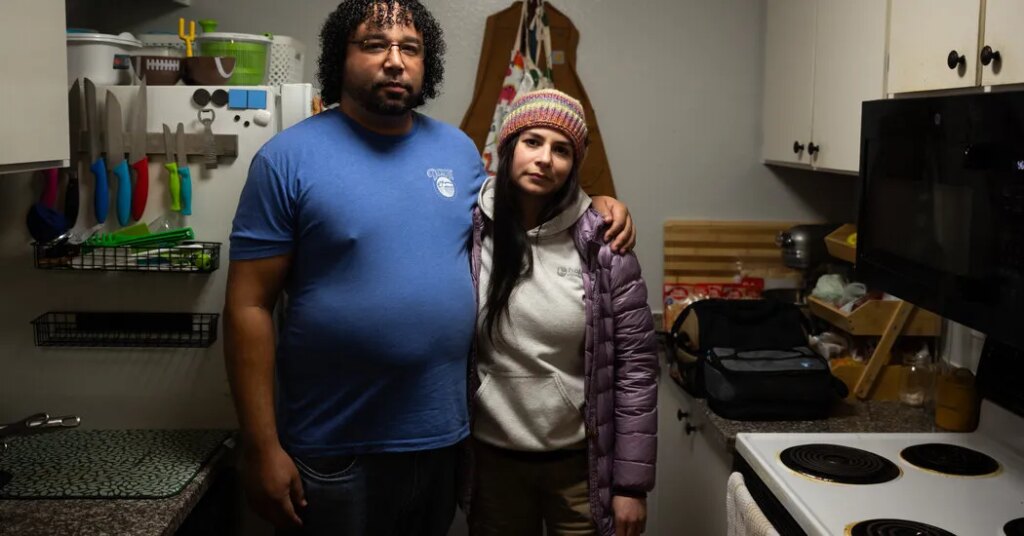
For Austin George, the first hint that something was wrong with the economy — beyond the typical bumps — started during his girlfriend’s job hunt this spring.
It took months before Jessica Marmolejo settled for a pay cut from what she had earned at a dentist office and accepted a position at a lighting warehouse.
The couple delayed purchasing a house and held onto their down payment as a financial cushion to help them weather punishing inflation and uncomfortably high prices.
No matter how sturdy the economy might appear on paper, Mr. George, 41, who lives in Fairfield, Calif., with Ms. Marmolejo and their eight-year-old son, believes the country is in a recession — or barreling toward one.
Economic indicators show quite the opposite. The nation’s economy grew at an annualized rate of 4.3 percent from June to September, the highest in three years, figures released Wednesday show. But such macroeconomic figures don’t reflect the experiences of Mr. George or many others who registered their dismay with President Trump and his party earlier this month at the polls.
To people like him, the more relevant number on Wednesday was 3.8 percent. That’s how much consumer prices rose in October from a year earlier, according to the latest Personal Consumption Expenditures price index released by the Commerce Department, and it marked a pickup from September’s 3.6 percent annual pace.
“The warning lights are blinking,” Mr. George said. “I think we have reached the tipping point and things could get ugly real quick.”
The country is far from a recession, which economists define as is two consecutive quarters of negative growth measured by real gross domestic product. Yet a clear majority of Americans — about 61 percent across political parties — believe the United States is in a recession, according to a Harris Poll conducted for the Guardian in October.
For those Americans, the word simply captures the persistent pessimism they feel about their personal finances and future.
Unemployment is low at 4.1 percent and consumer spending has remained solid, although in October, the pace stalled out once adjusted for inflation, Wednesday’s numbers indicated.
But the economy’s strength is not equally distributed. Many high-income households are thriving with a rising stock market while lower-income households tread water or fall behind. And, the economy is vulnerable to cost of living pressures, government spending and growth tied to the artificial intelligence build out.
The divergence suggests there are two economies, one for the elite and one for the rest.
That was made all the more stark by the saga of Jensen Huang, the billionaire chief executive of Nvidia, one of the major technology companies in the artificial intelligence boom. He was reinstated less than two weeks past his resignation after admitting to an affair with a woman whom U.S. officials had identified as a Chinese intelligence asset.
“It all points to an economy working for the rich and selling out the average American,” said Mr. George.
This is not the first time the public has declared a “vibecession” despite metrics showing otherwise, most recently during the Biden presidency.
“You and your family struggling might suggest that it’s an individual level experience,” said Erin Hatton, a professor of sociology at the State University of New York at Buffalo who studies the labor market, “but by calling it a recession, they’re saying, no it’s not just me. They are pointing to how widespread it is and that it’s a structural issue.”
After enduring more than a year of stiff trade tariffs and shocks related to the war in Iran, many Americans have lost faith.
They view the slashes they made to their household monthly budgets as an indicator of a personal recession. They fret over planning for the future when so much feels out of reach. And they remember the stress of past recessions — the short pandemic-induced downturn of 2020 and the financial crisis that began in late 2007.
The new macro data doesn’t reflect the real-world mismatch between slow wage growth and increasing expenses. Almost half of Americans struggle to pay for at least one of their basic needs, a recent study by the Pew Research Center found. Nearly three-quarters of lower-income adults reported difficulty covering the cost of basic necessities such as daily transportation, housing, groceries or health care.
Don Crafton, a longtime Democrat who switched to the Republican Party and supported Mr. Trump in the last two presidential elections, questioned the statistics projecting a healthy economy.
What he knows for sure is the $3,500 that he and his girlfriend bring home in pay each month is just enough to get by. But not much more.
To Mr. Crafton, describing the economy as in a recession or headed that way, seems beside the point.
“The economy is terrible. Everything is expensive and it doesn’t have to be that way. We live paycheck to paycheck,” said Mr. Crafton, 56, who works in a school district maintenance department and lives in Belle Vernon, Pa. “We don’t go without, but we can’t put any money in the bank for if something happens.”
Financial pressure, along with fear of a recession, has forced Americans to rethink their spending.
Spencer Smith, 39, a company manager for a Broadway show in New York City, said he began thinking a downturn might be imminent after watching the impact of the tariffs and war on the economy.
He began preparing for a “worst-case” scenario by cutting monthly costs and building his savings to cover about six months of living expenses.
That meant delaying a nonemergency foot surgery that could include out-of-pocket physical therapy fees. He decided against taking a vacation to Mexico City planned for January. He swapped pricey Uber rides for the subway. And he dialed back on dining out where the tab can easily top $100.
“I am asking myself the question that I think Americans are all asking themselves: Is this something that I need to do or is this something that I can reduce in order to save money?” he said. “I am now in a budget mind-set.”
When Democrats take control of Congress in January, many voters say they are expecting them to advance an ambitious agenda to lower costs by ending the Iran war, reversing tariffs and undoing much of the president’s signature domestic policy law, including cuts to Medicaid and food aid, and tax cuts for the rich.
Mr. Smith said he was also hopeful Democrats would reinstate expired health insurance subsidies under the Affordable Care Act.
“I don’t want to see a food fight in the party arguing over who is the most right on some issue,” he said. “It’s time to get some stuff done and try to help people who are suffering.”
Megan Irving, 51, a psychotherapist who lives on the Oregon coast, is convinced that parts of the country are already experiencing a recession based on some economic forecasts and what she sees firsthand at her grocery store.
Routine shopping, she said, tells a different story than what the top lines suggest.
“I am shopping and I see lots of calculators and coupons and moms telling their kids to put something back because they can’t afford it right now,” she said. “This feels like a recession or something close to it. It walks and talks like a recession.”
Kitty Bennett and Sheelagh McNeill contributed research.
The post The U.S. Isn’t in a Recession. Try Telling Many Americans That. appeared first on New York Times.