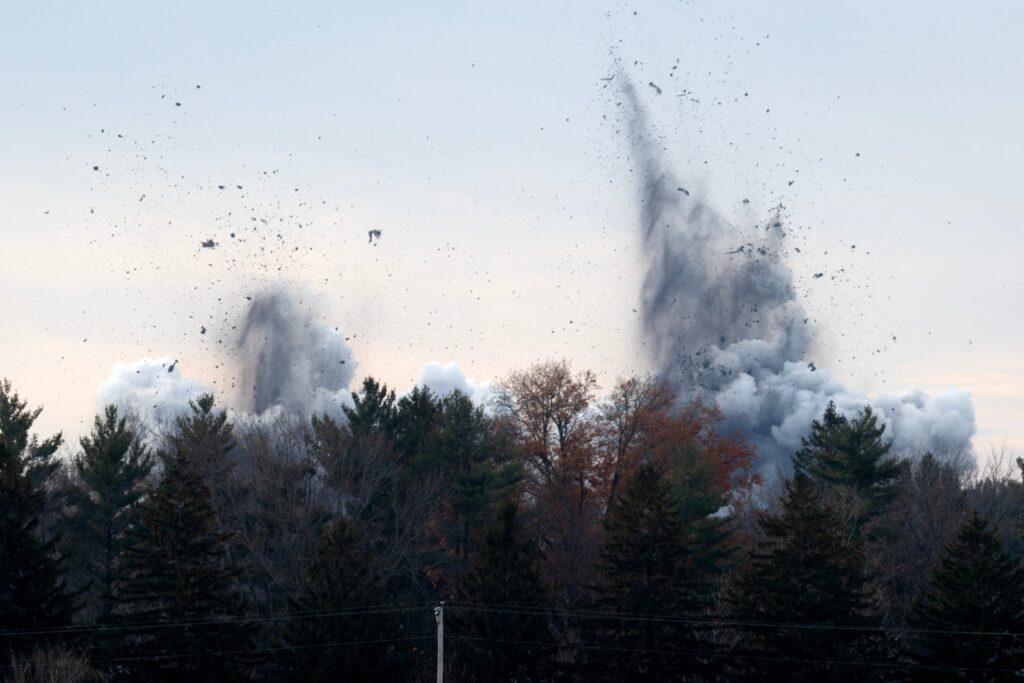
The Army detonated nearly 10,000 pounds of degrading lead explosives in Iowa on Wednesday morning, an operation that led to evacuations and sparked contamination fears across the state.
In a post on Truth Social, President Donald Trump said early reports indicated that mitigation measures intended to prevent the spread of pollution had “far exceeded expectations.”
Data posted to an Environmental Protection Agency monitoring site also indicated that no lead had been detected at four air-sampling stations southwest of the plant in the 30 minutes after the blast.
The Army said the detonation, originally scheduled for last Friday, was the only safe way to dispose of its stockpile of highly reactive lead azide, which would otherwise pose a risk of spontaneous explosion. But it was pushed back several times amid a legal challenge and outcry from residents and local officials who feared a resulting plume of toxic lead dust, which Army models suggested could extend as far as dozens of miles away.
Ultimately Iowa’s governor and a federal appellate court gave approval for the detonation, which the Army said would be carried out inside the earth-covered magazines where the explosives were stored. Television video crews captured the blast at approximately 9:03 a.m. local time.
With light winds blowing amid freezing temperatures on Wednesday morning, any lead particles from the explosion were projected to drift southwest across acres of farmland and into Missouri. Lead is a potent neurotoxin for which there is no established safe level of exposure.
All residents of Middletown, Iowa, where the Iowa Army Ammunition Plant is located, and those within a five-mile cone southwest of the plant were advised to evacuate from the area.
Middletown Mayor Rodney Johnson lives about a mile from the detonation site and works about eight miles from it. Johnson told The Washington Post that he has full confidence in the Army’s plan to detonate the lead azide in a way that doesn’t harm people or property.
He reported to work on Wednesday as usual, and he said many of his constituents in the roughly 320-person town did the same.
“There’s absolutely nothing to be concerned about,” he said. “They have taken every precaution.”
Iowa Gov. Kim Reynolds (R) declared a disaster emergency for Des Moines County, where Middletown is located, and nearby Lee and Van Buren counties.
Before the operation, Reynolds outlined plans for federally activated Iowa National Guard troops to assist with outreach to roughly 150 households in the area. The soldiers went door to door, Lee County Sheriff Elliott Vandenberg said in a news release.
The Army has said it discovered in March that the 68 barrels of degraded lead azide, a chemical used to make munitions, had become unstable. But documents reviewed by The Post show that contractors at the plant sought to neutralize the hazardous material nearly six months before that.
On Nov. 15, the Army announced plans to perform a controlled detonation of the highly reactive waste, prompting outcry from local residents over short notice of the Army’s plans and the risk of adverse health effects from potential exposure to toxic lead dust.
According to the Centers for Disease Control and Prevention, lead exposure can cause damage to the brain and nervous system, slowed growth and development, and learning problems. Pregnant women and children are especially at risk from the element, which can linger in the environment for years.
In court filings over the weekend, Col. Aaron C. Teller, commander of an Army Explosive Ordnance Disposal unit, said the material poses an immediate threat to human health. The lead azide has started to crystallize, increasing the risk of a spontaneous explosion, particularly as the weather changes and the temperature drops. Officials say they have no choice but to detonate the materiel.
“Inaction is no longer an option,” Maj. Gen. Eric Shirley, who is commanding the operation, said at a news conference Tuesday.
The Army said it had taken steps to mitigate the dispersal of lead particles and dust, using weather modeling, water barriers and misting systems designed to contain the blast and limit the spread of lead particles.
On Monday, President Donald Trump said he ordered the Army to halt detonation plans until the Army had secured approval from a federal appeals court, which blocked the Army’s EPA permit Thursday to consider a lawsuit from environmental groups, and Iowa Gov.-elect Rob Sand (D).
A federal appeals court lifted the temporary block on the Army’s permit for the operation Monday. In a post to X, Sand said the Trump administration “should make this decision based on the information they have from the people they brought in to do the job months ago and have been on the ground in Middletown for weeks.”
Reynolds issued a statement supporting the plans Monday.
“I believe, based on the information I’ve been given, that the danger is immediate, and I trust the Army will do everything in its power to protect the people who could be affected,” she said.
The post Army detonates lead-based explosives in Iowa appeared first on Washington Post.