I have never been a hardcore libertarian when it comes to surveillance cameras. We’ve long since gotten used to security cameras watching us not just in a bank lobby or at an ATM, but on street corners and in stores, bars, restaurants and all kinds of other establishments. I’m annoyed by the speed cameras in Washington, but that’s mostly because they think 10 miles above the speed limit is ticket-worthy, when it’s just the default speed of most area drivers.
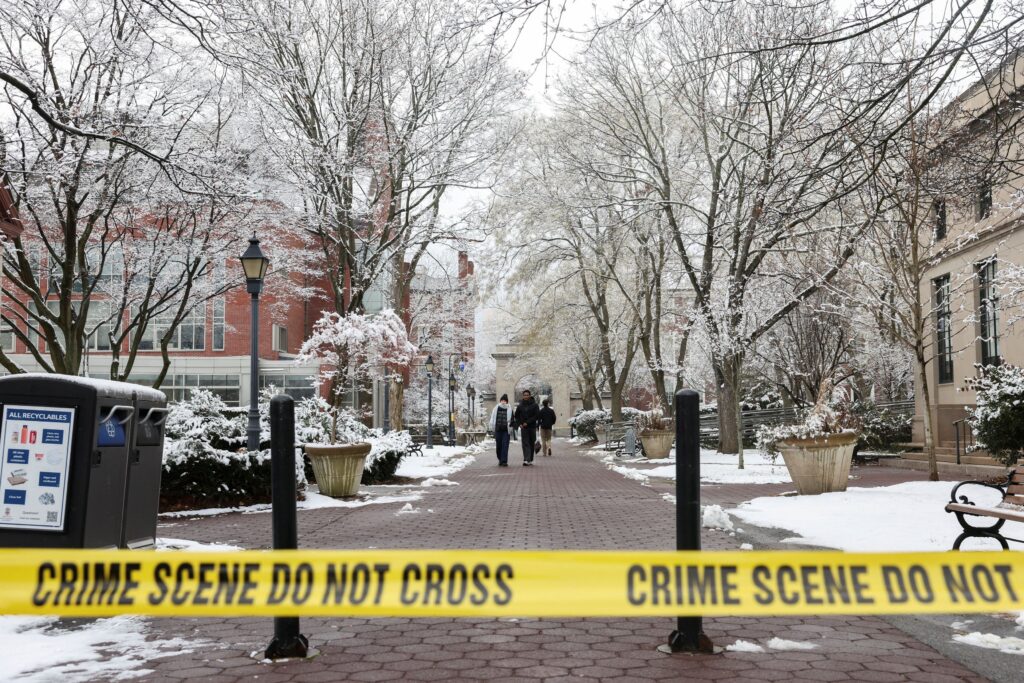
But there’s something weird and unnerving about the situation with surveillance cameras in the recent horrific shooting on the Brown University campus in Providence, Rhode Island.
On Saturday afternoon, some malevolence-minded individual brought either a very long gun (as described by one eyewitness) or a 9mm handgun onto a college campus and covered his face. He entered Room 166 in the Barus and Holley building, where students were wrapping up a final exam review session for Econ 110, the “Principles of Economics” course.
And he went on a rampage, firing more than 40 rounds, killing two people and wounding nine more. According to a statement from Brown University president Christina Paxson released Sunday, one student remains in critical condition.
Apparently there were no police or campus security around to confront or even follow the shooter as he left the scene. He left little or no clue to his identity or motive, and as of this writing, he is still at large.
And apparently, the entire time, he managed to avoid his face being captured by any surveillance camera.
Authorities did release images of a person of interest from surveillance footage outside the building, but the suspect isn’t facing the camera, is wearing a hat and has virtually nothing distinguishable about him. (Hey, everybody at the Blaze, no need to rush on naming anyone based upon “gait analysis.”)
On Sunday, authorities announced that a person who had been taken into custody was being released and was no longer a suspect. At a news conference late Sunday night, Providence Mayor Brett Smiley said, “At this time, we have no additional actionable information from the video that has been reviewed from the building. And so we are looking for new and additional video evidence … The video that was released was the corner of Hope and Waterman Streets. If you are in that area and you have video, you have home video, ring camera, security camera, you’re a small-business owner, please reach out to us. Call that number 401-272-3121.” The FBI is also welcoming tips in the investigation.
State Attorney General Peter Neronha said during the news conference, “If there was a piece of video where we could show you a face and say this is our person of interest or suspect, you’d have it.”
Now, if your gut reaction is that an Ivy League campus must have security cameras all over the place, your instincts are correct. Back in 2021, John Wrenn, then a fifth-year doctoral candidate at Brown, wrote in the school newspaper, the Brown Daily Herald, that the school was becoming obsessive in its surveillance.
“Since 2017, my friends and I have marked the locations of approximately 150 surveillance cameras on College Hill,” Wrenn wrote. “While this is only a fraction of Brown University’s more than 800 cameras, the scope of the surveillance is staggering: It is impossible to cross (or even approach) Brown University without being surveilled. I encourage you to try.”
Apparently, the shooter figured it out.
At Sunday night’s news conference, a reporter asked the sort of question on the mind of anyone who’s ever gotten a camera-based ticket: “In a state where somehow if you have a speeding ticket and a Flock camera or some other speeding camera can capture you, how you can have a position where there’s hundreds of cameras in that immediate [area], maybe thousands … how is it possible not to have any other evidence surrounding this?”
Neronha responded, “There just weren’t a lot of cameras in that Brown building … The reality is, it’s an old building attached to a new one … We’re not holding back video that we think would be useful.”
Again, this doesn’t make a ton of sense, as old buildings can have new security cameras installed. And while the Barus and Holley building is on one edge of campus, you would figure that no matter which direction the shooter fled in, he would have passed by at least one camera that could have gotten a glimpse of his face.
The failure of the university’s system of surveillance cameras to generate more useful leads is a frustrating and infuriating wrinkle in an already frightening situation. And it raises the question: If a network of security cameras can’t offer much help in a situation like this — why do we have them in place?
The post An infuriating wrinkle in the Brown University shooting appeared first on Washington Post.