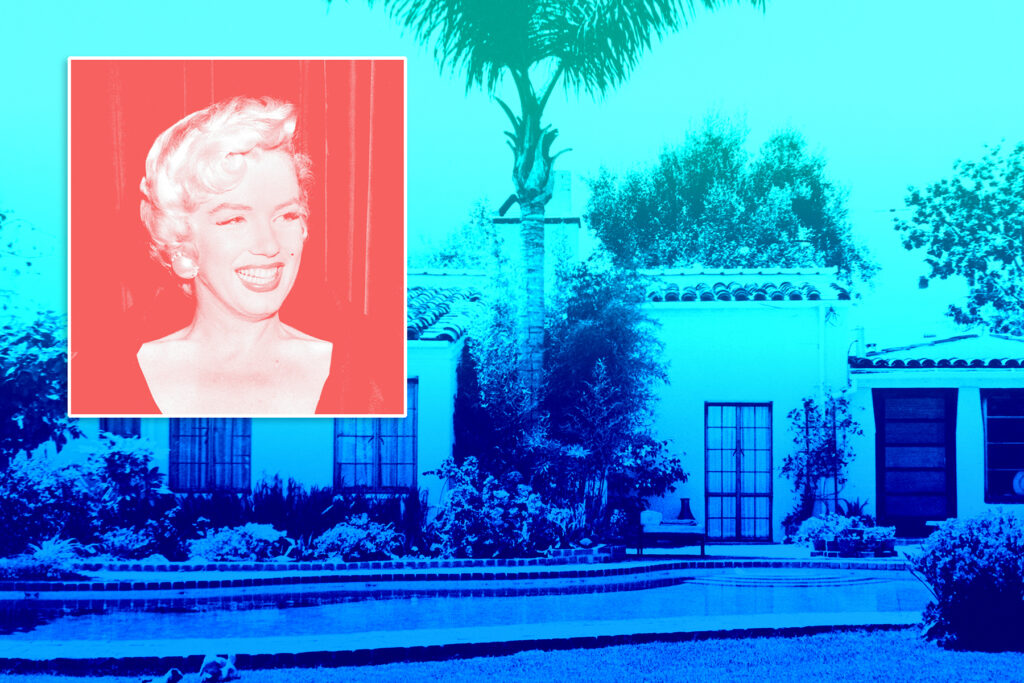
For most Americans, Marilyn Monroe’s legacy can be found on the silver screen or in Andy Warhol’s pop art prints. For the Los Angeles City Council, though, Monroe is immortalized by the now-dilapidated house where she lived for about six months before she died of a drug overdose at age 36 in 1962.
In 2023, Brinah Milstein and Roy Bank bought that Los Angeles house, which is next door to theirs. They planned to tear it down and build a new one. The house, 94 years old and vacant since 2019, was in disrepair. After buying the property, they applied for permits from the city and were approved for demolition.
But after the approval, the City Council decided the house was actually a historic cultural monument because of its brief association with the movie star. Los Angeles revoked the building permits and placed the entire property under the protection of the city’s historic-preservation law.
At face value, the connection to the life and death of one of America’s most famous pop culture icons might justify the monument designation. It’s the house where Monroe died, and the only one she ever owned. But Monroe only lived on the property for a short period. Her primary and legal residence was in New York.
Beyond that, the house is architecturally unremarkable; the city doesn’t even know who the architect was. And it isn’t as though the building has remained unchanged since 1962. The city has granted permits for the property more than two dozen times, allowing the 14 previous owners to make substantial changes without ever objecting on the grounds it was a landmark. When the city approved Milstein and Bank’s plans in 2023, it did so following a 30-day period when anyone could object. No one did.
It wasn’t until after the city issued its permits that the City Council approved a motion to consider a monument designation. Traci Park, a member of the City Council, held a press conference dressed as Monroe to gin up support. She incorrectly claimed that the interior of the house, which she had never seen, bore Monroe’s personal touches. Milstein and Bank say there is “not a single artifact” relating to Monroe at the house.
Perhaps Milstein and Bank should have known better than to buy a house Monroe once owned. But it’s hard to blame them, since the city had more than six decades to declare it a monument and hadn’t bothered.
Milstein and Bank sued, saying their constitutional rights had been violated. If the city wants to make the house into a public monument, that’s fine. But the Fifth Amendment says private property cannot “be taken for public use, without just compensation.”
As things stand, the house is run-down and unrentable. There are large holes in the roof. Even to repair the damaged features of the house, Milstein and Bank need approval from the city’s historic-preservation commission.
Los Angeles argues that it didn’t take any property for public use. It didn’t authorize the public to enter the house, and the city isn’t forcing Milstein and Bank to do anything with the real estate. A federal district court judge ruled in favor of the city in September. Milstein and Bank are appealing to the U.S. Court of Appeals for the 9th Circuit.
Los Angeles’s blasé attitude toward the property is almost worse than if the city had plans to do something with it. The City Council gets to pat itself on the back for preserving a historic house, even though the public can’t actually visit it. The property is separated from the street by a wall, and the house is hardly visible. Milstein and Bank also offered to pay to move the structure and create a publicly accessible museum in exchange for the restoration of their property rights. The city refused.
Historic preservation can be a form of asymmetrical legal warfare. A small group of motivated people can persuade politicians and bureaucrats to make a designation. Putting one in place is easy; removing it is hard. The only people likely to be truly upset about it are the property owners.
Tinkering with preservation laws could help protect property owners from abuses, but the simplest way to ensure that governments focus on important historic landmarks is to require them to compensate the owners. If Los Angeles had to pay Milstein and Bank, it would have taken more care in determining whether Marilyn Monroe’s former house was worth preserving. Fortunately, the remedy is right there in the Fifth Amendment.
The post L.A. drags Marilyn Monroe into a property rights fight appeared first on Washington Post.