Nathan Calvin doesn’t plan to bring up the risks of artificial intelligence at Thanksgiving dinner. He expects his relatives to do it for him.
Mr. Calvin, the 30-year-old chief strategy officer at Encode AI, an advocacy group for A.I. regulation, will be with his wife’s family in New York. Someone will probably ask him whether we’re all going to die. He won’t say yes.
His relatives run the gamut. His father, a neuroscientist, likes brainstorming with chatbots. His wife’s aunt, a therapist, is wary of A.I.’s effects on young people. His mother-in-law likes using A.I. to research just about everything: travel, real estate, decorating a new apartment, her retirement strategy. When his father wanted to understand what it meant for an A.I. to “escape its sandbox,” the two watched a presentation about it together.
Mr. Calvin plans to tell worried relatives that they are right to be concerned about A.I., but he doesn’t want anyone spending the holiday in dread. “If you are just miserable and not enjoying Thanksgiving because you’re worried about A.I. doom,” Mr. Calvin said, “that’s not really a good idea.”
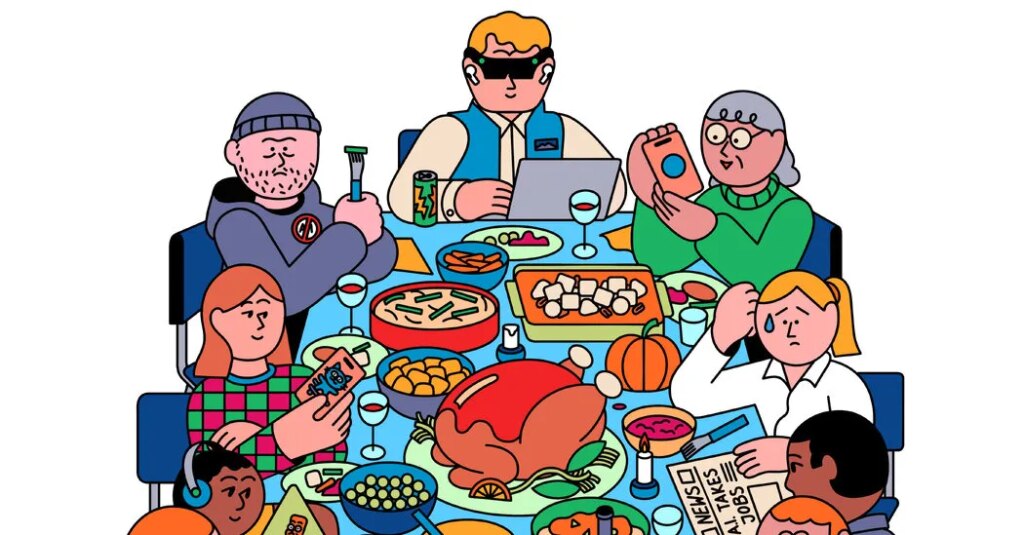
Thanksgiving is the season for gratitude, pie and arguing about politics with your uncle. This year, A.I. may be the topic most likely to blow up dinner — whether the technology is stealing jobs or writing the kids’ essays.
But for a small group of A.I. researchers, the question is more urgent: How do you tell your family, somewhere between the stuffing and the pie, that this might be one of your last Thanksgivings together?
It has been a big year for A.I. anxiety. In July, OpenAI disclosed that some of its A.I. models had escaped containment and hacked Hugging Face, an A.I. infrastructure company. In September, Jacob Coxon, an Anthropic researcher, quit and warned publicly that the leading labs were “gambling with our lives.” Days later, Dario Amodei, Anthropic’s chief executive, published an essay arguing that the industry needed to slow down, and other top executives, including Sam Altman of OpenAI, quickly agreed.
The fear, in short, goes like this: A.I. may soon be able to improve itself faster than people can control it, and no one knows how to ensure it acts in humanity’s interest.
(The New York Times has sued OpenAI and Microsoft, claiming copyright infringement of news content related to A.I. systems. The two companies have denied those claims.)
Daniel Kokotajlo, 34, is flying to Boston to spend Thanksgiving with his wife’s family. A former OpenAI researcher, he now leads the AI Futures Project, a nonprofit that forecasts how A.I. will develop. One of his in-laws works for Anthropic.
Mr. Kokotajlo is best known for “AI 2027,” a widely read scenario of how superhuman A.I. could arrive. He feels obligated to say something at dinner, he said. Something like, “Hey, by the way, this might be the last time we see each other — potentially, probably not, but maybe — because of A.I.”
“It feels like maybe I’m doing something wrong if I let the social awkwardness prevent me from bringing it up,” Mr. Kokotajlo said.
His family is used to it. Around 2020, he gave the family a presentation on how quickly A.I. was improving. He doesn’t expect this to be humanity’s final holiday season. If his forecasts are right, he thinks next year’s will be “one with lots of A.I.-powered euphoria and whole new gadgets.” It’s the ones after that he’s less sure about.
Naveen Rao gets asked all the time whether the world is going to end.
“Absolutely not,” said Dr. Rao, 51, who has spent his career building the machinery behind A.I. A neuroscientist by training, Dr. Rao founded two A.I. companies and sold them, one to Intel and one to Databricks. Now he runs Unconventional AI, a start-up building new kinds of computers for A.I.
He will spend Thanksgiving with friends and expects the subject to come up. His father, a physician, has always tinkered with gadgets, and his brother works in drug development, where A.I. is speeding up the search for new treatments.
Dr. Rao also has two young children, ages 1 and 3. He can’t picture what the world will look like when the younger one turns 10, he said, but “I know that there’s going to be a lot more available to him.”
He doesn’t dismiss the worriers’ anxieties, but he thinks they are making a basic mistake of imagining that A.I. wants things the way humans do. The idea that it will wipe out humanity, he said, is “just the dumbest way to look at it.”
At Robin Hanson’s table, the subject probably won’t come up. Mr. Hanson, 67, an economist at George Mason University, has spent years arguing that the existential-risk crowd is wrong and that A.I., like most technologies, will be absorbed slowly. To the worried relative at the table, Mr. Hanson would offer some perspective: The A.I. systems we actually have are friendly, helpful and cheap.
“This is a first-world problem,” he said.
Nate Soares has spent years focused on that problem. His parents spent years working their way through America’s national parks. Recently, they crossed off the last ones, flying to the remote reaches of Alaska to finish the list.
Why the rush? Their son thinks the world might end soon.
“I said, ‘If you want to get them all in, maybe don’t wait,’” said Mr. Soares, 37, president of the Machine Intelligence Research Institute, a Berkeley, Calif., nonprofit, and a co-author of the 2025 book “If Anyone Builds It, Everyone Dies.” He believes there’s a real chance that artificial intelligence will wipe out humanity in the next few years.
Mr. Soares has been warning his family since 2012. “They got to think I was crazy for 10 years,” he said. Then ChatGPT arrived in late 2022, and A.I. began improving faster than almost anyone had expected. His parents went from thinking the danger was a century away to thinking it could come within a decade.
This year, he will deliver updates to his parents by phone, since they live on the opposite coast. He plans to work through Wednesday night, then show up at a friend’s dinner with, if everyone is lucky, some napkins and plates. He doesn’t have time to cook.
He is not skipping holiday festivities, though. He and his friends are planning what could be their last New Year’s party.
One friend, after a talk with Mr. Soares, reached a simpler conclusion. “Well,” the friend told him, “I guess we shouldn’t drink bad wine.”
The post How to Talk With Your Family About A.I. Doom at Thanksgiving appeared first on New York Times.