Economists like to say that the stock market isn’t the economy. President Donald Trump’s unprecedented intervention in Nvidia’s boardroom drama says otherwise.
The president’s push to reinstate ousted Nvidia CEO Jensen Huang this weekend came as the chipmaker’s plunging stock price threatened to capsize Wall Street’s artificial intelligence trade and, in so doing, derail the U.S. economy.
The Nvidia affair demonstrates just how big a bet the United States is making on AI even as tech insiders warn of uncontrollable dangers and public opposition mounts to the industry’s proliferating data centers.
Eight AI-related companies accounted for more than half the stock market’s gains this year through Sept. 30, according to Choate Wealth in Boston, and just three stocks — Nvidia, Micron and AMD — delivered more than a third. The boost those rising stock values gave to consumer spending, along with AI companies’ investment in new data centers, has been the most powerful engine driving the economy since the start of 2025.
This growing concentration of financial and economic heft, however, has left the fortunes of the average American unusually vulnerable to the performance of a single industry, economists say.
On Friday, the S&P 500 index was down 12 percent from its early-October high. If a collapsing AI bubble triggers a sustained 20 percent decline in the stock market, the economy could come close to recession, according to Gregory Daco, chief economist for EY-Parthenon. Growth next year would slow to just 0.3 percent compared with the 2.1 percent he forecasts.
“We’re in a unique period because we’re not talking about a hundred firms contributing significantly to GDP growth via AI investment. We’re really talking about a very small number of firms that are investing [in AI] to an incredible degree,” he said.
Just five AI hyperscalers — Amazon, Alphabet, Microsoft, Meta and Oracle — could spend $780 billion on new data centers this year, five times what they invested three years ago, according to Bain & Co.
Likewise, the “wealth effects” of rising stock values on household spending are “unusually sensitive to the performance of a narrow set of companies,” Goldman Sachs warned in a June report. And because stocks are disproportionately owned by more affluent households, that extra household spending tends to flow toward businesses that cater to people of means.
Shares of Darden Restaurants, owner of high-end eateries such as the Capital Grille and Eddie V’s, are up more than 27 percent this year, compared with just 4 percent for the broader market. Delta Air Lines, boosted by an increase in premium ticket revenue, has gained more than 21 percent.
But as stock prices fall, what had been an important economic tailwind could become an equally strong headwind.
Getting a fix on AI’s contribution to the nation’s $33 trillion economy is difficult. Much of the hardware used in data centers is imported, and the government subtracts imports from its calculations of gross domestic product.
But viewed another way, it’s clear that AI’s role has been paramount. One way or another, it’s been responsible for roughly 42 percent of total purchases by consumers, businesses and governments, excluding trade, over the past seven quarters, Daco said.
The link between the AI market and the AI economy was clearly on the president’s mind as he grappled with the Nvidia situation. After watching the company’s stock sink steadily following Huang’s resignation under pressure on Nov. 12, Trump said on Truth Social that the disgraced CEO needed to return “to ensure the Success and Prosperity of not only the Company but the American Economy.”
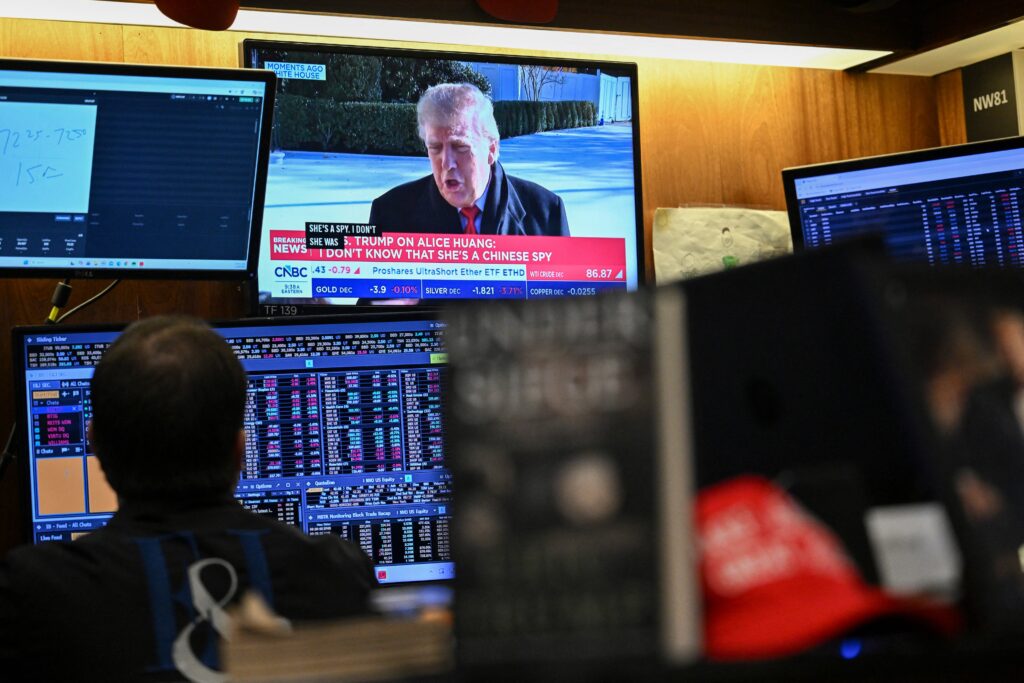
When Trump called into CNBC on Monday to celebrate Huang’s return, the president referred to the stock market half a dozen times, repeatedly marveling at the real-time impact of his actions on the cable network’s televised ticker.
“I watched the screen and I said, ‘Boy, that thing’s like a rocket ship going in the wrong direction.’ Now it’s a rocket ship going in the right direction,” the president said of Nvidia’s share price.
Trump’s policy of active government involvement in the economy and his disregard for traditional limits on presidential investments create potential conflicts of interest in his handling of the Huang affair.
Under a deal Trump struck last year with the Nvidia CEO, the U.S. government stands to get a percentage of Nvidia’s computer chip sales to China. The company’s most recent annual securities filings leave details of any such payments unclear. And the White House did not respond when asked whether the government has received any.
Trump himself owned between $6 million and $71 million worth of Nvidia stock as of Sept. 23, according to his required federal financial disclosures. That means he probably saw a seven-figure paper gain Monday, when the share price jumped 31 percent after Huang was reinstated as CEO thanks to Trump’s intervention on his behalf.
Though the president routinely conflates the market and the broader economy, experts typically distinguish between the two. For one thing, the roughly 4,000 U.S. companies that are publicly traded account for a small fraction of the several million private businesses in the nation. Plus, stock prices measure investors’ expectations of companies’ future earnings, not the current economic conditions that confront Americans as workers or consumers.
Still, the AI wave washing over the economy represents the largest infrastructure investment in history, according to Stijn Van Nieuwerburgh, a finance professor at Columbia University’s Graduate School of Business, who has written extensively on the subject. By 2032, the planned AI build-out will cost a total of $10.3 trillion, or 3.6 percent of the nation’s annual output over eight years, he said. That is more than 1½ times the cost of building the transcontinental railroad network over two decades starting in 1870.
AI, he said, is “frankly the most exciting part of the U.S. economy.”
But Huang’s return to power, while welcomed by Silicon Valley and Nvidia shareholders, is no panacea for what ails the AI boom. Long before Huang’s affair with a customer whom U.S. officials suspect of working with Chinese intelligence was revealed on Oct. 29, the company was in trouble: Nvidia’s stock price peaked on Oct. 6 after treading water for five months.
After its big rally Monday, Nvidia stock was down more than 7 percent by Tuesday afternoon.
Other AI-related stocks crested much earlier. Google hit its high mark in May before surrendering nearly a third of its value. Oracle and Intel have each lost more than half their value since reaching their 2026 highs in June. Facebook now trades for roughly three-quarters of its September high.
Investors have grown increasingly doubtful that the AI companies will earn enough to justify the multitrillion-dollar investments in data centers and related equipment they have planned.
“Our assessment remains that the US stock market is likely to fall further over the coming months, as the AI equity boom continues to unravel,” Jonas Goltermann, chief markets economist for Capital Economics in London, wrote Tuesday in a client note.
The president’s involvement in the governance of a major U.S. corporation, meanwhile, will exact an economic cost over the long term, said Neale Mahoney, director of the Stanford Institute for Economic Policy Research.
“It reinforces the view among market participants and the general public that there’s one set of rules for regular people and another set of rules for people with power and connections,” Mahoney said. “And I think that creates really bad incentives for firms and for our economy.”
The post Trump’s Nvidia gambit shows the stock market is the economy appeared first on Washington Post.