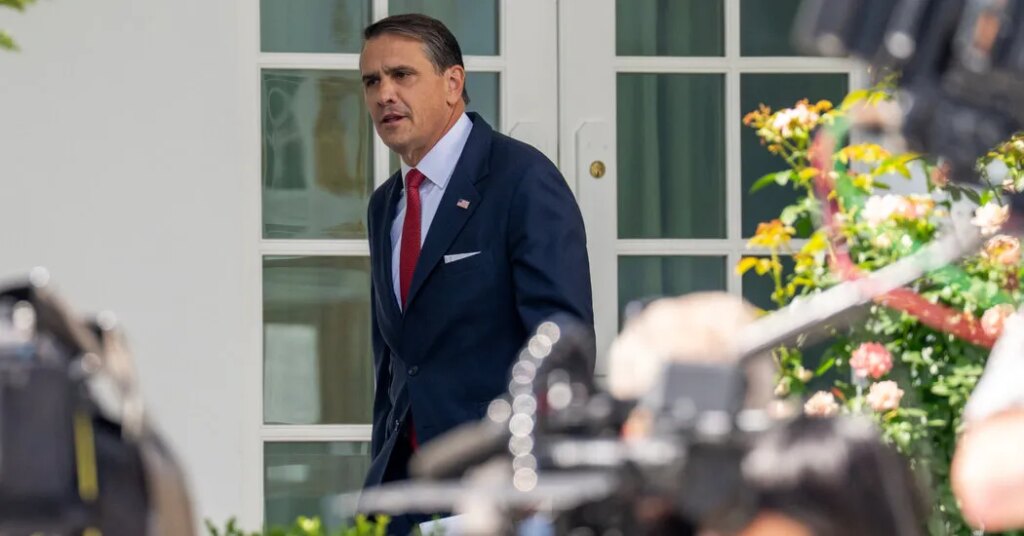
Attorney General Todd Blanche on Tuesday dismissed mounting questions about Nvidia’s possible exposure to criminal charges, publicly blessing the company as a “good corporate citizen.”
His remarks, made at a news conference, came even as Justice Department investigators have gathered evidence on two separate fronts of the company’s high-powered computer chips being illegally diverted by other firms to China, according to people familiar with the inquiries.
His comments suggested the administration had no evidence that the company was a witting participant in any diversion of A.I. technology to China, despite the fact that investigators are pushing forward with cases against Nvidia’s customers in Asia, including a woman, seen by U.S. officials as an asset of Chinese intelligence, with whom the company’s chief executive, Jensen Huang, has acknowledged having an affair.
President Trump has similarly all but exonerated Mr. Huang of any wrongdoing, even though investigations into the diversion of the chips remain in progress. The president said on Monday that there was no evidence that Mr. Huang had broken the law, an assertion repeated by Mr. Blanche on Tuesday.
“I have no reason to stand up here and say Nvidia is anything but a good corporate citizen,” Mr. Blanche declared, adding that the F.B.I. had found no evidence of criminal wrongdoing by Mr. Huang.
“To the extent that the Department of Justice had information that he was committing crimes or something like this, that is something I certainly would have told the president, had it been true,” Mr. Blanche said.
Mr. Huang has come under intense scrutiny after The New York Times reported in October that American national security officials believed that Alice Huang, the woman with whom Mr. Huang had a personal relationship and an executive at the Singaporean data center firm Megaspeed, was a Chinese intelligence asset.
Mr. Huang eventually acknowledged an affair and was forced out of Nvidia, the company he founded. Nvidia’s share price slumped badly and on Monday the company’s board of directors, prodded by the White House, put him back in charge, giving a major one-day boost to the firm’s stock price, which fell again on Tuesday.
The company’s fast-changing fortunes this week are in large part because of Mr. Trump, who pushed for Mr. Huang’s return by telling the board that he posed no security risk.
On the same day that Mr. Huang was reinstated, the government imposed sanctions on Megaspeed, saying that the firm had acted contrary to U.S. national security interests.
Federal prosecutors in New York have already indicted several individuals for what they say was a scheme to divert Nvidia chips to Chinese customers who are barred by U.S. law from buying the technology directly. That investigation, according to people familiar with the matter, has also gathered some evidence against Ms. Huang, though she has not been charged in the case.
Separately, federal prosecutors in Northern California are examining whether Megaspeed engaged in a criminal scheme to divert restricted Nvidia computer chips.
That investigation has obtained airfreight records showing shipments of advanced Nvidia chips, including a banned chip called the H200, traveling from Malaysia into Hong Kong, according to people familiar with the matter who spoke on the condition of anonymity to describe an ongoing investigation.
The evidence implicated Megaspeed, as well as two freight forwarding companies. One of those freight forwarders is Apex Logistics, a unit of shipping giant Kuehne+Nagel. Bloomberg reported in August that U.S. officials were looking into Apex Logistics for allegedly smuggling Nvidia chips.
When a Times reporter contacted Apex Logistics on Monday to ask about its corporate network, the person who answered the phone repeatedly asked what the information was for and whether it would be used in an article. The person then declined to respond to further questions.
The F.B.I. investigation into Megaspeed was described as “well developed” by people familiar with it.
The post Blanche Downplays Questions Over Nvidia as Company’s Customers Come Under Scrutiny appeared first on New York Times.