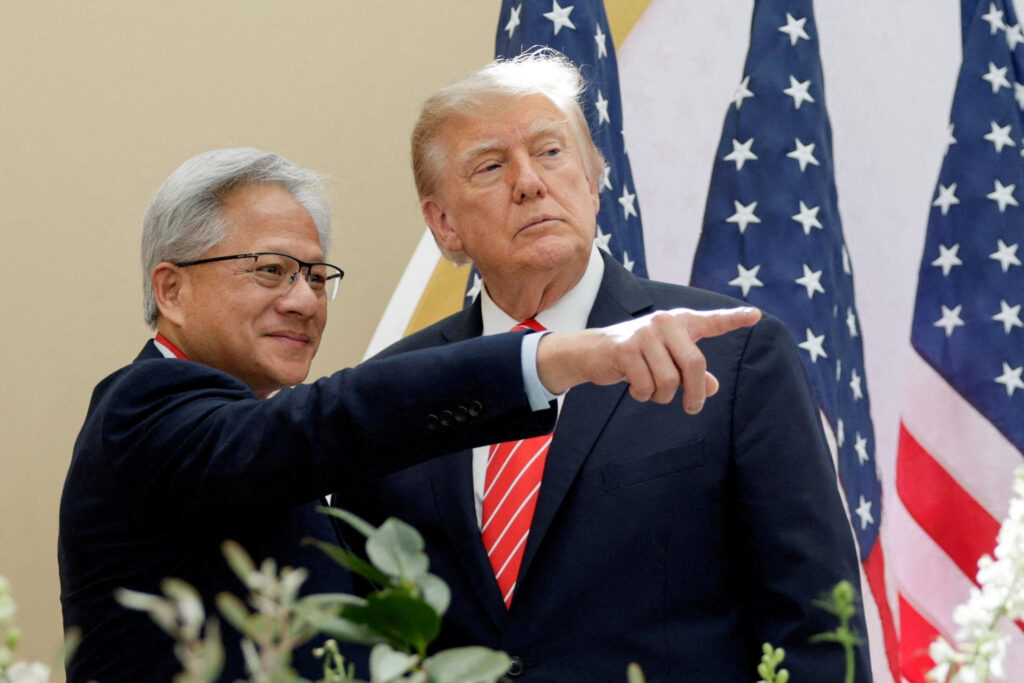
The spectacle surrounding Jensen Huang’s return to Nvidia has produced plenty of questions about conflicts of interest. Did President Donald Trump personally intervene with the board because he thought Huang’s restoration would lift the stock? Did administration officials go easy on Nvidia because of financial interests?
But there’s no need to speculate about one potential conflict, because it’s real and right out in the open: The federal government makes money when Nvidia sells certain chips to China. That captures what’s wrong with the Trump administration’s creeping crony capitalism. The government is charged with deciding whether selling advanced technology to America’s foremost strategic rival threatens national security — and the government gets a cut when the sales are permitted.
In August 2025, the administration allowed Nvidia and AMD to resume sales of certain artificial intelligence chips to China in exchange for 15 percent of the revenue. Trump later agreed to let Nvidia sell its more powerful H200 chip to approved Chinese customers in exchange for a 25 percent cut.
That raised a constitutional problem. The founders expressly prohibited taxes on exports. So the administration created an extraordinary work-around in January: Taiwan-made chips destined for China would first enter the United States, incur a 25 percent import tariff and then head back across the Pacific.
The libertarian Cato Institute estimates that the arrangement probably generated about $333 million through September. That’s pocket change in a $7 trillion federal budget. The problem is warped incentives. “Suddenly companies might not be making decisions based on commercial considerations,” said Cato economist Scott Lincicome.
Consider Megaspeed. The Commerce Department finally blacklisted the Singapore-based company on Monday over the risk that it could divert advanced chips to unauthorized users. The action came after months of pressure from other agencies. Nvidia had stopped selling to Megaspeed in June 2025 amid a federal investigation. Commerce Secretary Howard Lutnick still resisted putting it on the list. Even now, the restriction might do little because it doesn’t appear to cover foreign-made products using American technology, and most Nvidia chips are manufactured in Taiwan.
Maybe Commerce acted entirely on the merits. Megaspeed says it complies with U.S. law, and Commerce says it enforces export controls “strictly by the book.” Yet congressional Democrats are investigating whether Nvidia improperly influenced the inquiry. When government goes into business with companies it regulates, even legitimate decisions become harder to trust.
Huang showed poor judgment by reportedly having affairs with an executive who reported to him and a woman whom U.S. officials allege had ties to Chinese intelligence. But he is also a visionary founder who transformed a graphics-chip maker into a pillar of the AI revolution. Huang has been an essential voice against sci-fi doomerism and in favor of full-throttle competition. Nvidia releases open models that developers can download and modify, providing a counterweight to the more proprietary strategies of Anthropic and OpenAI.
Unfortunately, Nvidia is far from the only example of business decisions becoming contests for political favor. Last year, the Trump administration took a 10 percent stake in Intel two weeks after Trump demanded chief executive Lip-Bu Tan resign. The CEO stayed.
The Biden administration also embraced industrial policy, subsidizing semiconductor makers under the Chips Act but stopping short of ownership. Trump crossed that line and sprinted: The federal government has announced more than 40 equity stakes since he returned to power. Sen. Bernie Sanders (I-Vermont) would go further, forcing large AI companies to transfer half their equity to a government-controlled sovereign wealth fund, with politically chosen commissioners gaining representation on company boards.
The convergence of Democratic and Republican administrations in this area should alarm anyone who believes in free markets. Biden subsidized favored industries. Trump turned government into a shareholder. Sanders would make public ownership a governing principle. Most elected Republicans have remained silent while Trump takes equity stakes. Members of Congress in both parties should think harder about how any machinery their president creates to influence the private sector might be abused by the other side.
Trump supplied the best argument against his approach when he called into CNBC on Monday to tout his role in Huang’s comeback. Asked where presidential intervention would stop — Microsoft, Alphabet, OpenAI or Anthropic? — Trump said there would be no formula. He compared his judgment to the touch of a scratch golfer around the green. “It’s touch, it’s feel,” he said. “You got to look at the individual case.”
Free markets replace the whims of politicians with predictable rules and decisions by people risking their own money. It shouldn’t matter who resides in the White House. The economy is too important to run on presidential touch and feel.
The post The clearest conflict of interest involving Nvidia is no secret appeared first on Washington Post.