Jake Tilove was scanning apartment listings in Jackson Heights, Queens, last summer when he saw a four-bedroom co-op in the Chateau, a garden complex a block from where he lived with his wife, Kasey Tilove, and their two children. Something unusual in the listing caught his eye.
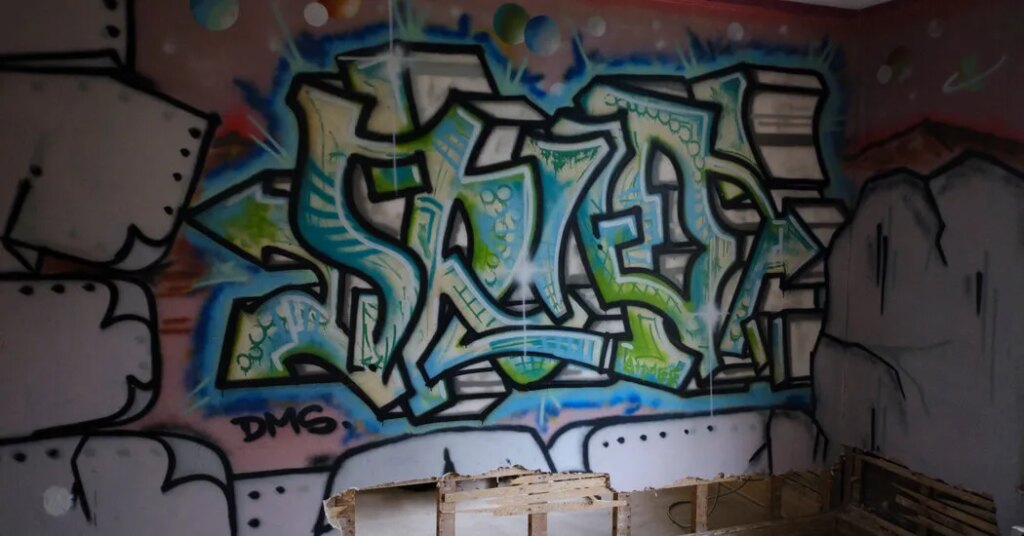
One bedroom, it said, was “a true artistic treasure,” with “vibrant murals” by “the late graffiti artist David ‘Sane’ Smith.”
Watermarked photos showed “Sane” splashed across one long wall in a riot of color and intersecting lines. On the opposite wall, under the name “Smith,” was a cartoon spaceboy with a ray gun and an electric-green mohawk. Jake, who has a graduate degree in historic preservation, knew a bit about graffiti, but the names meant nothing to him.
The Tiloves closed on the apartment on March 27. The next morning, Kasey searched online for “Sane Smith” and up popped a YouTube video with a man calling himself “the Graffiti Wanderer” wandering through her new home, urging any buyer to preserve the art.
Kasey texted the video to Jake. It has a message for us, she wrote. But leaving the wall as is was out of the question: It was in what would be their children’s room. The other option — removing a century-old, 11-foot-by-8-foot plaster slab — sounded costly and complicated. And where would it go?
‘Doing Damage’
In the breezy darkness of a September night in 1988, two brothers made their way to the Brooklyn Bridge with brushes and a bucket of white paint, climbed down to a narrow ledge high over the East River and went to work.
The brothers, Roger and David Smith, were among New York’s most prolific graffiti writers. To politicians and much of the public, they were faceless names in a mosaic of subway scribbles and scrawls that signaled urban disorder. To their peers, they were all-city kings. Roger, who went by Smith, was 21. David, known as Sane, was 18. He would be dead in two years.
But when the sun rose after that night, their unified name, painted in simple white letters, could be seen a mile away: Sane Smith.
“In graffiti circles, where ‘getting up’ — as in having your stuff seen — is the key achievement,” a Newsday reporter wrote at the time, “this daring display of sure-footed arrogance is a feat akin to painting the Sistine Chapel.”
In other words, a masterpiece.
After Jake and Kasey learned about it from “The Legend of Sane Smith,” a 90-minute YouTube documentary posted by a “JWF Documentaries,” they were all in.
They wanted to keep the legend alive.
David Smith, born in Manhattan in August 1970 as the youngest of three children, was a true product of his place and time, according to interviews with relatives, friends and others who knew him; court filings and other public records; books, newspapers, magazines and the YouTube documentary.
He was an altar boy, an Eagle Scout, a student at a top public high school — and one of the city’s most-wanted vandals.
Joseph Rivera, a retired Vandal Squad officer who wrote a memoir, called Sane “a slippery one” and said police bosses were “really hot and heavy on this kid.”
Steve Mona, a retired commanding Vandal Squad officer, called the brothers “worthy adversaries” unrivaled in “their quest for their version of fame.”
“They were able to get up more than anyone,” Mona said. They wrote together maybe half the time, Roger Smith said in an interview; otherwise, each one typically wrote both names. For a while, the police thought they were one person.
Officers came to the brothers’ apartment in Washington Heights and implored their mother, Helga Smith, to rein them in. She had tried, she said, and she had. But she was a single parent.
“She’s a working woman,” Roger Smith said. “She has to be up the next day. So you wait ’til 11, that’s all.”
As to whether graffiti was art or crime, Sane would say both.
“Some things I do are art,” he said in an interview with The Revolutionary Worker, the newspaper of the Revolutionary Communist Party, USA, published after his death, “but doing art will never take away from doing damage too, ’cause it’s fun.”
His work never made it to galleries or brand logos, but he has two pieces in the Museum of the City of New York’s collection, one in a closet at his high school and another, improbably, still standing on a wall on the Lower East Side. A piece that says “Mom” hangs on his mother’s wall.
The letter styles at the foundation of modern graffiti emerged in the 1960s. Julio 204 of Manhattan’s Inwood section is often cited as the first to tag all over a New York neighborhood, and a 1971 New York Times profile made Taki 183, a Washington Heights teenager, famous as the first to use the subway to tag citywide.
By the early 1980s, as graffiti meshed with a growing hip-hop culture and gained cachet as art, hundreds of teens with aerosol cans were spending hours in dark train yards and tunnels, where they dodged arrest, rivals and the third rail.
But many people recoiled at having to ride in subway cars covered in graffiti. In 1984, transit officials started a five-year plan to pull trains out of service until every one running was clean.
These were the Sane Smith years. The name was everywhere.
‘I May Have Crossed the Line’
Jake Tilove was at a bluegrass jam in SoHo when he mentioned his new home’s graffiti to a friend, who asked for a picture to share with people he knew in that world.
The next morning, Tilove got a text from Sane’s brother, Roger Smith: Could he come have a look? He had never seen the piece. “It would be nice to preserve it,” Smith wrote, and “quite a feat to do so, but I am open to trying.”
A few days later, Tilove and Smith met at the apartment. Smith regarded his brother’s work calmly and took some measurements. Tilove was surprised when Smith said he was going to a rail yard to paint freights with friends. Later, Smith texted Tilove a picture: “SaneSmith Thanks to Jake + Fam” sprayed on the side of a tanker car.
Over the next several weeks, Tilove and Smith went back and forth about how to proceed. “I told Roger early on that I wanted to avoid caring more about the art than he did,” Tilove said in late May. “I fear I may have crossed the line.”
Smith agreed.
In graffiti culture, he explained, “we were always taught to not really value your product.”
“You do it, you enjoy it,” he continued. “If you’re lucky, you take a photo of it, and then it’s gone.”
Yet he did not seem ready to let this piece of his brother’s legacy go. Strategies involving a crane, for nearly $40,000 (legally) or sneaking the wall out during a sheet-rock delivery (not so much) were discussed and dismissed.
But an idea from Tilove’s contractor, Rafael Cruces, stuck: Cut the wall into three pieces that would fit in the elevator. Smith was skeptical, but Cruces was confident. Three pieces it would be.
Smith had posted a video of the wall on social media. “Only time will reveal the fate of this remarkable piece of history,” he wrote.
Two People
Sane painted the Jackson Heights bedroom a few months after graduating from Hunter College High School, in the summer of 1988. The room belonged to his girlfriend, Aimee Christian; he did it for her and painted her name at the bottom. Her mother sold the apartment to the Tiloves.
Aimee was 15 and had just finished her sophomore year at Hunter. David, her preferred name for him, was 17. They had been a couple for several months after meeting in the school library when he was shelving books.
“We became pretty tight pretty quickly,” she said in an interview. They wrote letters to each other because he could communicate more openly that way.
Her family had moved into the apartment when she was 7, and her bedroom had yellow butterfly wallpaper. It was fine for a young girl, but not for the goth teen she was in high school.
They stripped the walls, then David used bucket paint, spray paint and paper plate cutouts for stencils. The cartoon character was Spaceman Spiff from “Calvin and Hobbes.”
He and Aimee stayed together until shortly before she graduated in 1990. She was thinking about college and the future; he seemed to be focused only on graffiti and, increasingly, drugs like cocaine.
He was also struggling with his mental health to a degree that no one truly understood, she said. Before they broke up, he told her he felt like two people, David and Sane, that Sane was “taking over” and “couldn’t sustain a relationship.”
He was one of the few in his class who did not go on to college. He kept writing graffiti, mixing hip-hop influences with hardcore-punk themes and hanging out at the Lower East Side alternative community center ABC No Rio. He worked as a busboy at the nightclub M.K. and as a subway token clerk. He and Smith, working for hire, painted a wall at a popular vintage clothing store, Antique Boutique.
He painted a banner for a concert sponsored by a left-wing activist group and a wall in the ABC No Rio yard with a burning American flag and a message: “Baseball, Mom, Apple Pie, + Racism.”
‘So Much Potential’
It was Sane’s idea to hit the Brooklyn Bridge. He had scouted it out. The idea was like a plot point from “Turk 182,” a campy 1985 movie that was a Sane favorite. In it, the title character hounds a corrupt mayor with a guerrilla graffiti campaign that ends with his name in lights on the Queensboro Bridge.
Painting their name on the Brooklyn Bridge, Smith said, was a general “thumbing your nose at authority.”
Sean Corcoran, a Museum of the City of New York curator, said Sane and Smith were “in the center” of a rebellion against Mayor Ed Koch’s administration’s crackdown on graffiti and other petty crimes.
The next spring, 1989, in what officials said was a first, the city and the Metropolitan Transportation Authority sued the brothers for $5,000 and punitive damages, accusing them of defacing the Brooklyn Bridge, road signs, and subway cars and stations. Because some of the alleged vandalism dated to when they were minors, their mother was sued for $5,000.
Sane persuaded the prominent left-wing lawyer William Kunstler, then busy arguing to the Supreme Court that burning an American flag was protected free speech, to take the case.
Kunstler said in a court filing that the government had failed to provide graffiti writers with suitable places to paint, unlike “the Republic of Mexico, which made the walls of many public buildings available to Diego Rivera.”
His entrance effectively froze the case. In the meantime, Newsday reported, “Sane Smith” appeared on the Brooklyn Bridge again, with a punchline: “It’s nothing new. Ed Koch is thru. Sane 182” — a play on a line from “Turk 182.”
That October, Sane held a show at ABC No Rio, “Selected Works of a So-Called Graffiti Vandal.” Few people came. “Disastrous,” Smith said.
About a year later, on Oct. 17, 1990, the police pulled David Smith’s body from Flushing Bay. His death certificate lists the cause and manner of death as accidental drowning, and his last employer as the M.T.A.
Christian, who was also friends with his sister, Monica, said she has no doubt that David died by suicide. Smith declined to discuss his brother’s death in detail. Helga Smith, 86, was similarly stoic.
“David was my son,” she said when approached about an interview. “I loved him. He’s been gone 35 years. There’s nothing more I can say.”
A funeral service was held at the Church of the Incarnation in Washington Heights, where David Smith made his first communion. In the pews were Christian, family friends and dozens of graffiti writers. Lingering outside were two men who resembled Vandal Squad officers. Were they? “I’m not saying yes,” Rivera, the retired officer, said. “But I’m not saying no.”
David Smith’s ashes were scattered in some of his favorite places, including along the No. 1 train line in Manhattan.
“He had so much potential,” his mother said. “He would have done great things.”
‘Stay Tuned’
Just before 10:30 a.m. on a Tuesday in June, a man in goggles, a face mask and a white Tyvek suit began the first cut of the day at the apartment.
Several inches from the wall’s left edge, he used a grinder with a diamond blade of the kind that cuts tile, switching to a jigsaw-type tool to cut through the wood studs underneath. A co-worker followed with a vacuum, sucking dust from the air.
There was another cut four feet to the right, another just under four feet to the right of that, and a final one at the right corner.
After a cleaning, an acrylic plastic sheet went over the first section and was secured with vertical braces. Cruces, the contractor, attached handles at the back and side. Beams were cut at the top and the bottom, and the first of three 550-pound hunks of plaster was lowered for the crew to carry into a corner.
Over the next several hours, the pattern repeated twice. There was shouting and laughter, and by about 2 p.m., the wall was in three secure pieces neatly stacked in a corner.
Jake Tilove shared pictures and video with Smith, who posted them on Instagram.
“Stay tuned for the final destination,” Smith wrote.
In all the discussion and planning about what to do with the piece, little attention was paid to a three-letter tag to one side: DMS.
In July 1990, two years after David painted Aimee’s wall, a 29-year-old bartender named Julio Rivera was ambushed in a brutal killing in a Jackson Heights schoolyard, the first gay hate crime tried in New York State. Prosecutors said the three men charged had ties to a hardcore punk crew from the neighborhood, Doc Martens Skinheads. DMS.
Aimee, who described the killing as “horrifying,” had grown up with several crew members. David, she said, met them through her. Throwing up a name of a crew or other writer in their neighborhood was standard. “David was not a racist or a homophobe,” she said.
His piece on her bedroom wall is still awaiting a permanent home. The Tiloves hope a museum will take it and put it on public display.
Several weeks after the wall came down, Smith was on a sunny Isham Street in Inwood for an old-timers’ day organized by Manhattan Subway Kings, an uptown crew he and Sane admired as young writers.
Smith had a spot on a so-called permission wall that was the day’s focus, the backside of a Dunkin’ shop attached to a gas station. He had begun to outline his piece in orange and white. A sketch on his phone showed the basic design: PFunk, a “backup” or alternate name his brother sometimes used.
When he was done, Smith took a picture of the finished piece: PFunk in what might be called “Aqua Boogie” blue against a candy-stripe background.
And in the lower left corner, there it was: SaneSmith ’26.
Georgia Gee and Kirsten Noyes contributed research.
The post Their New Apartment Came With Legendary Graffiti. Should They Keep It? appeared first on New York Times.