John Ficarra was the editor of Mad magazine from 1985 to 2018.
On my table this Thanksgiving, strategically placed among the mashed potatoes, slices of cranberry sauce and other dishes I will be serving, will be several stuffed artichokes.
Not everyone is a fan of this vegetable. Some find it messy to eat or too much work for too little food. Others object to the pointy leaves (technically called “bracts”) you occasionally encounter. Whatever the reason, I’m fine with it. More artichokes for me.
Growing up on Staten Island in the 1960s, it was my mom who sold me on the vegetable. She began with fried artichoke hearts. Bite-size, warm and crispy, it was an easy sale. I have vivid memories of standing beside her, barely waist-high, at the stove as she fried them. Her plan was always to let them cool on a paper towel to absorb some of the excess oil before eating, but I could never wait. Burning my little fingers or the tip of my tongue was a small price to pay as I picked them up and popped them into my mouth one after another.
As I got older and my taste buds became more refined, she added stuffed artichokes to the menu. This was when my fondness for the vegetable turned into a lifelong love affair.
Unfortunately, I was so busy with school, then work and parenthood, that I never had time to make artichokes, but I was never wanting for them. Just knowing how much her son enjoyed them was enough for my mother to routinely show up at my home bearing them, along with garlic mashed potatoes, eggplant parm casseroles and my other favorites. (You’ve probably surmised by now that she was an Italian mother.)
After my father passed away, my mom began spending Sundays at my house. It was a bittersweet experience. I loved the extra time with her, but it was obvious she was slowing down and beginning to show signs of early dementia. One day I asked her to teach me to make a stuffed artichoke. She jumped at the chance.
I set two artichokes on the kitchen counter: one for her to demonstrate on and one for me to screw up, which I quickly did. I learned that her method was a delicate, intricate process requiring time and finesse to get just right.
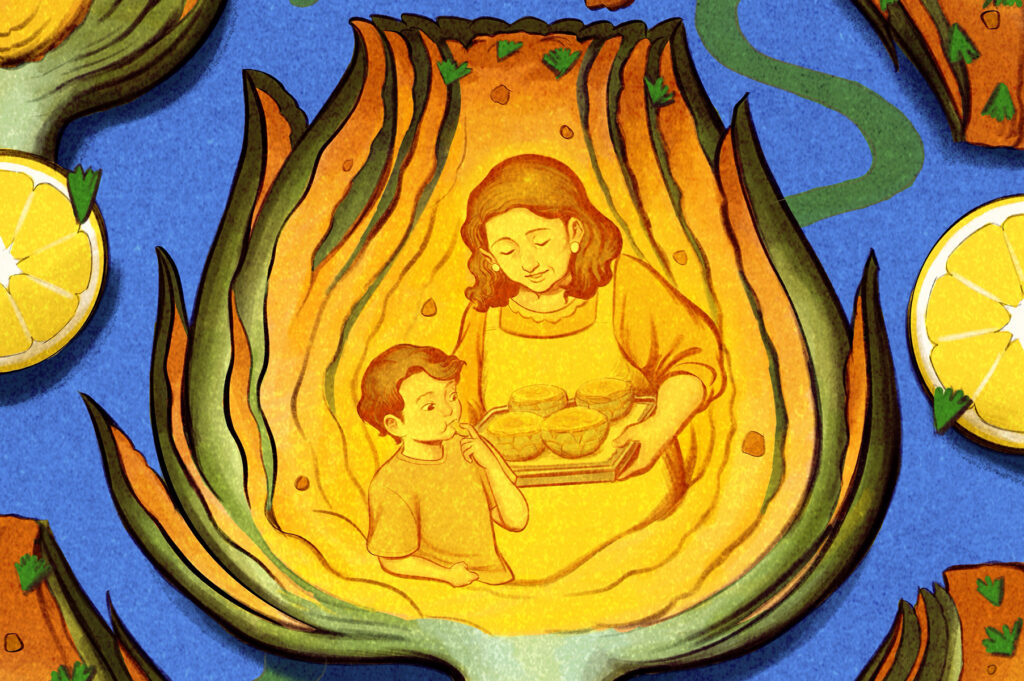
After snipping off the thorns and removing the prickly center, she gently pried away each layer from the center, an increasingly difficult task because of the severe arthritis in her fingers. She then carefully stuffed every nook and cranny with culinary goodies — garlic, pimientos, sautéed mushrooms, breadcrumbs, fresh parsley, black olives, onions, parmesan cheese, lemon, a dash of salt and some pepper flakes.
“The trick,” she explained to me, “is creating just the right balance of ingredients so that the artichoke overflows with different flavors but isn’t so stuffed that it breaks apart when you steam it.”
“The best,” she added, “is when the heart is warm and tender.”
After several less-than-successful attempts, I began to get the hang of it. I quickly upped the number of artichokes I bought from two to three: one for each of us to eat during the week and a third for us to share the instant it came out of the steamer.
As I reflect on these times with my mother, it occurs to me that the approach she used to stuff an artichoke was the same approach she used in raising me. She was gentle and patient, but determined in her desire to fill me with the ingredients needed for a full and happy life — love, kindness, curiosity, humor, an appreciation for hard work as its own reward and a belief in endless possibilities, all centered around a warm and tender heart.
I don’t believe any of this was intentional on my mom’s part. There was no stack of child-rearing books on her nightstand, no Venn diagram taped to the refrigerator noting the overlap between parenthood and vegetable preparation. It was more organic. I think she was just being the caring and generous person she always was, whether stuffing an artichoke or raising a son. And that is one of the things I will be most grateful for this Thanksgiving and beyond.
The post My mom had a secret ingredient. I discovered it making stuffed artichokes. appeared first on Washington Post.