Jonathan Haidt is a social psychologist at New York University’s Stern School of Business and the author of “The Anxious Generation.” Jeff Hancock is a professor of communication and the director of the Tech Impact and Policy Center at Stanford University.
The two of us disagree about the effects of social media on teens. One of us (Haidt) believes that social media is one of the two leading drivers of the teen mental health crisis and should be off limits to those under 16. The other (Hancock) believes that while social media can be harmful to some teens, it is only one of many contributing factors to the crisis and can provide a range of benefits, too. For the past several years, we have engaged in friendly debates on these points.
But we are united in our concern about the lack of independent, reliable and consistent quality data needed to understand and compare the harms teens experience across social media platforms.
Social media companies have detailed data on what their users see and how they respond to it. But they keep these findings largely to themselves, and few independent surveys regularly track the harmful experiences teens encounter on specific platforms. As a result, policymakers, parents and the public have little reliable information to go on when they compare platforms or assess whether safety is improving. We both want to see that change.
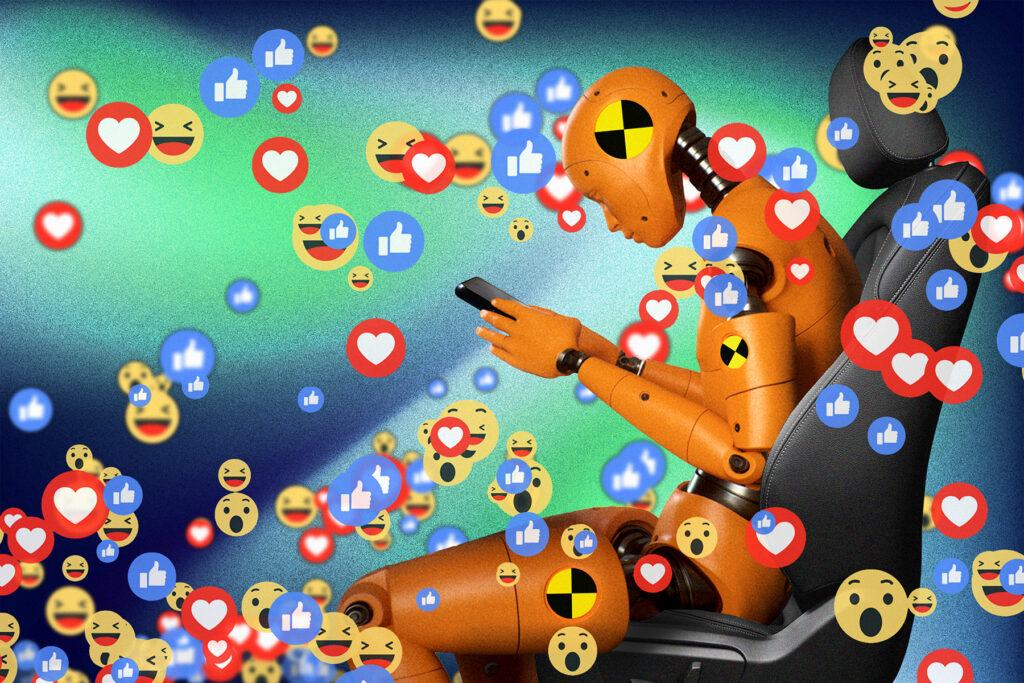
Social media in the 2010s was like cars in the 1950s: Both technologies transformed daily life, reshaped the economy and created some of the world’s most valuable companies. In both cases, product safety was not a priority.
Back then, if you wanted a car with seat belts, you were mostly out of luck. Ironically, carmakers feared that installing them would suggest that their cars were dangerous. With little evidence linking car design to injuries and deaths, car buyers were not demanding better safety features, and the government blamed crashes on drivers.
But when researchers began systematically collecting collision data, they found evidence that for some injuries, car design was the culprit — when a non-collapsible steering column was pushed into a driver’s chest in a collision, for example. Such research findings, along with advocacy and congressional hearings, helped produce the 1968 law requiring seat belts in new cars. The federal government later built a centralized database of fatal automobile crashes and started publishing safety ratings.
Today, this database shows investigators which safety features work and which ones have unintended side effects. And the ratings let buyers compare cars, which pushes manufacturers to compete on safety. Volvo, for instance, has built its brand around its superior performance in safety tests.
Social media platforms need a similar feedback loop to create safer products. Imagine there was independent and reliable data, updated every year, on the harms teens experience on Instagram, TikTok, Snapchat and other platforms. Parents could compare apps, policymakers could assess whether laws and regulations intended to protect kids online are working, and social media companies would have a strong incentive to remove or modify specific features that lead to victimization. Such data, collected regularly, would drive new industry standards that prioritize product safety, not just engagement.
That’s why we are collaborating to build an ongoing, independent, standardized U.S. survey that asks teens directly about a wide range of harms they experience on each social media platform. Our effort builds on Meta’s own internal survey of teens’ bad experiences, which the company didn’t make public until whistleblower Arturo Bejar brought it to light in 2023. Our teams at the Tech and Society Lab at NYU Stern and the Stanford Tech Impact and Policy Center are collaborating in this effort with the Stanford Center for Digital Health and USC Marshall School’s Neely Center.
As a first step, we ran a nationally representative pilot survey of 472 teens, ages 13 to 17, which was just published in JAMA Pediatrics. This survey confirmed that teens have very different experiences across social media platforms.
Take sleep. More than half of the teens surveyed said technology gets in the way of their sleep at least sometimes. But not all apps do this equally — 42 percent of TikTok users blamed TikTok for lost sleep, while 28 percent of Instagram and YouTube users and only 8 percent of Pinterest and Discord users blamed those apps. Some apps are simply harder to put down at bedtime, and TikTok in particular should feel public pressure to do something about this problem.
Beyond cutting into sleep, social media platforms can also expose teens to a range of negative experiences online. These vary by platform, too.
In our survey, 9 percent of Instagram users said they had seen violent, bloody or disturbing images on the app in the past four weeks, while for Snapchat the share was below 1 percent. However, a higher percentage of Snapchat users said they had been involved in unwanted conversation (10 percent) or received unwanted sexual advances (4 percent). A similar share of users reported seeing unwanted nudity and sexual images on both Snapchat and Instagram (6 to 8 percent), compared with 1 percent of Pinterest users. An app that looks safe on one measure can look worse on another.
A survey that asked teens only about “digital technology” or “social media,” or about just a few apps or harms, would not give parents and policymakers enough insight to make informed decisions. Our recent review of 41 national surveys found that most ask about bullying, but far fewer ask about harms such as the sharing of intimate images without consent, self-harm content or eating disorder content or problematic and only a handful report how often each app’s users are harmed. Yet this is exactly the information that’s needed to improve teens’ online experiences.
One survey is only a snapshot, however. To know whether teens are getting safer online, the same questions must be asked over many years. That’s how we know the 1998 tobacco settlement worked: The Centers for Disease Control and Prevention had been using the same questions to survey teens about smoking for years before the settlement, so it was possible to confirm that teen smoking actually plummeted afterward. Online safety deserves the same continuous scrutiny.
This is a pivotal moment to start measuring the specific harms teens experience on each social media app, and for state governments and attorneys general to act. Across social media platforms, we estimated that roughly 3 million adolescents ages 13 to 17 reported seeing unwanted sexual content in the previous four weeks, and more than 10 million reported sleep disruption from their use. In August, Meta settled claims by 48 U.S. attorneys general that Instagram and Facebook were designed to addict young users. Meta agreed to pay up to $18 billion and introduce new teen protections, including a two-hour daily limit for both apps and a “night mode” that blocks access overnight.
Will these changes help teens get more sleep? The settlement itself won’t provide that answer. Under the agreement, Meta will pay for an auditor, on a five-year term, to verify that it is carrying out the new youth-safety measures. But the auditor will inspect only Meta’s platforms, and only a summary of each report will be made public. Crucial details may remain confidential. The audit can confirm whether Meta kept its promise to make changes, but it won’t show whether teens are getting safer online, or whether they have simply moved their late-night scrolling to other apps.
Establishing a common standard of teen online safety isn’t a radical idea. Even Meta chief executive Mark Zuckerberg has made the case for regular, standardized public reporting on harm. Other tech leaders, including Instagram’s head, Adam Mosseri, and Pinterest’s CEO, Bill Ready, have spoken in favor of consistently and transparently measuring online safety.
Our survey is already showing that this kind of measurement can be done by outside researchers; we don’t need to rely on companies to disclose their own data. The cost is manageable, too. We estimate it would cost about $2 million a year to run an independent national survey of teens’ online experiences in the U.S. That comes to $20 million over 10 years, a small sum — less than a fifth of one percent — next to the Meta settlement of at least $12 billion and potentially up to $18 billion. We hope that the attorneys general will dedicate a portion of these funds toward online-harm measurements.
By 1966, people had come to accept that car safety depended not just on responsible drivers but also on responsible carmakers. Yet it took another nine years before the United States had a system that recorded every fatal car crash to help identify what was keeping passengers safe and what was endangering their lives.
Americans should not wait that long for evidence about online safety. Parents, policymakers and the public need to be able to evaluate, with confidence, whether the safety features Meta and others introduce are actually making teens safer. They should be able to compare how frequently teens experience harm on different platforms, and companies should have a reason to compete not just on views and likes but on safety. It’s time to bring teen online-safety measurements out of the 1950s.
The post Social media needs its seat-belt moment appeared first on Washington Post.