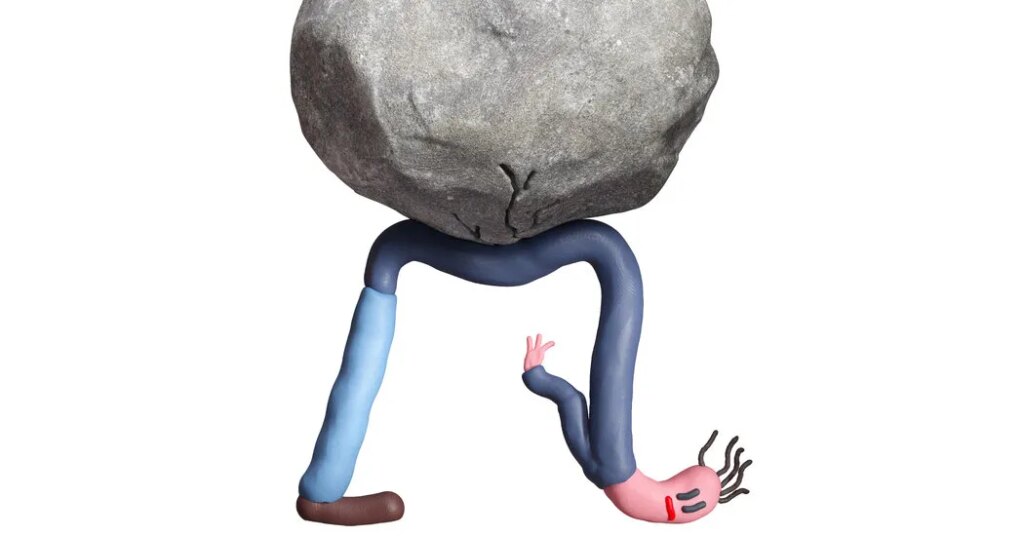
The average adult spine measures approximately 18 inches — slightly more in the mornings, when the intervertebral disks are still ripe with fluid, and slightly less after a long day of standing, when they are maximally compressed. Like any enduring piece of technology, it is deceptively sophisticated in design. Up top, closest to the skull, is the so-called Atlas bone and the six additional cervical vertebrae that support our head and shoulders. Next comes the thoracic region, after the ancient Greek word for breastplate and so named for its role as anchor to the ribs. Last in line are the lumbar, or lower back, which keeps us upright, and the fused bones of the sacrum and coccyx.
As the spinal surgeon Christopher Bono explained to me during a visit to his office at Massachusetts General Hospital in Boston, the resulting shape — the product of millions of years of evolution — quite literally made us who we are today. Without full vertebral articulation, we couldn’t turn to greet a friend or bend down to pick up an Amazon box; without a slight spinal curve near our hips, we wouldn’t be able to stay balanced on two feet. But there was a trade-off involved.
“Bipedalism,” Bono said, “meant all the movement and stress and shear of life was now loading the lower back.” He picked up a plastic scale model of the human spine and tapped his fingers against the two vertebrae at the base of the lumbar: L4 and L5. “It loaded these big knobby blocks of bone, and it loaded the adjacent joints, and it loaded anything that moved between them,” he said. “And that pressure makes the area exceptionally prone to degeneration.”
Bono, who is 55, has three main gigs. He is the executive vice chairman of orthopedic surgery at Massachusetts General. He is a professor at Harvard Medical School. And he is the editor in chief of The Spine Journal, one of two leading journals devoted to the topic (the other is Spine). I’d arranged to meet with him because it’s possible that no one knows as much about the back and its various afflictions — and also because earlier in the year, The Spine Journal, under his watch, published a remarkable (if onerously titled) article, “Development of an Internationally Agreed National Minimum Dataset for Low Back Pain: A Modified Delphi Study,” which focused largely on efforts to standardize diagnostic procedures across the field. But it was a statistic in the opening line that had stuck in my mind and sent me tunneling through a few thousand pages of associated academic research: “Low back pain is the leading cause of disability worldwide.”
The statement, it turned out, was both undeniably correct — only migraines come close — and somehow, given the actual scope of the issue, not nearly emphatic enough. According to a 2023 study in The Lancet Rheumatology, an astonishing 619 million people suffer from some form of low-back pain, a 60 percent increase from 1990; by 2050, the study’s authors predict, the total number of sufferers will hit 843 million, or more than the entire population of Europe.
In the last few years, spikes in diagnoses have been recorded in nearly every part of the world, from Latin America to Asia and Africa, where, The Lancet noted, “social support systems and health care systems are often underresourced and overburdened.” As is the case with many diseases, “the burden falls most heavily on socioeconomically disadvantaged” groups. The less access you have to good medical care, the better your odds of developing back pain become.
But appropriately enough for an issue that researchers say has reached epidemic status, no one is truly exempt, no matter where we live or how much we make. In August, the journal Medicine published an analysis of three decades of back-pain data and found that in the United States, the largest concentrations of sufferers were in Kentucky, with Wyoming and Iowa not far behind — probably, the paper’s authors speculate, because so many residents of those states work in physically demanding professions like agriculture, manufacturing and mining. Similarly, age seemed to correlate with the onset of symptoms, giving credence to the idea that the rise in back pain is an unavoidable byproduct of our ever-increasing life spans.
But other studies have shown that back pain can as easily be brought on by white-collar stressors — too much time in a desk chair, for instance — and that in the United States, more than a quarter of people between the ages 18 and 29 suffer from back pain. In fact, if you are reading this article and you don’t have firsthand experience with a bad back, count yourself lucky. Or just wait: The National Center for Complementary and Integrative Health, a federal research agency, has estimated that a full 80 percent of adults can expect to weather a spell of low-back pain at some point in their lives.
It would be one thing, of course, if a fix was within reach. But for most of us, it is not. Americans now pour about $100 billion annually into various back-pain treatments — more than we devote to any other single malady, including cancer. (Crucially, this figure does not account for lost productivity and disability payments, or the additional billions wasted on so-called complementary solutions like emphatically non-F.D.A.-approved braces and muscle-zapping gadgets.) And every year, the number of sufferers ticks steadily upward anyway.
“Overall,” researchers at Stanford have written, “we are spending more and getting much less.” Partly, this is a testament to the complexity of the back and the delicate web of muscles and tendons and nerve endings it contains. And partly it’s because in 2026, two centuries after scientists began seriously investigating the origins of the condition, we are only now beginning to understand how back pain actually works — and why it so confoundingly hard to address.
“The reality is,” Bono told me, “everyone wants that holy grail, that magic bullet. But while the science is improving, while we’ve made great strides, a lot of the conversations I have now involve the idea that a magic bullet isn’t coming anytime soon. It’s saying, Listen, if there is a cure, quote-un-quote, it’s probably going to look a lot different than you may be expecting.”
For most of medical history, and dismayingly far into the modern era, back pain was viewed almost exclusively as a mechanical issue. It originated in the vertebrae and could be caused by disease, trauma or genetic aberration, such as a misaligned spine; as with any other broken bone, you treated it by locating the site of the injury and immobilizing the area to encourage healing. (If that failed, you could always call in the leeches, or beat your patient repeatedly on the legs with reeds, or coat her body in layers of toxin, thus purging any residual “ill humors.”)
“It is only by removing pressure, and avoiding motion, that the nerves and muscles can be allowed to recover their powers,” the pioneering British physician Thomas Brown wrote in an 1828 tract called “On Irritation of the Spinal Nerves.” When said irritation was severe, Brown continued, the “recumbent posture is absolutely necessary” — and the longer the patient stayed in bed, the better.
A few decades later, as the rigors of the industrial age inspired an unprecedented wave of crippling back pain, a different British Thomas — Hugh Owen Thomas — developed a splint that immobilized the inflamed joints of children; in New York, the surgeon Lewis Albert Sayre experimented with wrapping patients’ torsos in casts, secured with layer upon layer of plaster of Paris. Not be outdone, Richard Davy, a London surgeon, devised a system of pulleys and straps that could be used to alleviate pressure on the vertebrae by stretching out the sufferer like a Gumby doll.
Rarely did a patient emerge from these sorts of treatments with any meaningful reduction in symptoms; many got worse. Indeed, as the surgeons David B. Allan and Gordon Waddell argue in their landmark 1989 history of back pain and its treatments, what was really being inaugurated in those years was not a glide path to a cure for back pain but a century-plus of disastrous missteps and unforeseen side effects. “Iatrogenic,” they call it — a term for an injury caused by a doctor in the course of treatment. Early forms of back surgery, involving the slicing of tendons and the fusing of vertebrae, were frequently botched, leading to widespread infection or paralysis; bed rest — far from speeding recovery — often seemed to prolong it.
And yet to Allan and Waddell, no single intervention would prove as lastingly destructive as intervertebral disk surgery. Introduced in the 1930s by the Boston surgeons William Mixter and Joseph Barr, the treatment was predicated on the belief that most patients’ issues were related to the presence of lesioned or damaged — herniated, in the modern parlance — disks. Shave down the vertebrae to allow for decompression (a procedure known as a laminectomy) or remove the herniation (a diskectomy), the doctors contended, and the pain would be erased.
As it happens, Mixter and Barr were not wrong about the potential efficacy of the approach, hence the enduring popularity of laminectomies and diskectomies today. If a patient’s back ailment can definitively be traced to herniation, an operation may reduce the pain. The problem, which scientists wouldn’t grasp until much later, is that not all back pain is a result of herniation. Not even most of it is: Modern research has shown that 90 percent of diagnoses fall under the heading of “nonspecific” — meaning, in essence, that the pain cannot be traced to a recognizable injury or defect and almost certainly won’t respond to surgery.
But Mixter and Barr handed the medical establishment the equivalent of a hammer, and suddenly everything looked an awful lot like a nail. “Intervertebral Disk Lesions Are the Most Common Cause of Low Back Pain With or Without Sciatica,” reads the title of a representative (and in retrospect, wildly irresponsible) paper from 1945. Outcomes, generally speaking, were better than they’d been in the days of torso casts. But inevitably, an untold number of back-pain sufferers who did not need surgery were sent to the operating theater, and a not-insignificant portion emerged with “at least one major complication,” as a 1989 study on lumbar laminectomies put it. Soon a new condition entered the medical lexicon: failed back surgery syndrome, which was characterized by motor weakness, reduced mobility and currents of intense pain.
The commercial rollout of the M.R.I. in the 1980s seemed to pave the way for a more careful approach to surgery, and in a lot of ways, Bono told me in Boston, it was “game changer.” But, he added, “it inspired some wild goose chases.” He wheeled his chair over to his desktop and brought up a recent patient scan. I spotted several dark blotches in the man’s lumbar, which I knew to be indicators of possible herniation. Noticing my reaction, Bono nodded. “Now, 30 or 40 years ago, we’d be thinking what you’re thinking,” he said. “Like, That disk bulge could be a pain generator. And, Oh, definitely a pain generator there. And, Wow, that’s stenosis,” a narrowing of the spinal canal that could result in nerve compression. “And we’d send him off for surgery, certain we’d settled on the issue. And the guy would be right back in the office a couple of months later, still in pain.”
The reason, it transpired, was that the M.R.I., in effect, was too good at its job. It revealed “more and smaller abnormalities” than any previous technology, the physician and researcher Richard A. Deyo wrote in a groundbreaking 1994 paper. And yet those abnormalities were often not the cause of the patient’s symptoms: One study showed that 64 percent of pain-free people have the sort of structural issues that would show up on an M.R.I. scan. Deyo correctly intuited that a bad back could be traced to an array of factors, psychological as well as physical. Anxiety could be masquerading as back pain; an injury might appear to be in the vertebrae when really it was being caused by a tendon strain or simple muscle fatigue.
It took a couple of decades for Deyo’s peers to come around. From 1996 to 2004, the United States recorded a 14 percent increase in the number of diskectomies; from 1990 to 2001, the rate of lumbar fusion operations grew by 220 percent. As Bono told me — and plenty of contemporary studies confirmed — surgeons were highly incentivized to recommend an operation. They still are. “You’d very much like to believe that every time — or the majority of times, anyway — a surgery is done, it is done because that doctor wants to help that patient’s symptoms,” Bono said. “But that’s not always true. What you can say is that there is a financial incentive for any surgeon to do an operation in our current health care system, unless they work at a place that’s 100 percent salaried and their salary is independent of how much they do. That’s just the truth.”
It wasn’t until the mid-2000s that the number of back surgeries in the United States finally began to flatten and then subside — only to be replaced by another apparently groundbreaking treatment. “There can be life with relief,” proclaimed a 2003 ad for OxyContin, an opioid manufactured by Purdue Pharma, which was later accused of lavishing gifts on physicians for their help promoting the drug. A 2007 study showed that almost half of back- or neck-pain sufferers in the United States had been prescribed narcotics for their condition, despite studies demonstrating that prolonged opioid use steadily altered the pathways in the nervous system, actually enhancing a patient’s sensitivity to pain.
That same year, the American College of Physicians and the American Pain Society released a new set of guidelines on treating low-back pain, signifying the beginning of the end to what has come to be known as the dynasty of the disk. Like Deyo, the authors of the guidelines framed back pain as a composite ailment that required a correspondingly composite approach. Yes, they agreed, when it came to extreme herniation, diskectomy or epidural steroids should be on the table. But nonspecific back pain was different. Doctors were advised to consider the low back in its entirety: the tendons and muscles, the vast web of fascia and stabilizing ligaments and the nerves that ferry pain signals up to the brain.
To that end, over-the-counter painkillers were recommended as a “first-line medication,” to be followed — or supplemented — by stretching, spinal manipulation and a regimen of physical therapy. Diskectomies for nonspecific back pain were out; yoga and acupuncture were in, as was massage. And for the brain, there was always cognitive behavioral therapy, a kind of hybrid of physical and traditional talk therapy in which patients learn to overcome their fear of the pain that has kept them in bed or on the couch. If these methods failed and there was evidence of radiculopathy, or damage to the nerve endings, steroidal injections were an option.
In June, some 20 years after the publication of the guidelines, one of their primary architects, Roger Chou, a professor of medicine based in Oregon, helped write a review of 21 years of clinical data on low-back-pain treatments for The Journal of the American Medical Association. In all, he and his colleagues examined 108 studies and concluded that for nonspecific low-back pain, noninvasive techniques, writ large, can both reduce pain and improve function. Medically, scientifically, this should count as major progress: confirmation, in one of the world’s most prestigious medical journals, that we should no longer be trying to cut our way out of the problem.
But to the average patient, it may not feel like it. Surgery at least gave the illusion of action — of a path to a cure. What has replaced it is a dizzying array of potential fixes, some of which seem reductively obvious (exercise more!) and some of which are new and relatively untested. It’s hard to know what, if anything, will work — necessitating a long process of trial and error that might lead to relief. Then again, it might not.
About 15 years ago, Tatyana Baranovsky, a 41-year-old pharmaceutical director in New York, developed a needling, sharp pain in her back, which seemed to worsen the more she arched it. A longtime athlete, Baranovsky wanted a treatment that wouldn’t interrupt her training. After completing close to a dozen sessions with a chiropractor, she realized that she was “spending a lot of money in co-pays and not getting relief.” Later, she went to an acupuncturist. “And the acupuncturist was excellent,” Baranovsky said. “She fixed a lot of other aches and pains I’d been having. She just didn’t fix my back.” Strolling around New York, she would often find her low back tightening up, and she’d have to stop and hinge at the waist to unstick it. Soon the pain had migrated to a new section of her lumbar, slightly off-center from her spine.
“So I reached out to my physician and asked for help, and he gave me three names” of back specialists, she recalled. “I took the first available appointment, but it still meant a two-month wait.” Dissatisfied, she tried another, and another. “And I got a load of responses. One said my glutes were too weak.” Another opined that she had inflammation near the sacrum. “You feel a bit like a hamster,” she went on. “You’re trying to chase that diagnosis, but you’re running in place.” Her pain continues to this day, and she recently had another M.R.I., her third.
Ethan Blumen, a 62-year-old writer and editor who came down with low-back pain this year, told me that he initially tried to soldier through the condition — he’d had a sore back before and assumed this bout would eventually subside, too. When it didn’t, he reached out to his doctor to discuss what sort of treatment might be appropriate. “If you’re lucky,” he told me, “something sticks. If you’re not, there’s more pain, more powerlessness, more doctor’s visits. Lots and lots of doctor’s visits.” He remembered, early in his treatment, receiving a steroidal epidural on one side of his back. “And that did the job for a couple of weeks,” Blumen told me. “But the pain moved to the other side of my body. I got an epidural there, too, and it was completely ineffective. I felt like I was going nuts.”
James Swift, a college student in Pittsburgh, said, “It’s a weird and unnerving feeling to be told, ‘We don’t really know what’s causing the problem, and there are a lot of approaches that could work.’ ” A few years ago, Swift underwent an M.R.I., which couldn’t conclusively point to a single cause of his chronic back pain. “It’s not a matter of a doctor saying, ‘This is the problem, right here, and this is precisely what we’re going to do to address it,’” he told me. “You can get lost, or end up losing hope entirely.”
His experience is alarmingly common, as the briefest of clicks through the dizzying number of forums and websites devoted to back pain will confirm. On YouTube, uncertified experts offer up “instant fix” tips on eradicating lumbar soreness with natural home remedies and spine massagers; on a subreddit called r/backpain, users gather to solicit recommendations from fellow sufferers or to vent their frustrations. “I just feel like every medical professional I’ve talked to over the years has never actually experienced chronic back pain, and if they have they are doing a great impression of someone that hasn’t,” one Redditor wrote recently. “I’m not sure who else identifies with this, but I have NO IDEA what causes pain. Nothing feels black and white. Lack of activity causes pain. Too much activity causes pain. Too much rest causes pain.” The Redditor described seeing a physical therapist, who assigned a daily exercise regimen that included lifting weights. But three days into the new routine, the post continued, “I sneeze and my back completely tweaks out in a bad way which tends to happen when I introduce anything new. And this is always how it goes.”
In a sense, says David Brody, a Colorado internist with decades of experience treating back pain, the frustration felt by many with nonspecific back pain is a direct product of the labyrinthine — and disconnected — American health care system. “A lot of back pain is managed in primary care,” he told me. “And general practitioners are very good at prescribing medicine, but we are not always good at teasing out the causes and contributors.” That’s assuming, of course, that a patient has health insurance at all; many don’t, leaving millions of back-pain sufferers to seek treatment at emergency rooms. “To me,” Brody said, “it’s a great example of our inability to deal with really complicated conditions.”
No wonder, then, that many people end up turning to the rapidly expanding gray market in questionable cures. “I remember spending hours going down the rabbit holes of whatever website, whatever blog I found, and checking out whatever weird things they were recommending,” says Toby Lawhon, a back-pain sufferer from Atlanta. “At one point, I ordered some strange Chinese supplements off Amazon, which probably were sugar pills. The list was long. I just needed something — anything — to work.” He went on, “Where the science isn’t clear-cut, where we’re still figuring things out, it’s the perfect terrain for nefarious actors to break in.”
It’s also part and parcel of a culture that encourages patients to believe that there will be an easy and fast cure, providing they search hard enough. In 2026, we’ve solved balding and obesity; why not back pain? “People of my age,” Baranovsky told me, “we’re taught that if we want an answer to something, we can Google it, and we can figure out how to fix it. We’re spoiled that way.” She went on: “But when a doctor says, ‘Well, look, all I know is that you don’t have the kind of condition I can operate on, and back pain is really complicated,’ you realize the instant fix isn’t going to happen. And so the onus falls back on you to navigate this confusing landscape, ideally with a good physician at your side, but always with you playing advocate for yourself.”
And if you make it a point to stay current on the latest scientific literature, there will always be a new cause for hope. In the past half decade alone, scientists have promoted the potential of electrical implants that stimulate the muscles of the back and stem-cell injections that foster the regrowth of depleted vertebral tissue. Some clinics offer a minimally invasive outpatient treatment called BVNA, which uses a radio-frequency probe to heat the nerves in the spine — interrupting the transmission of pain signals — and has shown promise in early studies. For industrial workers, there’s the option of an exosuit called the SafeLift, which supplements the natural action of the back and alleviates spinal compression and muscle strain. (Picture the prosthetics from “Edge of Tomorrow,” and you’re halfway there.)
Swift told me that after a cortisone shot failed to alleviate his chronic back pain, he studied up on similarly newfangled technology — being bedbound for weeks, it wasn’t like he had anything else to do. But eventually, he decided to take matters into his own hands and create his own rehabilitation regimen. He walked slow circles around his apartment, working his way up to body-weight exercises. “I was training myself to understand that it was possible,” he told me. “And I felt that surge of positivity, which I carried forward in other exercises.” As word spread around campus about his progress, he started helping other sufferers overcome their own chronic pain. Later, he wrote a paper on the training protocol he designed and had it published in a peer-reviewed journal.
“For me, it was a matter of adjusting my thinking,” Blumen agrees. “It was a kind of progression: I went from thinking, OK, I’ve had back pain before, and it went away; to searching for that holy grail, that silver bullet; to figuring out that, OK, yeah, this isn’t going away. I’m going to have manage my pain symptoms somehow. And I’m going to start with my brain.”
In recent years, much of the most intriguing work in back-pain research has been devoted to expanding upon an idea originally floated by the physician John Sarno. In the 1970s, Sarno, the director of a clinic in New York, noticed that patients with bad backs seemed to struggle with other maladies, like stomach problems and allergies and anxiety, and theorized that these ailments had a common root. In his best-selling self-help book “Healing Back Pain,” he proposed a mantra to be recited by sufferers any time they felt pain: “I must think psychological at all times, not physical.” Before his death in 2017 at age 92, Sarno claimed to have reduced pain levels in 90 percent of his patients.
Today, his reputation among orthopedic specialists is mixed. He is widely appreciated for his insistence on addressing the brain-based causes of back pain, and modern research has substantiated many of his theories: In 2023, the journal Pain published a paper showing that many people dealing with chronic back pain are also at risk for other stubborn inflictions, including irritable bowel syndrome, migraines, fibromyalgia and arthritis. But an important aspect of Sarno’s work — the focus on psychological trauma as the cause for back pain — is now viewed as misleadingly oversimplistic. Although mental-health problems do sometimes seem to correlate with back pain, the most recent research indicates that biology and genetics are considerably better predictors of who will end up with a perpetually sore lumbar — and for how long.
Imagine, for a moment, you’re walking around the house, and you step on a Lego block that your kid forgot to put back in the bucket. You squeal, curse and instinctively reach down for your foot, since your foot is where the pain seems to originate. In reality, it is being produced in the brain, in a cluster of nerves known as the pain matrix. Without the pain matrix, humans would never have survived as long as we have. We would walk around bumping into things and putting our hands into open flames; our foot would stay planted on the sharp edge of a Lego.
But recent science, says Jane Ballantyne, a pain expert and anesthesiologist, shows that pain signals aren’t transmitted in just one direction. “You could have an acute injury, and the signal will go up to the brain, where you perceive it,” she said. But the brain is also capable of misfiring. It can send pain signals to parts of the body “where there may be nothing going on — no inflammation or torn ligament, nothing at all.” She went on, “It’s a breakdown in the system.”
In 2013, Apkar Vania Apkarian, a professor at Northwestern Medicine and the eponymous director of a lab that studies chronic pain, published the results of a study of 100-odd individuals with newly diagnosed low-back issues. At the outset, each participant had the same level of pain, but over the course of a year, a sizable subset saw symptoms fade, while others experienced no relief at all. The members of the second group, M.R.I. scans showed, had especially strong connections between two key sections of their brains: the medial prefrontal cortex, which regulates how we think about ourselves, and the nucleus accumbens, which translates thought into action.
“The brain was creating a value judgment about the injury out of past memories and learning processes, and that culminates in a risk factor for those subjects,” Apkarian told me. Translation: The neurochemical makeup of their brains apparently led to a sort of fixation on the pain. “What’s important,” he went on, is that we can use brain scans to “predict by something like 80 percent accuracy who will develop chronic pain a year after diagnosis.”
In recent months, Apkarian has begun “noodling” on a pharmaceutical treatment that could prevent an injury from evolving into a chronic condition. “We think we have a window, and it’s about three months from the initial event,” he told me. “Within that window, if we have the proper treatment, we can stop chronic pain from setting in.” It’s easy to see how it might work: A patient tweaks his back picking up his grandchild and visits his doctor, who prescribes a pill that reduces the communication between the medial prefrontal cortex and the nucleus accumbens. Still, such a drug, should it ever make its way onto the market, would have limitations. “We won’t cure long-term persistent back pain that’s already been there for years,” Apkarian said. “You could miss the boat — the brain would already be reorganized into a new state.”
In the meantime, there are a growing number of treatments that aim for the same effect, albeit with the assistance of a pharmaceutical compound. “Pain can be a false alarm, and you can unlearn that pain over time,” says Tor Wager, a professor of neuroscience at Dartmouth and a proponent of a technique known as pain reprocessing therapy, or P.R.T., a variation on cognitive behavioral therapy in which trained therapists encourage patients to “recontextualize” their experience through steady habituation.
The ideal patient is one for whom surgery is not recommended, or a person who has undergone surgery and is still in pain. “And you’d start with an M.D. sitting them down and saying, ‘That bulging disk — it’s not the issue,’” Wager said. “You tell them it’s OK to move, and then they go to a therapist, and the patient learns that they can do the things they thought would hurt them. They’re learning that, Yeah, you’re going to feel some pain, but it’s not permanently damaging you.”
In 2021, Wager was an author of a paper on the efficacy of P.R.T. on 151 patients with chronic nonspecific low-back pain; after four weeks of treatment, 60 percent of the group reported being nearly or entirely pain-free. And the effects were enduring: A follow-up study, released last year, found that 55 percent of the group was still largely pain-free, compared with 26 percent from the placebo group and 36 percent of those receiving standard-issue therapeutic care.
This year, Ethan Blumen, the writer and editor, signed up for an eight-week chronic-pain program provided by Mass General Brigham and credits his improvement to its pain reprocessing therapy. He stressed that his condition was not gone; it would most likely be there forever in one form or another. “But you learn to accept it. Like, I’ll be on a walk with my wife in the park, and I’ll get a shot of pain. But I use my brain. I say: You’re going to keep going. You’re strong enough. And I’ll think positively. I’ll say, It’s beautiful outside. I’ll say, Hey, body, I’m getting the message, but I’m OK.” He laughed. “It feels like sorcery or something, the way I’m describing it. But it’s not. It’s just practice.”
Blumen told me that one of the biggest epiphanies he had during his recovery involved the understanding that back pain was part of life and that he was better off acknowledging it, rather than exhausting himself with a futile fight to escape it. Swift, in our conversations, agreed. “You have to accept that there isn’t going to be one specific fix,” he told me. “You have to get rid of that notion, because back pain is so complex, right? It’s psychological, and it’s structural. It’s environmental. It involves the muscles, the brain, the bones — every aspect of your lifestyle.” He paused. “I don’t know. Maybe that might make some people pessimistic. But I think it means there are so many ways you can teach yourself to get better — an entire world of possibilities. And I hold onto that.”
Matthew Shaer is a contributing writer for the magazine based in Atlanta. He has written about the loneliness epidemic, efforts to reanimate brain cells and a rise in driving fatalities.
The post Why So Many of Us Have Chronic Back Pain, and Why It Won’t Go Away appeared first on New York Times.