The International Criminal Court has faced a series of grave threats recently: severe sanctions from the Trump administration, acute budget strains and denunciations from China, Russia and the United States.
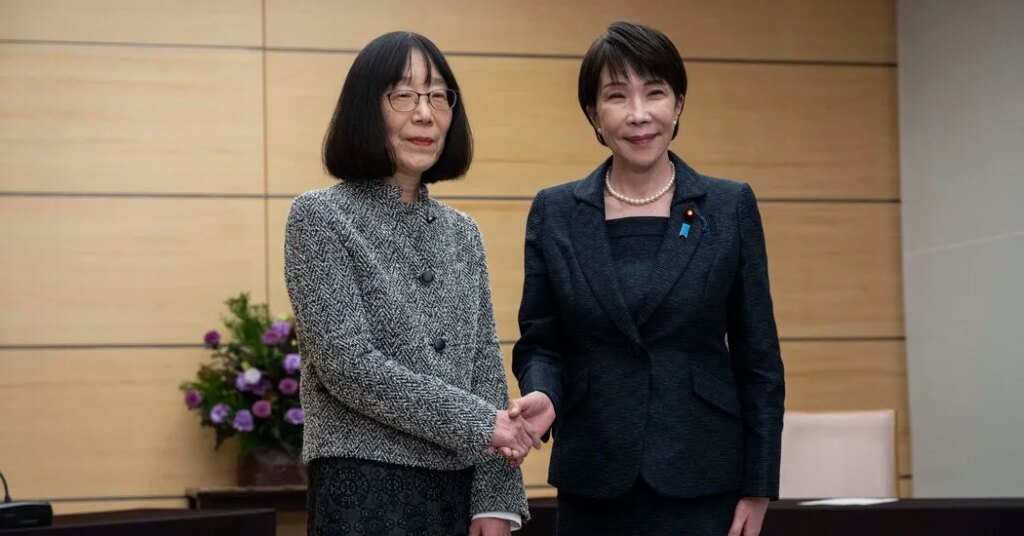
But on Tuesday the court got a boost from a critical ally, as Prime Minister Sanae Takaichi of Japan welcomed the court’s president, Judge Tomoko Akane, to Tokyo and vowed to accelerate financial support.
“The Japanese government will continue to provide robust support to the I.C.C.,” Ms. Takaichi wrote on X after the meeting, “ensuring that it can effectively fulfill its intended role and functions in upholding the ‘rule of law.’”
Ms. Takaichi’s comments were a rare break from President Trump, whose administration has led an aggressive effort recently to rein in the global body. Her appearance with Judge Akane, a renowned Japanese jurist, came days after Mr. Trump joined Xi Jinping of China and Vladimir V. Putin of Russia in criticizing the court during a historic three-way meeting at the APEC forum in Shenzhen, China.
The Trump administration last month imposed financial sanctions on the court, potentially constraining its ability to carry out daily operations. Washington has also imposed sanctions on Judge Akane, who helped issue arrest warrants for Mr. Putin and Prime Minister Benjamin Netanyahu of Israel. The court prosecutes those accused of war crimes, genocide and other criminal acts.
Japan contributes about one-sixth of the court’s roughly $213 million budget, more than any other country. Ms. Takaichi said on Tuesday that Japan would offer its 2027 contribution early — by the end of this year — in a show of support, after a request from Judge Akane. While she did not reveal the size of the contribution, experts said it would likely be about $33 million, in line with previous years.
Judge Akane welcomed Ms. Takaichi’s backing, telling reporters in Tokyo that the early payment “reflects the high importance Japan places on the I.C.C. and its dedication to supporting the Court as a guardian of the rule of law.”
After the summit meeting in China last week, Mr. Trump, Mr. Xi and Mr. Putin released a joint statement describing areas of agreement, saying in part that the I.C.C. and similar bodies “must not abuse their jurisdiction” against state officials. (Mr. Putin is subject to an I.C.C. arrest warrant over accusations of war crimes in Ukraine.)
Ms. Takaichi, who has built a close relationship with Mr. Trump, is in a delicate situation. She faces intense domestic pressure to forcefully defend Judge Akane, but also appears eager to avoid alienating Mr. Trump. She has raised Japan’s support for the I.C.C. with him on at least two occasions, most recently when the two spoke by phone after Mr. Trump’s meeting with Mr. Xi and Mr. Putin.
Before the Trump administration imposed sanctions on Judge Akane, Japan led a behind-the-scenes effort to urge the Trump administration to avoid blacklisting her, The New York Times reported in August. Japanese officials were concerned that penalizing the judge would undermine the integrity of the international legal system and harm relations between the two allies.
Jeff Kingston, a professor of modern Japanese politics and history at Temple University’s Tokyo campus, said that Ms. Takaichi’s decision to host Judge Akane and offer financial support for the court was a “rare, defiant gesture toward the United States and Donald Trump.”
“Trump from the get-go has been trying to dismantle the multilateral system that Japan relies on,” he said. “For Japan, this is about its own self-interest and about the values that allegedly the alliance with the United States is based on.”
The court will next week convene the trial of Rodrigo Duterte, the former president of the Philippines, on charges of crimes against humanity. The accusations relate to Mr. Duterte’s deadly crackdown on drug dealers and users.
Hisako Ueno contributed reporting.
The post Japan’s Leader, in Break with U.S., Defends International Criminal Court appeared first on New York Times.