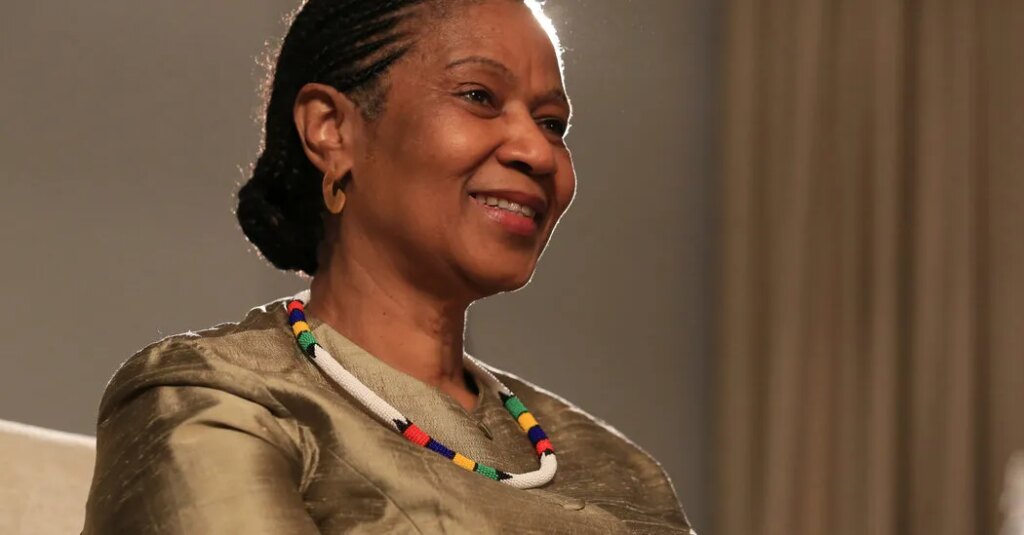
Phumzile Mlambo-Ngcuka, the first woman to serve as South Africa’s deputy president, who later took a top role at the United Nations to advocate for women’s rights globally, died on Friday. She was 71.
Her death was announced by South Africa’s current deputy president, Paul Mashatile. Ms. Mlambo-Ngcuka’s family said in a statement that she died from complications after a medical procedure she underwent about two weeks ago.
Ms. Mlambo-Ngcuka’s death has had the rare effect of uniting South Africa’s fractured political players. Politicians from across the spectrum have publicly celebrated her, praising her efforts to create better educational and employment opportunities for women and youth in the country, and her advocacy for women to have more leadership opportunities around the world.
Her own rise to the second-highest political office in South Africa in 2005 came after a messy transition involving the president at the time, Thabo Mbeki, his deputy, Jacob Zuma, and Ms. Mlambo-Ngcuka’s husband, who was the country’s chief prosecutor and had implicated Mr. Zuma in corruption. Yet she emerged from her three years in office as a highly respected technocrat and went on to earn widespread acclaim for the work she did in the years that followed.
Despite the esteemed titles and distinguished roles she held, Ms. Mlambo-Ngcuka seemed intent on self-improvement to the end. She earned a doctorate from the University of Warwick in England in 2013. This year, she started a fellowship in Germany to study the country’s vocational training system, hoping to draw lessons that could be applied to improve youth employment in Africa.
In a 2022 interview with the Inter Press Service news agency, Ms. Mlambo-Ngcuka said that while the world had made strides in helping women and girls obtain employment, schooling and leadership roles, “our best is not good enough,” adding, “There is still much more for us to do.”
Ms. Mlambo-Ngcuka was born on Nov. 3, 1955, in Clermont, an under-resourced township in the coastal city of Durban where the white-minority apartheid government had forced Black South Africans to live. She learned to prioritize education from a young age.
Her father, Michael Mlambo, was a schoolteacher, her mother, Khosi, a nurse. At night, her mother set up an informal school in the family’s kitchen at home to teach adults who were not allowed to receive formal schooling or had been given a substandard education by the apartheid regime. At 11, Phumzile began helping her mother with the classes.
“The greatest joy was when they had learned to write and to count,” she told the Robert Bosch Academy, which was hosting her fellowship in Germany, in June. “Then they could manage their own money. The seed was planted there.”
Ms. Mlambo-Ngcuka had to navigate her own difficult path to receive an education.
Her first year of university, in 1976, coincided with the Soweto uprising, when tens of thousands of Black schoolchildren across the country took to the streets to protest the education system, including the requirement to learn Afrikaans, a language formed out of colonization. The apartheid government responded with deadly violence, leading to international outrage and drawing many young people into the fight against the system.
Ms. Mlambo-Ngcuka was one of them, and she was barred from studying in South Africa. She went to the neighboring country of Lesotho, where she earned a degree in arts and education from the National University of Lesotho.
After stints teaching at her high school alma mater in Durban and working to promote educational development with the Young Women’s Christian Association, Ms. Mlambo-Ngcuka got a seat in South Africa’s first democratically elected Parliament in 1994.
In 2005, Ms. Mlambo-Ngcuka was serving as South Africa’s minister of minerals and energy when Mr. Mbeki appointed her to be his deputy president after dismissing Mr. Zuma, who had been implicated in a corrupt arms deal. Mr. Zuma, who denied any wrongdoing, had blamed Ms. Mlambo-Ngcuka’s husband, Bulelani Ngcuka, for playing a role in his political setback. As the nation’s chief prosecutor, Mr. Ngcuka said there was evidence to implicate Mr. Zuma in the corruption scandal, but he never formally brought a case. A government watchdog later found that Mr. Ngcuka had been “unfair and improper” to Mr. Zuma.
Supporters of Mr. Zuma, who eventually would succeed Mr. Mbeki as president, had booed Ms. Mlambo-Ngcuka when she got the role, demanding that Mr. Zuma be reinstated. When asked in Parliament about the mistreatment of Ms. Mlambo-Ngcuka, Mr. Mbeki said she did “not need any particular protective measures” because “she is a very grown-up girl,” according to a South African press report.
Ms. Mlambo-Ngcuka would go on to make her mark as deputy president by leading South Africa’s response to the H.I.V. epidemic, after Mr. Mbeki’s government had been accused of denialism. She ran an effort to address the country’s skills shortage with, among other things, internships for students and an overhaul of vocational training programs; she also shepherded an initiative to fight poverty and unemployment through measures like investing in infrastructure and providing support to small businesses.
She left office in 2008 when Mr. Mbeki was recalled as president after a factional dispute within his party, the African National Congress.
Back in private life, Ms. Mlambo-Ngcuka started the Umlambo Foundation, which aims to help under-resourced schools in South Africa.
In 2013, she was named executive director of U.N. Women, which promotes gender equality and empowerment. Her signature initiative was called HeForShe, an effort to encourage men to fight for women’s rights. Ms. Mlambo-Ngcuka was not shy about holding the U.N. accountable, openly campaigning for the organization to break the glass ceiling and select a female secretary general. While all of the secretary generals have been men, there are several women running to succeed António Guterres when his term expires at the end of this year.
Having a woman leading the organization would mean that women would come out “and lead, run for presidents, run as the C.E.O.s and the many other positions in your countries,” she said upon induction into the International Women’s Forum Hall of Fame in 2016.
Ms. Mlambo-Ngucka is survived by her husband, Bulelani Ngcuka; her son, Luyolo Ngcuka; her daughter-in-law, Mmabatho; her granddaughter Wadewafika Nnyeti Nomkhosi Zingisa Ngcuka; her brothers, Zipho and Bonga; and the many children in her extended family.
Viwe Mtshontshi, the chief executive of the Umlambo Foundation, said in an interview on South African radio that she first met Ms. Mlambo-Ngucka when she was deputy president and participating in a fellowship in Washington. Ms. Mtshontshi said she had been struck by Ms. Mlambo-Ngucka’s humility — there she was, a world leader, yet on the same plane as everyone in the fellowship.
Just recently, Ms. Mtshontshi said, she was at a U.N. anniversary celebration with Ms. Mlambo-Ngucka and she noticed how everyone gravitated toward her, from ambassadors to young women who were children when she was deputy president.
“They still loved her,” she said, “and they’ve come to learn about her and know her.”
The post Phumzile Mlambo-Ngcuka, South Africa’s First Female Deputy President, Has Died appeared first on New York Times.