When Charlie Blackwell-Thompson was a senior at Clemson University in 1988, she was flown to Kennedy Space Center to interview for a job testing software for space shuttle payloads, the cargo carried into space. While touring the center, she visited Firing Room 1, the primary command and control center for nearly every historic rocket launch, from Apollo 11 in July 1969 to Artemis II in April 2026.
“It was like walking onto hallowed ground,” recalled Ms. Blackwell-Thompson. “I had only seen it on television.” Standing at the launch team console, she was told, if hired, that she might someday have a seat there too.
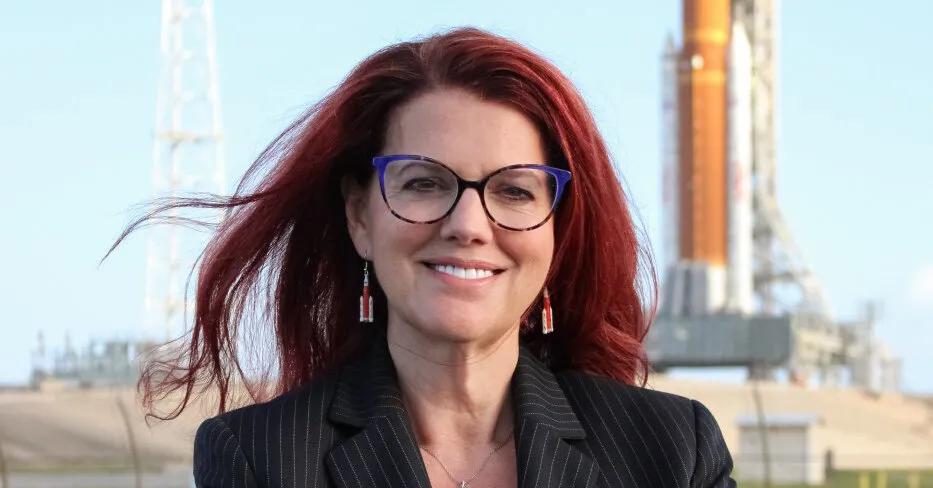
Today, Ms. Blackwell-Thompson does indeed sit in Firing Room 1, on a raised platform above the launch team, as the first female launch director at NASA. Her career has included more than two decades working on shuttle launches, including for the Hubble Space Telescope and the International Space Station, and she directed the countdown and liftoff for Artemis I in 2022 and Artemis II, the first crewed mission to the moon in more than 50 years.
The achievement is especially noteworthy because women comprise a little more than 36 percent of NASA’s work force. A 2023 Inspector General’s report on NASA’s efforts to improve diversity found the agency “struggled” to promote more women to senior leadership positions.
The Kennedy Space Center was so male-oriented that tradition included cutting an employee’s tie after his first launch, said Emily A. Margolis, a historian and a curator at the National Air and Space Museum.
“Firing Room 1 was a predominantly male space,” Dr. Margolis said. “The tie-cutting ceremony is left over from that period.”
So Ms. Blackwell-Thompson marked the launch of Artemis I by wearing a tie that was cut.
Ms. Blackwell-Thompson, who grew up in a small town in rural South Carolina, remembers watching the last Apollo mission, in 1972, on a black-and-white television that had been rolled into her grade school classroom. That night, she looked up at the moon and tried to understand how the astronauts had gotten there.
“That is where my curiosity about space exploration started,” she said.
Her mother, who owned a hair salon, encouraged Ms. Blackwell-Thompson to go to college. “She always told me, you can do anything you want to do; she never differentiated between what women could do versus men.”
When Ms. Blackwell-Thompson began to think about college and careers, however, she felt overwhelmed. Then her high school physics teacher offered advice.
“He asked what I was going to study in college and I told him I wasn’t sure,” she recalled. “He said, ‘Have you ever thought about engineering?’ And I said, ‘What would I do with that degree?’ And he said, ‘What couldn’t you do?’ That ended up being so impactful for me.” She went on to study computer engineering.
Ms. Blackwell-Thompson started at Kennedy Space Center as a contractor for McDonnell Douglas and then for Boeing, but in 2004 she was hired by NASA as a test director and became certified to conduct launch operations, one of only three people total in that position at the agency. “Until I was certified as a launch test director, we never had a woman in that role,” she said. “When other people pointed it out to me,” she said, “I remember thinking, ‘Well, we should.’ ”
In January 2016, she was put in charge of getting the Artemis program off the ground. She said the significance didn’t hit her until she heard from other young women. “They would say that seeing me in this job allowed them to see themselves in a similar position. And that means something to me, being part of that messaging to young women.”
Leading a team in such a high-stakes effort is a lot like being a coach in that it relies on teamwork and everyone taking ownership of their parts, Ms. Blackwell-Thompson said. “I’m the leader at the front of the room and ultimately responsible for the go or no-go on launch day, but everybody in that room has something they are responsible for and I want the best from them because I need the best from them.”
While moving up the ranks, Ms. Blackwell-Thompson and her husband were also raising three children.
She recalled working as a test director during the three-day countdown before a shuttle launch, completing necessary tasks before fueling in the midst of bad weather. On Day 2, she said, “I was out with my daughter, who was 2 or 3 at the time. She put a coin in a bubble gum machine and got a green plastic ring shaped like an umbrella. She gave it to me and said, ‘Mommy, I’m giving you this ring so that the weather will be good for you.’ I put the ring on my pinkie finger and lo and behold the weather that night was good and everything went according to plan.”
She has now worn it for every launch. “When I look at the ring I think about my daughter, and her thinking about me doing this job,” she said. “It’s important to me that my kids are watching the launch, looking up and knowing their mom is a part of this.”
The post At NASA, She Is a Pioneer Among Pioneers appeared first on New York Times.