On the first night of Hanukkah, I learned that Eli Schlanger, a rabbi I had known for decades, was gunned down at a Hanukkah celebration he had organized in Sydney, attended by roughly 1,000 people. When Eli and I were 16, we volunteered together at a summer camp for indigent Ukrainian boys in Odesa. The early mornings we spent watching the sun rise over the beach, as he spoke with quiet certainty about his dream of becoming a rabbi and building a Jewish community, are etched in my memory. He was killed doing the work he’d dreamed of.
As Jews gather this week to light candles, they are sure to rehearse familiar debates. Some will argue that Israel’s actions have provoked recent surges in anti-Semitism, tacitly collapsing Zionism, Israel, and Jewishness into a single moral object—so that Jews everywhere are made to answer for the conduct of a state. When I visited Istanbul last year, I spent hours speaking with a local café owner who insisted that anti-Zionism is not anti-Semitism, yet in the same breath told me not to be surprised by the rise in anti-Semitism given Israel’s actions in Gaza. Some Jews make the same mistake.
Meanwhile, others will respond by insisting that this violence only proves that the world has always hated Jews, and always will. They will argue that Jews can be safe only in Israel, and that Jewish life in the diaspora is naive and doomed. Many may focus on the faith of the two shooters, and lose sight of the fact that the brave father of two who risked his life to stop one of them, and was shot multiple times, was also Muslim.
[Graeme Wood: Speech laws won’t help Australia’s Jews]
But both responses erase something essential.
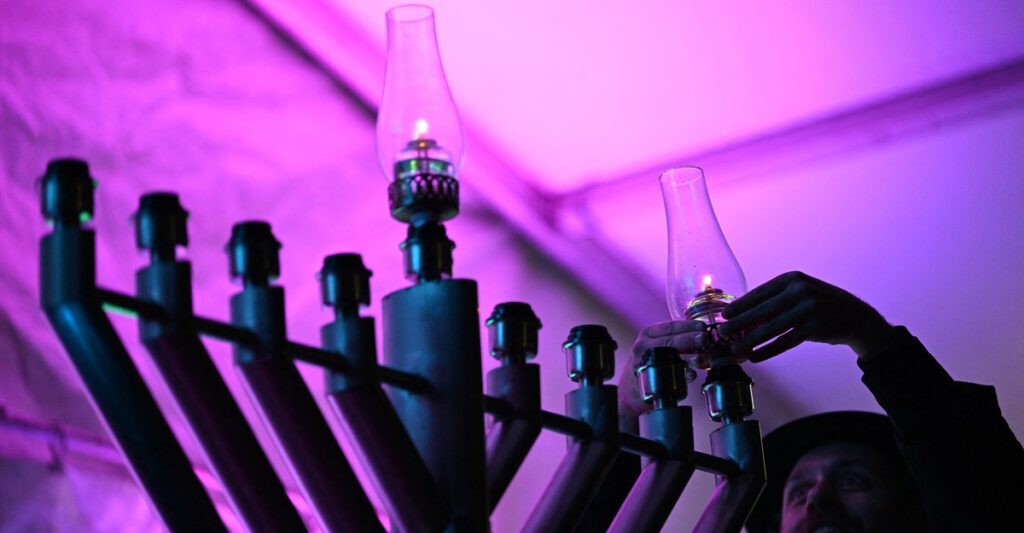
Hanukkah does not commemorate despair or isolation. It marks rededication—to Jewish life, Jewish practice, and Jewish responsibility. As Schlanger himself put it earlier this year, the way forward in the face of darkness is to “be more Jewish, act more Jewish, and appear more Jewish.” After October 7, 2023, my sister joined a synagogue for the first time and enrolled her daughters in Hebrew school—as did many others. On the road in Paris, I had no plans to light a menorah, but after learning of Schlanger’s murder, I felt compelled to attend a synagogue gathering and light a Hanukkah candle.
These impulses are understandable. But they need not and should not slide into absolutism. Israel and Zionism, the political theorist Michael Walzer recently told the students in my “Antisemitism and the Law” seminar, are a “necessity”: After the Holocaust and amid persistent global anti-Semitism, Jewish sovereignty is nonnegotiable. Schlanger’s murder is a grim reminder of why, for so many Jews, Walzer’s argument continues to carry such force.
Necessity, though, as Walzer also reminded us, is not a blank check. The legitimacy of Jewish self-determination does not place every policy carried out in its name beyond moral or legal critique. If sovereignty is necessary, so too are limits: proportionality, restraint, and a refusal to treat trauma as permission.
It is striking that the Hanukkah saga of the Maccabees’ uprising is absent from the Hebrew Bible, even though Christian Bibles preserved it in the Books of Maccabees. One common interpretation is that those who shaped the Jewish canon were wary of enshrining a story that cast Jewish identity in terms of military triumphalism. But after two millennia of exile, Zionist thinkers in the late 19th century rallied the image of the Maccabees. Theodor Herzl imagined that “a wondrous generation of Jews will spring into existence. The Maccabeans will rise again.” His colleague Max Nordau coined the term muscular Judaism, urging Jews to become “deep-chested, sturdy, sharp-eyed men” rather than embody the stereotype of the frail, ghettoized Jew.
[Michael Fullilove: We will swim again at Bondi]
But one need not choose between piety and power. David Ben-Gurion, another of Israel’s founding fathers, described “the struggle of the Maccabees” as “not merely a political-military struggle” and taught that “it was the spirit of the people, rather than the establishment” that enabled them to prevail. The story of Hanukkah is about political power and self-defense, but it is also about Judaism’s spirit and moral commitment. The words of the prophet Zechariah have been recited in synagogues for centuries on the Shabbat that falls on Hanukkah: “Not by might, nor by power, but by my spirit.”
And necessity is not the same as exclusivity. Schlanger was a fierce defender of Israel, yet he devoted his life to building Jewish community wherever Jews choose to live. He believed that Jewishness is not reducible to Zionism, and that Jewish survival requires more than fear-driven politics. It requires confidence: in Judaism itself, in the Jewish community, and in the possibility of living openly and proudly as Jews.
Hanukkah means dedication—and not to false binaries. Hanukkah’s lesson is not that anti-Semitic hatred is ineradicable, but that Jewish survival has always involved refusing the terms imposed by others. It challenges Jews to be more Jewish, not less moral; more committed, not more extreme. These, too, are acts of survival.
The post My Murdered Friend Eli appeared first on The Atlantic.