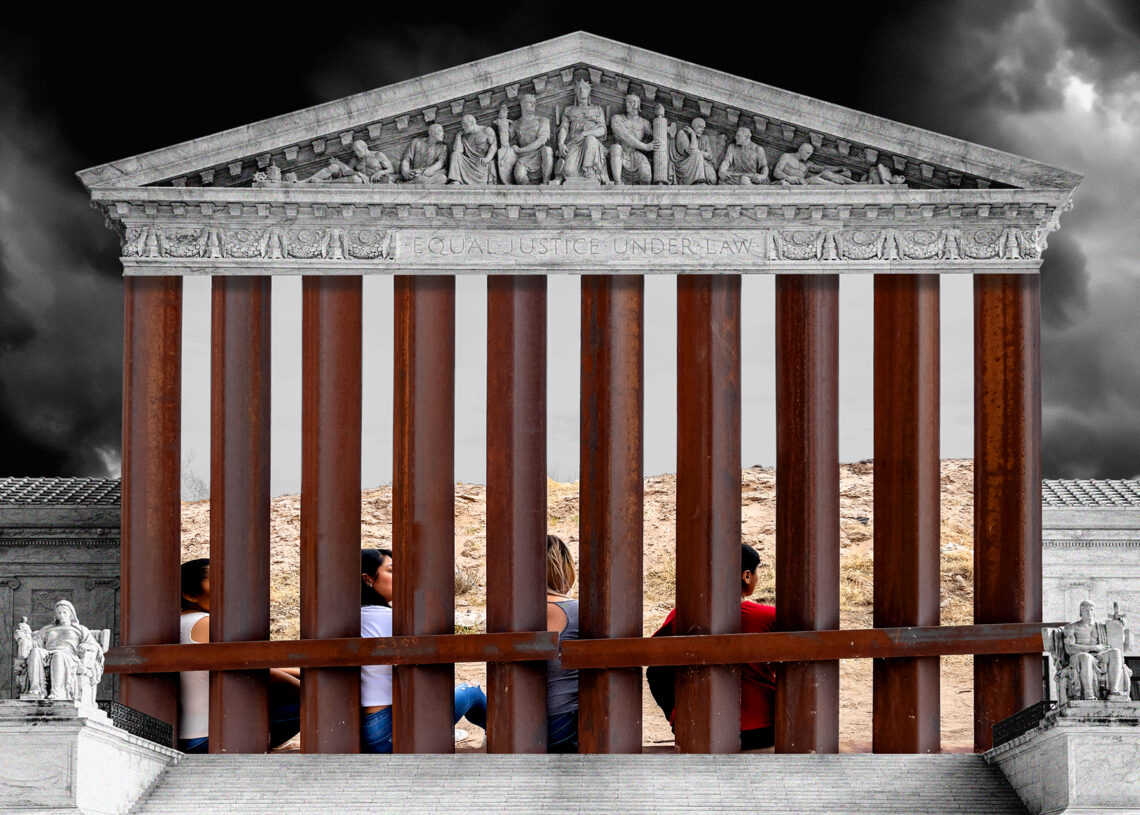
Immigration law is not a model of clarity. However, on two points it is pretty unambiguous. First, “any alien” present in the United States, no matter how he or she got there, may apply for asylum “irrespective of such alien’s status.” Second, the government has to follow rules — including offering certain more limited alternatives to asylum — before it can deport a migrant whose asylum application has been turned down.
Yet on his first day in office, President Donald Trump announced that he was essentially nullifying both provisions, to protect the country from an “invasion” of migrants. Proclamation 10888 said that no one crossing the U.S.-Mexico border, even at ports of entry, could seek asylum and instead would be summarily expelled.
The administration credits these measures with helping reduce illegal border crossings to minuscule levels last seen in 1970.
Still, a question arises: Maybe the proclamation is effective, but can Trump actually do it? You know — legally? A group of pro-immigration activists and would-be asylum seekers says no, and so far every court to consider their lawsuit has agreed.
In 2025, U.S. District Judge Randolph Moss found that “nothing in the [law] or the Constitution grants the President or his delegees the sweeping authority asserted in the Proclamation.” Earlier this year, a three-judge panel of the U.S. Court of Appeals for the D.C. Circuit largely affirmed his ruling.
Now the Supreme Court will have the final say. This month, the justices agreed to hear the Trump administration’s appeal of the D.C. Circuit’s ruling (which has been stayed pending the additional litigation).
It’s a highly consequential case for the law on asylum and border security — and for the court, which will find itself in a sticky situation, legally and politically.
Those challenging Trump’s proclamation have a strong legal case — but represent a small current of public opinion. The country generally seems loath to upset the tranquility at the border that has prevailed under Trump, in contrast to the chaotic situation under President Joe Biden. (Biden belatedly reduced the flow significantly in the second half of 2024, through less sweeping executive action than Trump’s.)
Voters disapprove of how Trump has unleashed Immigration and Customs Enforcement within the United States, but border security is one of the few issues on which he was still polling in the high 40s as of September. Two Democrats who flipped Republican Senate seats in November openly supported Trump on the border: Scott Colom of Mississippi and Josh Turek of Iowa. Adam Hamilton of Kansas denounced Biden’s record and campaigned against “open borders.”
As for the law, the administration’s petition to the court says that Proclamation 10888 reflects “a commonsense understanding of the President’s inherent and delegated powers to exclude aliens.” A separate provision of immigration law, it contends, empowers him to “suspend the entry of all aliens or any class of aliens,” whose entry “would be detrimental to the interests of the United States.”
Proclamation 10888 identified a class of “alien[s] engaged in the invasion across the southern border” and suspended their entry indefinitely. Then it authorized new summary expulsion guidelines for them — circumventing the established removal process — because the power to exclude “necessarily includes” the authority to expel,” as Solicitor General D. John Sauer put it in his petition to the Supreme Court.
Yes, Sauer argued, people have a right to apply for asylum, but granting or denying it is a matter of executive branch discretion, which is true, though usually that’s been applied case by case. Trump, by contrast, has preemptively denied asylum to all unauthorized border crossers, so, the administration argues, their petitions are futile and the government does not have to entertain them. Check and mate.
If this reminds you a bit of the tariffs case — in which Trump also invoked vast emergency powers discovered in obscure regions of the U.S. Code — it should. Once again, the president is taking a legal position none of his predecessors advanced and making it the basis for a signature policy.
Trump lost the tariffs case, of course. And conservative justices who ruled against him were expressing not only a legally valid view but also a popular one. The public did not like the president’s tariffs.
The public does like an under-control southern border. So this time, the administration’s adventuresome legal position is more consistent with popular sentiment.
If the justices ruled against Trump, they would not only be swimming against that tide, but might also, Sauer contended in his petition, “revive the chaos along the southwest border that the proclamation has fended off for the past year and a half.” That’s big-time rhetorical pressure.
What we really need is for Congress to revise asylum law, fundamentally unchanged since 1980, for a world in which asylum has expanded from its initially minor role into a loophole through which millions seek residence in the U.S., swamping the federal bureaucracy.
Congress is the branch of government best suited to make law, not the president — and not the Supreme Court, as this case might demonstrate yet again.
The post The Supreme Court might cross more than Trump at the border appeared first on Washington Post.