The president called it “a common hunger” — peace.
On Nov. 24, 2016, the world watched as Colombian President Juan Manuel Santos signed an accord with the country’s largest insurgency, the Revolutionary Armed Forces of Colombia. The agreement with the FARC ended a war that had lasted generations, dominated the regional security agenda and left millions of victims of kidnapping, disappearance and other abuse.
“Our dear Colombia,” Mr. Santos said, would no longer be “trapped in this labyrinth of violence.”
Thirteen thousand FARC fighters laid down their arms and the government pledged to address the root causes of the war, expand social programs, eliminate the illicit drug industry and establish a framework for truth and reconciliation.
Now, as Colombia marks the 10th anniversary of that deal, there is neither complete victory to celebrate nor absolute failure to mourn. Instead, Colombia has learned to live with a peace that is partial and uneven, a mix of real achievements and half-kept promises.
The deal led to one of the largest reductions in violence in modern Colombian history, measured in lives affected by displacement, massacres and homicides. But today, domestic support for the accord is at its lowest level since the signing. The country’s newly elected right-wing president, Abelardo De La Espriella, has criticized the deal and promised to dismantle it, and the country’s conflicts and criminal economies have only multiplied, fueling new cycles of violence.
Some Colombians see the country’s security problems as evidence of the deal’s failure; others say the violence is precisely why it must be kept in place — it is the hard-won framework needed to tackle deeply entrenched problems.
“We have a serious and comprehensive road map to close the gaps that fuel violence,” said Mr. Santos, who won the Nobel Peace Prize for his role in the deal. “That is why Colombia must continue moving forward with the implementation.”
As journalists working for The New York Times, we have documented this rocky path between peace and war, repeatedly visiting the nation’s most remote corners.
Colombia has long been an unequal country; in the 1960s the FARC sought to resolve that with guns, creating a Marxist revolutionary army that would redistribute wealth. Eventually, fighters used kidnapping, killing and the drug trade to fuel the insurgency, and the conflict became a war among leftist guerrillas, right-wing paramilitaries and a government backed by billions of dollars from Washington.
At the heart of the 2016 deal was a promise by FARC fighters to lay down their arms, and by the government to build institutions and fund programs that would eliminate the structural inequalities that caused the war.
It was an extremely ambitious promise: An oft-cited statistic from one international development organization is that it takes 11 generations for a Colombian family to rise out of poverty.
A decade in, many changes are tangible: The vast majority of FARC fighters have not returned to arms — 85 percent remain in a program meant to reintegrate them into society, according to the United Nations. People traveling the highways outside Bogotá or Medellín generally do not fear kidnapping or bombs. Tourism flourishes in places once torn by conflict.
The government, at least in some places, has arrived in long-ignored towns with roads, schools and hospitals. The country has seen the opening of a vast new political space to debate something other than security, including social and economic issues, enriching public debate in a way that many feel is irreversible.
For decades the Colombian left struggled to distance itself from the violent guerrilla insurgency; distanced from that stigma, it won the presidency for the first time in 2022.
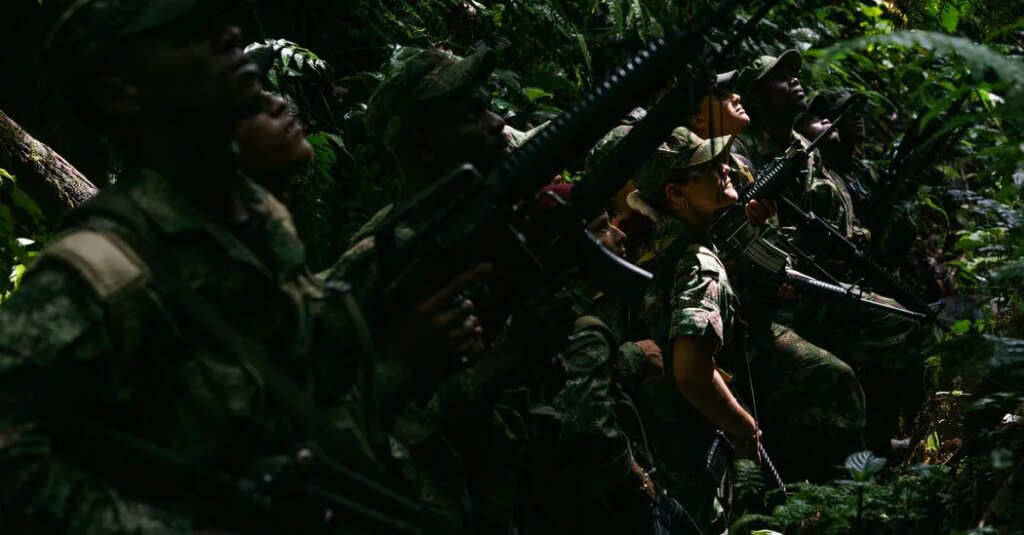
But Colombia’s violence did not disappear. Instead, it rearranged itself. The map of armed actors, each often competing to take over the criminal economies left by the FARC, is more dizzying than ever, and is supercharged by new technologies. TikTok and Facebook are used to recruit child soldiers. Hobby drones fitted with grenades are increasingly a weapon of choice.
FARC members who never signed the deal, or rearmed, have splintered into dissident factions. The National Liberation Army, or ELN, a Marxist group that never signed an accord, persists. One of the most powerful groups, known as the Clan del Golfo, is present in almost half of the country’s municipalities, according to Colombia’s ombudsman’s office, while FARC dissidents have a presence in more than a third.
The illicit economies that fed the war have been inherited, franchised and expanded. Production of the coca leaf, a key ingredient in cocaine, is up 80 percent since the accord was signed, according to the United Nations, and Colombia continues to be the world’s largest cocaine producer. For criminal groups, illegally mined gold is a growing part of the financial portfolio.
Some who remain in arms say they are still fighting for social justice.
“Colombia’s problem will be resolved when we resolve need and inequality,” said Andrey Avendaño, a FARC dissident commander, during an interview in a remote palm grove this year.
But increasingly, fighting has become a profession, with ideology as window dressing. The FARC never paid a salary; when we visited a new armed group, the Comandos de la Frontera, in 2022, it paid twice the minimum wage — and offered vacation time.
Since taking office in August, Mr. De La Espriella has called the accord a failure, saying the agreement amounted to impunity for perpetrators. He has ended peace negotiations with remaining groups, intensified a military approach to the conflict, and proposed an antiterror law that would expand his powers to target enemies.
The United States, long one of the peace deal’s chief backers, has shifted its focus to this militarized, anti-narcotics approach, part of a larger strategy across the region.
Representatives for Mr. De La Espriella declined to comment for this article.
Scholars and everyday Colombians say his election reflects impatience with the pace of change.
A comprehensive land reform meant to address a main driver of the conflict — unequal access to land — set a goal of distributing 3 million hectares to Colombians in need. About a tenth of that has been distributed, according to a United Nations Verification Mission.
Development programs in violence-affected areas were supposed to drive economic change. While 65 percent of programs are on an implementation track, only 5 to 10 percent of them were actually in place in areas recently studied by the ombudsman’s office.
A new court established by the deal, called the Special Jurisdiction for Peace, was one of the accord’s most symbolic and controversial aspects. Charged with investigating wrongdoing, it would mete out non-prison sentences, like hard labor, to those who admitted their crimes.
The court has uncovered the scope of many systematic crimes — establishing that the FARC kidnapped over 21,000 people and recruited nearly 19,000 children. And nearly 8,000 civilians were killed by the military and passed off as rebels in a scheme called the False Positives scandal.
But it has taken years to issue sentences, heightening a sense of impunity.
Just 27 percent of Colombians trust the court today, according to a study from the University of the Andes, down 10 percent from two years before.
Overall support for the agreement was just above 40 percent in 2016, and fell to about 37 percent last year.
A decade in, the nation debates the reasons violence persists.
Iván Duque, a conservative who opposed the deal, oversaw its early implementation. Critics accuse him of slow-walking the rollout of social programs and other measures, creating an institutional vacuum in rural areas in the first critical years.
Others fault the policies of his successor, leftist President Gustavo Petro, who favored negotiation with remaining groups over military operations, but failed to close any meaningful new deals.
Mr. Duque has blamed the end of a program that killed coca crops by dropping chemicals from planes, saying it allowed drugs to flourish. Mr. Petro has said he fast-tracked land reform after the country lost time under Mr. Duque.
In the territories most affected by violence, some remain skeptical of the deal, while others insist that a decade is not enough to judge a process devised to last generations.
And pain persists.
Deisy Dorelly Guanaro was 10 when FARC fighters took her from her mother’s home. She was sexually abused by commanders for years, she said, and rescued by the military after a battle in which she was the only survivor of 15 young fighters.
She criticized the accord’s truth and reconciliation process, saying perpetrators had not fully admitted their crimes and had received light punishments and even positions in Congress. The deal gave former FARC leaders seats in the legislature for two terms.
“I do not feel compensated for my pain,” Ms. Dorelly said, “or what they did to me when I was a child.”
Perhaps the most Colombian feature of this anniversary is the sense that every peace agreement opens a new chapter of negotiation rather than closing one.
“One thing this agreement did was create this very broad political consensus that this violence doesn’t come from nowhere,” said Elizabeth Dickinson, deputy director for Latin America at International Crisis Group who is based in Colombia. “The fundamental conclusion is: You have to fix the lack of state presence, you have to provide services to people, you have to govern in these spaces, because otherwise someone else will.”
The pact with the FARC did not resolve Colombia’s war. It resolved one war, the oldest and the most symbolic, and left on the table a map of lesser conflicts and illegal economies that the state still does not know how to confront, much less dismantle.
Colombia’s peace was never an endpoint but an unfinished process, subject to the shifting winds of each new government. The current president has inherited that ambiguity: an agreement that has survived against all odds, but that is still waiting, in the hardest-hit corners of the country, to accomplish the peace it promised on paper.
The post The Americas’ Longest War, and 10 Years of an Unfinished Peace appeared first on New York Times.